I am sure many of have fallen into the same spiral Elmcat describes in Death of a Hobby. I’m of the opinion that talking about RPGs online is its own hobby, pretty divorced from playing RPGs. I enjoy it a lot, clearly, but it can be quite distracting. I make much more of an effort nowadays not to get sucked into random arguments—though that is likely more to do with being so busy at work and life than true growth as a person.
I find it hilarious that there are two OSR blogging webrings you can join if you are so inclined. The 90s are back, in webring form. Daniel Sell of Troika set one up first, the New Old Gaming Blogring. Shortly after, Elmcat created rootr.ing, which serves the same purpose, but felt easier to customize, so you can its widget at the bottom of this page. If you dislike both of these options, Daniel shared the tutorial he followed to create his blogring, so you can make your own for you and your friends. The world needs more webrings.
Once again the keying of dungeons is the topic of day. Sam Sorensen writes in defence of the humble paragraph. In doing so he pits the paragraph against the bulleted list, a false dichotomy. In his post the examples of bulleted bolded lists are bad because they are word soup, not because they are lists. There is nothing precluding people from writing strong prose while also leaning on structure. Silent Titans and Gradient Descent both do this well.
Sam believes people consume text with more patience and thought when it’s presented in prose: bullet points and styled text encourage the reader to zip around skim. I can see that argument, but it’s almost certainly the case different people consume information effectively in different ways. A while ago I wrote about how Patrick’s approach to writing is a form of usability, which I think relates to this core point Sam is trying to make. Orthopraxy’s Eat the Book remains a great recent read on this topic.
A lot of caveats and comments on a post I’m sharing, but I’m sharing it because I often dislike the same sort of writing Sam does! We can do better, whether you choose to do better with a paragraphs or bullets.
I’ve migrated this site from Jekyll to Hugo, something I’ve wanted to do for ages, but haven’t been assed to do till now. I’ve been running the Hugo version of the site on beta.save.vs.totalpartykill.ca, which I may keep around as a place to muck around in public. I think I’ve caught all the issues that arose with the migration, but if you spot anything let me know. I’m curious if the change is seamless for feed readers.
Clayton has done an amazing job organizing the Bloggies this year. Everything is neatly organized on his blog, with little infographics to help you follow along with what’s happening and what you need to to participate. The first round of voting is happening right now. As before there are four main categories: advice, reviews, gameable, and theory. He’s added a new ‘meta’ category, to highlight posts that are a little bit meta. There are too many good blog posts, and Clayton has done a great job making some thematic and Sophie’s Choice match ups? How are you supposed to choose between The OSR Onion vs. What is an OSR? That was my hardest pick this round.
An interesting post from Clayton discusses what he calls Dominant Mechanics: “Dominant Mechanics are rules that cannot co-exist in a system without monopolizing play and overriding other rules.” My favourite example of this would be skill checks in later editions of Dungeons and Dragons. This idea relates to one of my big complaints about 4E, where your characters various powers end up being the sum total of play.
The man that brought you Fuck You Design brings you a rant about fancy-ass zines: “Am I language policing here? Sure, why not. I think the original sense of the word matters and is worth preserving, worth insisting upon. I think zines, as a non-luxury print media are important.”
Sam Pearson is the person behind two of Games Workshop’s greatest games: Warcry & Spearhead. He has recently started a YouTube channel after ending his time at the company as one of their lead game designers. So far the videos are all straight up bangers, but he’s recently shared three videos on game design that are worth watching in particular:
Meaningful Player Choice is an incredible discussion on game design, whether you’re interested in war-games or not. The last video is about turning your ideas into a polished product. This is all top tier! Enjoy.
When I first started this blog I had a periodic series of posts where I would highlight blogs I thought were cool. At some point I likely switched to just linking to cool blogs on G+ (and eventually Twitter and BlueSky). Dungeons of Signs, by Gus, was one of the blogs I thought people should know about many years ago. That blog is a classic. Gus stopped updating that Dungeons of Signs a few years ago, after becoming disillusioned with both the world and the OSR. But you can’t stop a man from talking about dungeons, so he returned with a new blog, All Dead Generations. This blog is mostly long essays about how to design good dungeons. There is lots of great advice here. Most recently, he shared a post on alternative obstacles to monsters in dungeons. It’s a good sample of the sort of stuff he’s been thinking about over the last few years. There is much more to read if you enjoy this post. He goes hard.
Friend of the #TorontOSR, Jonathan Benn, writes about his approach to creating dungeons. It’s been interesting to see Jon get more and more interested in the OSR and old-school play. This blog post is nice solid advice for people new to creating your own adventures.
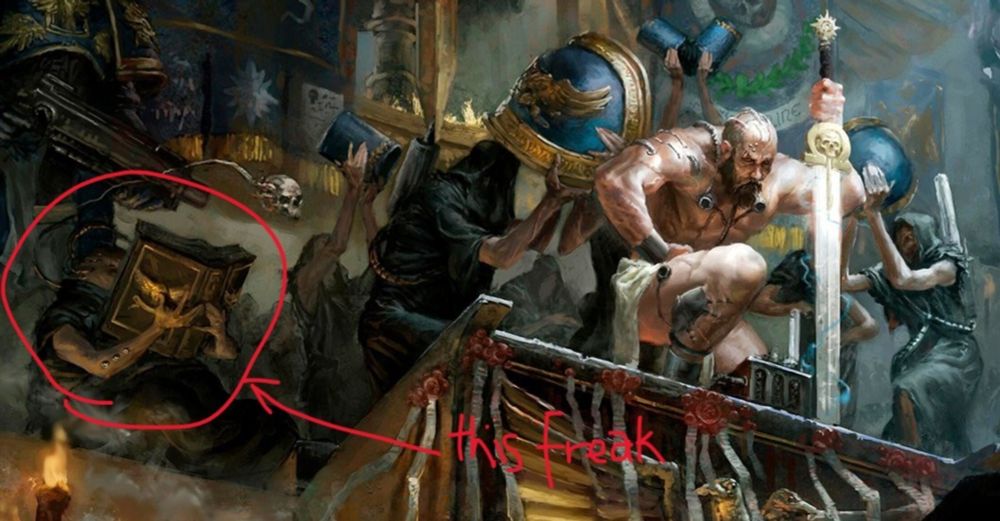
Zedeck Siew has finished his RPG about the background characters you find in the world of Warhammer 40,000. Your characters live in servitude to five Space Marines aboard the Warmask of Gloriana, where your characters are tasked to ferry them to their next engagement. Chapter Serfs is exactly the sort of RPG I love: to the point and focused. There are just enough words and no more. The setting of this ship is brought to life via a couple sentences afforded to each of the possible backgrounds for your characters, the rules themselves and what they tell you about the world, the leaders of the various factions aboard the ship and the tasks they will ask you to perform, etc. The ship is mapped out for the players to explore. This is all a self contained game, ready to be played. My friend Tim shared his thoughts about it as well for Wargamer.
It’s been a while since I’ve updated my Random Character Generator. I had promised my friend Nick I’d make him something that spits out the random grimoires from Errant, and finally got around to it last night: Random Grimoire. I’ll probably try and add random Errant characters next. There are several games I want to this generator. One day.
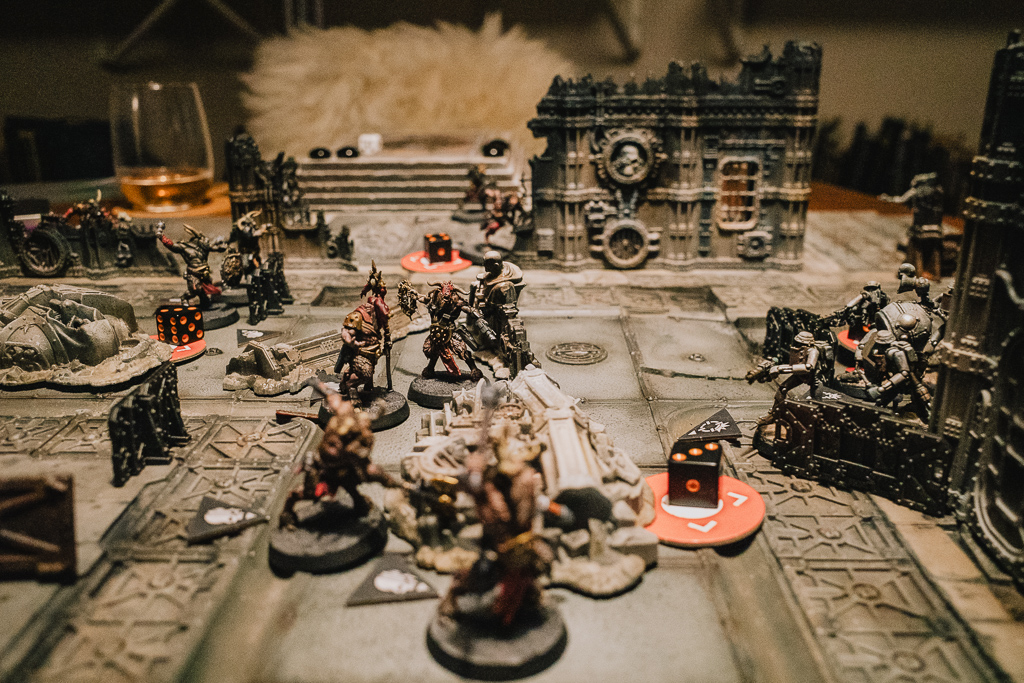
My friends were over to kitbash minis and play Warcry to celebrate our friend Richard’s birthday. There was a small posse of us, so Richard came up with a simple and ingenious way to play mutli-player co-op Warcry that matches the random spirit of the game. We wanted to play a 3 vs 3 game. Each of us took our warbands and split them up into the Dagger, Hammer, Shield groups as usual. We then randomly assigned each group to each player, so each player would bring one of the groups for their team. (For a 2 vs 2 game, you could just one player from each team bring two of their groups, rather than one.) In our game the ways things shook out ended up giving a slight advantage to our opponents, they had a few more points than us, but I don’t think it skewed things thast much. You could grant the underdog team bonus wild dice based on the point differential, though how many is left as an exercise for the reader. Since by the rules you must make your groups with as even a split of minis as possible, and with this format you don’t know which group you’ll take, it likely will lead to fairly even splits anyway. Playing this way means you don’t need to mess with any other rules or the balance of the game. Each team had about 1000 points of minis, would roll initiative dice for their team as usual, etc.
For Mothership Month—a crowdfunding campaign extravaganza—Sean decided to spend some of his marketing budget funding a crazy giant digital LARP. Sam Sorensen is running Over/Under, a 100% bananas play-by-post “war-game”. There are over 1000 players! A much smaller subset are ‘bosses’ who get to make actual decisions and interact with Sam to direct the energies of the various factions in play. I had originally planned to avoid the game, it seemed so overwhelming (and honestly still is), but how often does stuff like this happen? I joined the Tempest Mercenary squad, because Amanda is the person in charge, and have been a loyal soldier ever since. The bulk of my “playing” consist of showing up when I see we’ve all been tagged and posting a salute emojis. I don’t think you really need to spend more effort than that if you want to play as well. If I had more time, I probably would have tried to ply my trade as a misinformation broker. Another time. I still don’t really understand what’s happening half the time. It’s still fun & weird experience nevertheless.
I really enjoyed this sort of meta-review from Paul, The New Novely. Paul writes very deep meaningful reviews of the games he plays. We also have very different interests or goals when it comes to gaming.
Stuff coming out of the Forge movement either interested me or repelled me. But at least it was novel! Polaris might not have landed for me but Dust Devils sure as shit did. Dogs in the Vineyard was great and Carolina Death Crawl was upsetting. And the new ideas just kept coming. A solid decade-plus of envelope-pushing. … I can’t tell you the last truly new, engaging idea that hit me out of game design. … Looking forward at the next 20ish years of play and it’s all gonna be pretty much the same? Not a great feeling.
Maybe it’s cliche that OSR fans aren’t that obsessed with rulesets, but I’m not that obsessed with rulesets. I have so many variations of D&D, and will honestly buy more before I die. I like whisky, and have so many different bottles in my pantry. They are all unique, interesting in their own ways, enjoyable to drink. I don’t need stuff to be wildly different. I enjoy subtle refinement. But Paul’s point is a good one: where are people doing wildly different stuff right now? Jay Dragon is one person that comes to mind. Who are the other people trying to do something novel?
The “you don’t need to play to review” folks are just wrong if you want anything deeper.
I don’t think Paul is wrong here, you will certainly be able to tell a more complete story about a game or adventure after you’ve run it. I make more of an effort now to play the games I write about before I write about them, but the net result of doing that is I write less reviews. Some games and adventures do benefit from my having sat down and played them. My Night Witches review after having played the game is far better than the one I wrote before playing. But what I wrote about Another Bug Huntbefore I played it isn’t so far off from how I felt after I played it. And I still haven’t gone back to write about Another Bug Hunt. I try and write when I have the energy and thoughts to write, not when I think what I’ll produce is perfect. This is a blog, not A Survey of Game and Adventure Design, 2020-2025 from MIT Press. There is a lot of good criticism and writing of games that comes from solely from people reading things carefully and thinking deeply.
A recent episode of Between Two Cairns opened with a discussion on what to do when a reaction role doesn’t jive with the idea you have in your head for the situation. Yochai’s sentiment more or less mirrors my own: if you roll the dice, you should just go with what the roll says. There is something chaotic and fun in trying to figure out why the troll in the middle of the dungeon is actually excited to see you. But what if the roll doesn’t make any fictional sense whatsoever? In that case I would question why you are rolling in the first place! I try and assign modifiers to creatures encountered when I want them to have a default disposition that is more negative or positive than a plain 2d6 spread. I also only include any charisma modifiers where it would make fictional sense for a characters charisma to come into play. Finally some monsters are truly mindless and will always want to eat the players, like zombies, perhaps. It’s easy to fall into the trap of rolling dice for the sake of rolling dice. I like Chris’s post on this topic: Information, Choice, Impact.
Gus, Mr. Dungeon Crawling himself, asks the hard questions: why do most adventures suck? He suggests ways to improve the adventures you are writing (to sell for cash-money). Something he touches on, that gets glossed over in a lot of the discussions I see about writing and running adventures, is around that distinction between writing to be consumed by yourself versus writing to be consumed by others. You can run an amazing session with keys that look like the original keys for Dwimmermount. You don’t need fancy maps. You don’t need perfect prose. You need enough information to remind yourself of the amazing ideas in your head!
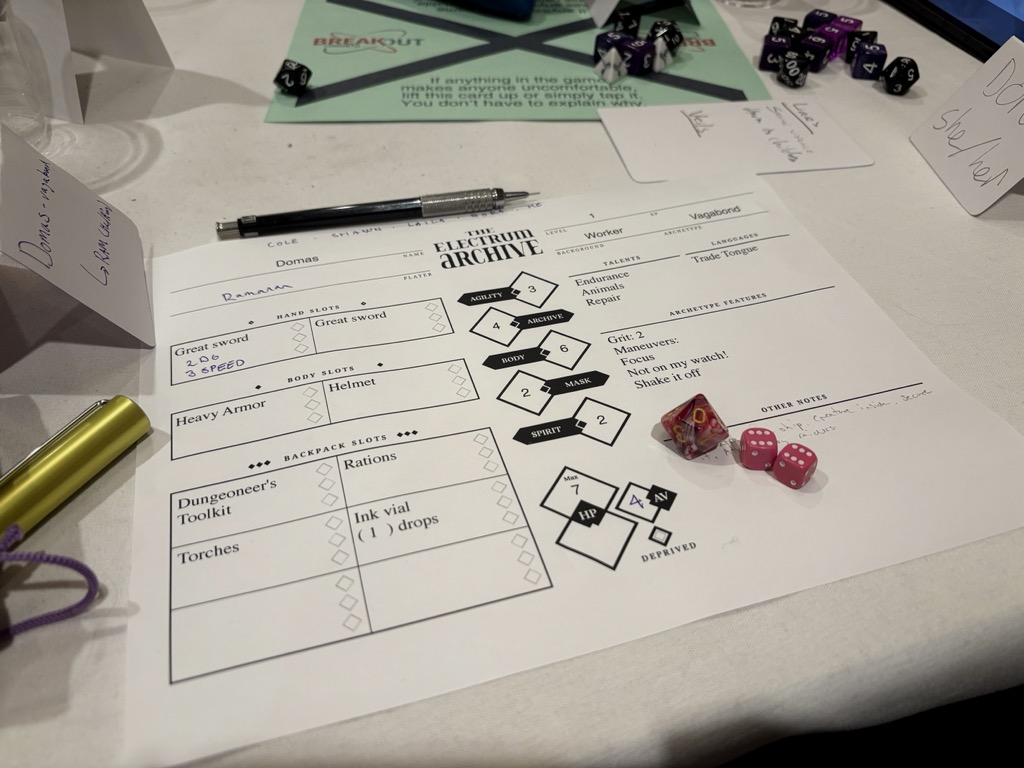
I met up with Emiel and Ava shortly after they arrived in Toronto for Breakout Con. I love to see my D&D friends in real life: that’s what it’s all about. (Our meetup also included Jon, the Retired Adventurer, who lives so close to me it’s embarrassing I only see him when Ava is in town.) I managed to see them a few times before they left, ending my convention crashing a game Ava ran of The Electrum Archive. We played through an adventure that was intended to be part of the second zine, but which was cut for space—the zine was already massive. The adventure was a lot of fun, so I’m looking forward to its release. In The Electrum Archive the typical dungeons are the crashed spaceships of an ancient people. Our characters were sent to find a missing posse of soldiers who were exploring one such ship. We would discover they had all been murdered like something out of Alien. The adventure included: someone gaining telepathy; the rest of the party not clueing into how that happened, and instead gaining random crap mutations; a giant mech suit that ended the session just hulk smashing stuff; lots of sphincters; blood, guts and gore. So, all the good stuff.
I love this post from Yochai about running a sandbox style game using his game Cairn and the advice and tools from its Dungeon Masters guide. I’m a big fan of people writing about how they actually prep and run games. I wrote briefly about the start of my Carcosa campaign, how I kicked it off, but never came back to talk about how it was going, or offer advice on running a hexcrawl. It’s something I keep meaning to do, and seeing this post makes me want to do so all the more.
BlueSky feels like it’s having a moment. I’m on the site using my domain as
my username, @save.vs.totalpartykill.ca. When Google+ was a thing, I
would just link my posts there, and use that space as my comments. That really
bit me in the ass. Anyway, let’s do that again. If you reply to my link
to this post on BlueSky, it should show up as a comment here. Shoutout to
Matt Kane / ascorbic for making this set up easy to do. I’m not sure if
something like BlueSky can capture all the things that made Google+ great.
Being able to actually comment on someones post, and nothing be constrained to
some character limit really encouraged a lot of interesting collaboration. Still,
it feels like there is a lot happening on that space recently.
Patrick’s launched his latest Kickstarter, Queen Mabs Palace. In a real plot twist, the book isn’t a D&D module, but a novel. I suppose novels were the first adventures. I’m reading Patrick’s last book now, Gackling Moon, which is a gazeteer for the Wodlands, a weird fantasy setting. It reminds me the Wanderer’s Journal from Dark Sun: pure vibes. There is some gaming material in the book, but it feels there is maybe just enough to still call it a gaming book and not have people moan too much. In many ways it’s the setting book version of Fire on the Velvet Horizon. I should say more here, but just wanted to point out that Queen Mabs Palace feels like the natural follow up to a book like Gackling Moon, perhaps.
I enjoyed this post from Ty over on Mindstorm, where he takes Jason Cordova’s Paint the Scene idea and tries to jam it into OSR gaming. Collaborative Worldbuilding: Glimpses is all about sharing elements of world building with your players. Mindstorm puts out consistently good blog posts: well worth adding to your RSS feed.
Some friends were discussing how one might approach making RPGs play a bit more like skirmish war games. From my perspective, playing with minis and measuring distances are the only ingredients you need in order to change how a game feels. A good wargame will make the choices you make around positioning matter.
It’s often the case when playing D&D using “theatre of the mind” that characters simply move from monster to monster, fire their ranged weapons from anywhere to anywhere, etc. It’s hard to keep track of where everyone is, what the complex state of the game world looks like. To mitigate this I will sometimes sketch on paper (or on the screen) when playing to help players better understand their circumstances, what they can and can’t do. I am just as likely to simply eat the messy abstraction: it makes combat play much faster. When I was playing 4th Edition D&D a single combat might be the bulk of a gaming session!
Approaching running a skirmish style RPG by looking directly at indie narrative skirmish wargames might be interesting and fruitful as well. Games to checkout include: Forbiden Psalms (based on Mork Borg) and it’s many variations, Brawl Arcane 28, A Song of Blades and Heroes, and Sword Weirdoes. These games feel like they could form the basis for playing an RPG in and of themselves.
I am a man with too many hobbies and interests, but James’s lovely ode to OD&D has me thinking about the game once again. Some of the longest campaigns I’ve ran and played in have been OD&D games: impressive for a game that came out 6 years before I was born. The 50th anniversary of D&D is this year. I suspect we’ll see a lot of writing about the game over the coming months. For example, here is a great post from Gus that looks at the history and design of the earliest D&D dungeons: The Underground Maze or Primordial Stack. Something worth revisiting this year is Philotomy’s Musings by the enigmatic Jason Cone. A lot of the modern thinking about OD&D feels like it comes directly from his writing about the game. I plan to re-read the OD&D booklets: it’s been a while.
I love this: nicer warband and campaign sheets for The Doomed, aka Grimlite from traaa.sh. If you haven’t seen traaa.sh before, it’s such a well designed blog. They always post useful stuff. So this is really par for the course. Evan and I have been playing The Doomed recently, continuing our epic multi-system neverending Warhammer 40,000 campaign. I’ll have to write about those games soon. I have been tracking everything in Google Sheets. Looking at these sheets gives me ideas for how to tweak my digital set up, though I like the idea of writing things out on paper. That feels more legit.
I haven’t played Magic: The Gathering seriously since High School, though I stil have many of my cards and decks from the 90s. (Sadly most everything I have are the sorts of cards that no one cares about, nevermind my cards are hardly pristine.) Reading Jay Dragon talk about a diffferent format for playing the game, what he’s dubbed the Magpie Cube, was really facinating. I was only vaguely aware of the cube format of organizing games, which Jay sums up before expanding upon in ways game design nerds will surely enjoy. Briefly, you and your friends play magic games drafting cards from a very small fixed pool of cards. If you’re already playing Magic and want to make it feel more fresh, this seems like a great approach. This format also feels like it strips away the whole pay-to-play aspect of the game. Every so often I’ll see something about Magic and feel this energy trying to pull me back in. Thus far I’ve always resisted: not today, satan!
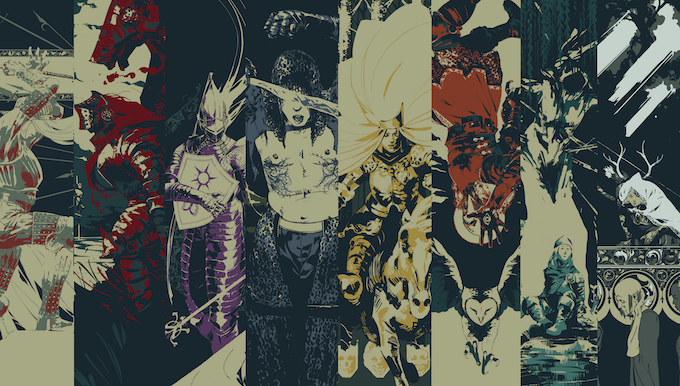
The Mythic Bastionland Kickstarter is wrapping up today. For those unfamiliar this is the Arthurian take on Chris’s games Into the Odd and Electric Bastionland. I’ve been excited about this game since he first started talking about it, as it ties into my interests in this genre. (You may recall my aborted attempt to create a vaguely Arthurian / Dark Souls setting many months ago now: The Misericorde.) Chris is working with Alec Sorensen, and the art they have shared so far looks really incredible. My friend Alex was running the playtest version of this game when it was first announced, and we had a fun time questing around the hexcrawl he created. The game works well, and I assume knowing Chris it’s only been tightened up and improved upon since first announced. He’s one of my favourite game designers. This will be great.
Patrick turned his blog into a giant bible sized book: Speak, False Machine. I have the more modest PDF, which I have been reading on my iPad here and there. When Patrick told me he wanted to make this book I thought him a bit mad: “who wants an absolutely beastly book of blog posts?” I thought. The scope of this thing is kind of incredible. Reading it now, though, I can see the appeal of this format: it’s a much nicer way to read his writing. There is some slight rearangement of texts to form more of a cohesive narrative of sorts through his posts. I had forgotten some of his earlier posts, like his gaming with “the teenagers”. The new art work he commissioned for the book is great! There is no reason not to grab the PDF, and if you love False Machine the big book looks amazing.
Now that Speak, False Machine is shipping, he has moved on to getting his Wodlands setting turned into a proper book. Once again he’s found a great artist to work with. This project is looking great, and so obviously good I don’t really understand why it isn’t more wildly successful. (Well, probably because Patrick refuses or fails to do all the things people do when running Kickstarters, I suppose.) The original Wodlands posts are on his blog, for those who want to read them before throwing your money at the computer screen. I am looking forward to this book a lot.
Michael, of Trilemma fame, has started running a zombie survival game set on the Isle of Wight. The game takes place at the end of the cold war turned hot. The players are all crew of the cargo ship BF Fortaleza. I managed to join in for one session, and hope to make some more in the future. I love Zombie World, as you all ay now, but the system Michael cobbled together for his game worked really well. I think it illustrates neatly how you can really jam a bunch of ideas together and make something compelling enough. (I hadn’t encountered the encounter move from The Regiment before, and it seems like something everyone should steal for their games.)
My current obsession is the 2021 edition of Kill Team. This game is probably most famous for using shapes to represent distances, but not having those distances have anything to do with the shapes used. How many inches do you think a square represents? If you said 4" you’d be wrong, it’s 3". You might be asking yourself, why wouldn’t you use a triangle for 3". Well, they had already used the triangle to represent 1". For reals. Anyway, this is a big tangent, because the game is actually loads of fun when you give it a chance. I’ve been playing it over the last month or so at the other local game store, Negative Zone Comics, and been having a really great time. It’s more complicated than Warcry, but feels like it’ll be manageable once you have more games under your belt. The core of the game feels fresh and interesting, rather than simply re-skinning 40K. Fighting in close combat is a simple dice game of trading blows or parrying. Shooting is complicated by marking models as concealed versus engaged. The various Kill Teams have really flavourful rules. I’m hoping to play a short campaign with Evan, and will write up more thoughts once that’s done.
Nick writes about one of my favourite video games, and probably the most difficult Final Fantasy game in its series, FF1. It’s an excellent game, and wears its D&D inspiration quite heavily on its sleeve. The monsters are so clearly taken from the Monster Manual. It even has Vancian magic! It’s genuinely challenging. I remember having to try some dungeons several times. Resource management plays such a heavy role in this game, something that became far less important as the series would move on. Nick discusses how it’s probably the most OSR of all the FF games.
A million years ago Rey started talking about a game he was working on called Break!!, I suppose building on top of the ideas began in his OSR setting Baroviania. Back in 2017 Grey or Rey sent me an early draft of the game, but it was so full of stuff I honestly thought the games release was imminent. Honestly i’m sure they did too. But no! The years ticked by and I was worried this game would never happen, as Rey improved the rules or Grey improved the layout and art. This game is such a creative vision of what an RPG can be. Everything i’ve seen over the years is so beautiful and feels so fully realized. I’ve been hyped for this game for years now. Many of us have. Now they are ready to take your fucking money. The game’s already funded. It happened in minutes, apparently. And why not? This game is going to be amazing.
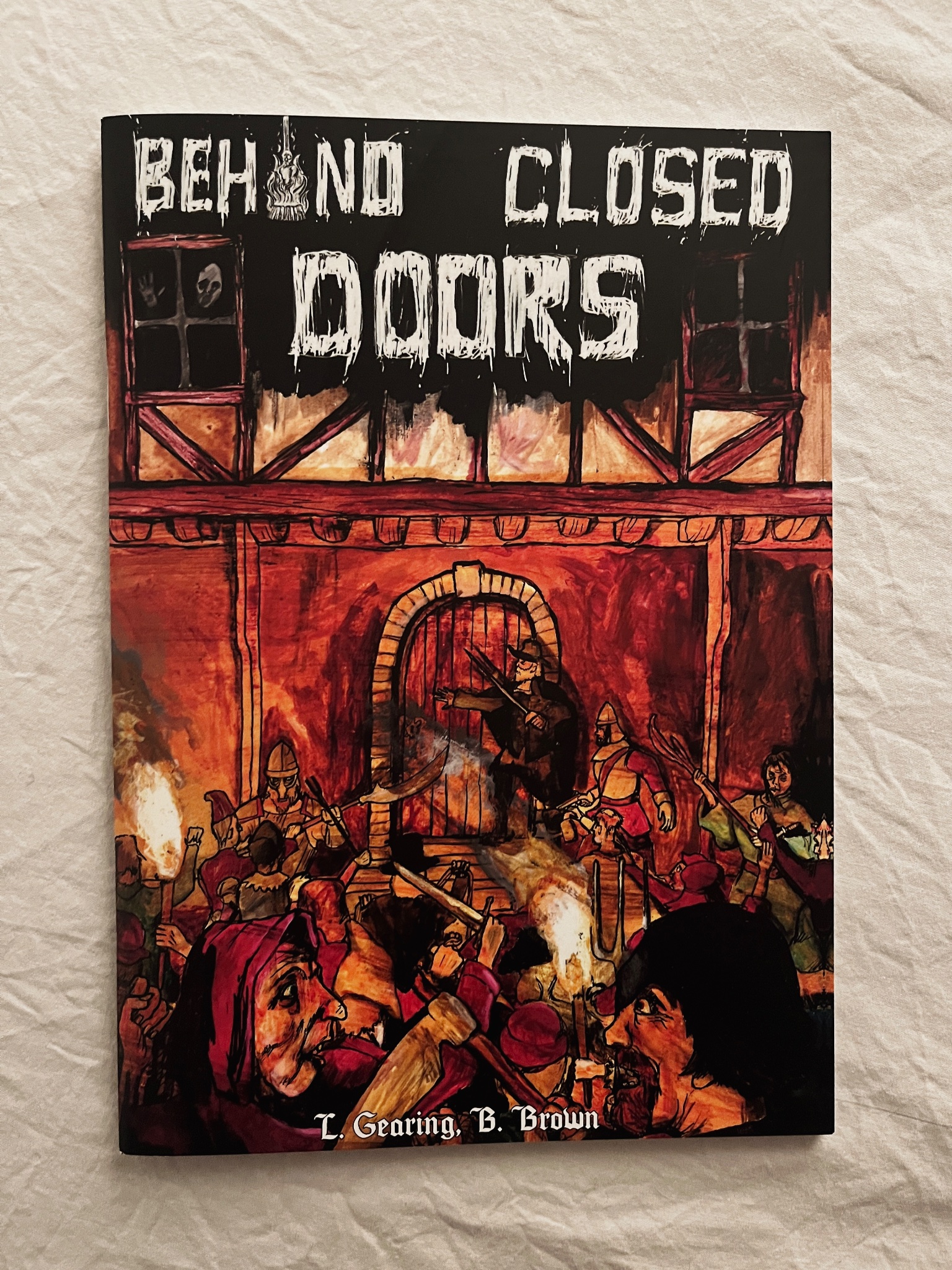
I picked up Luke Gearing’s adventure for the Best Left Burried system, Behind Closed Doors. It was also waiting for me in my brother’s flat in London. If you were looking for something with some strong old-school Warhammer Fantasy RPG vibes look no futher. The players are given license to hunt down witches, and are set off into the world to do just that. There are some witchy things going on, but no overarching plot to this sandbox adventure. There its lots of love in this book. There is a creepy castle that feels straight out of a good LotFP adventure. There is a powder keg of a town that ends the book that would likely be a lot of fun to play through. The book looks like it’d be a bit challenging to use: I felt the urge to take notes as I was reading. There is lots going on: places to go, people to see. I’d be interested to run this with a system like Dogs in the Vineyard. This feels like it should be a more notable adventure than it seems to be. It feels like some very good OSR nonsense. I would check it out.
I had shipped several books to my brother in UK, one of those was Gangs of Titan City. I don’t think it’s unfair to say this is a Necromunda RPG with all the serial numbers filed off. The RPG is what I’d describe as OSR, but you can see the influence of games like Apocalypse World and Blades in the Dark. The game has a clear structure to play, starting with an escalation phase where you figure out what’s going on and prepare for your operation, an operation phase where you’ll play out the action of your chose mission, and finally a fallout phase where you see how your actions have changed the larger world, tally XP, etc. There its lots of support in the book itself to help you start your campaign and keep it going. The mechanics of the game are quite simple, familiar to people who have played any PbtA game: you roll 2d6 and add an attribute modifier to see if you succeed. There are no predefined moves, you’ll pick the modifier you use based on the action you’re trying to accomplish. The game looks interesting. I’d be keen to try and work in using minis as part of play.
They announced the latest edition of Warhammer 40,000 last night at AdeptiCon. I never even managed to play a game of 9th edition, the pace of their releases feels a bit ridiculous. I had told friends I was going to ignore whatever comes next in protest. Except, in a real plot twist, everything they’ve announced sounds weirdly amazing. The rules are going to be free. The army rules, normally sold as (expensive) Codex books are also going to be free. The rules are going to be simplified. (No more lists and lists of strategems!) I am curious if they can pull this all off—and fight the urge to sell you 50 new strategems in a few months.
I have described the hex descriptions of Carcosa as tweet sized bites of information, descriptions you can quickly read in the midst of a game. They are both flavourful and useful. Well, sometimes. Sometimes they are too terse. Terse descriptions and bullet points can become too utilitarian, too boring. I often find it hard to read adventures written in this style because they are so dull. Silent Titans and Luke’s own Gradient Descent are both good examples of marrying beautiful writing written out in bullet points. I found both easy to run and read. (Patrick’s module is still quite wordy as that style goes, mind you.)
Of course, a lot of D&D books will never be run, simply read. I suspect this is actually the more common use case. DMs may harvest your book for ideas, a room or NPC, or simply something that will live in their brain. It’s perfectly reasonable to optimize for reading over play: sacraligous, I know.
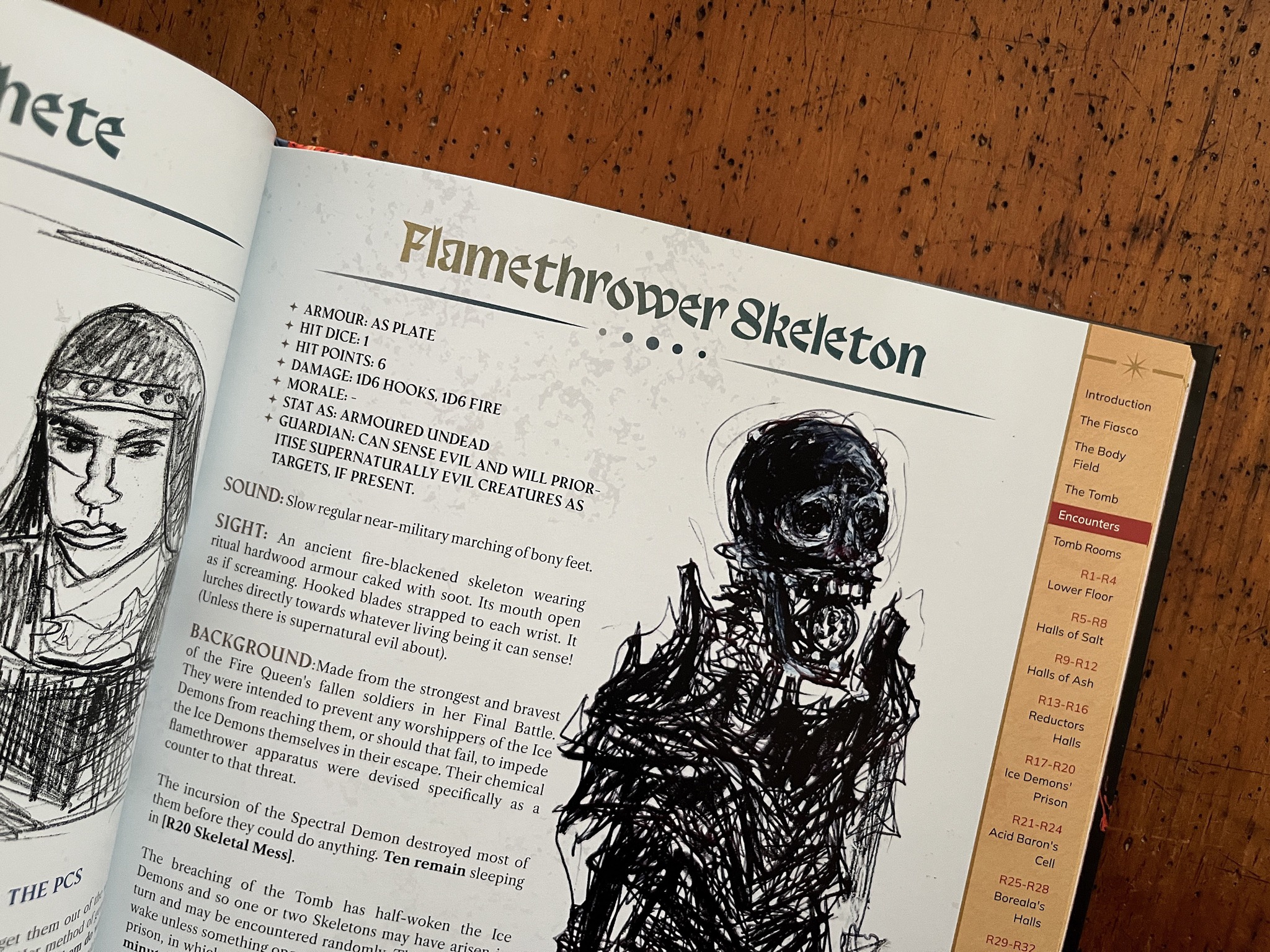
Patrick could have given this monster a dumb fantasy name, but like a true professional tells you what it does on the box.
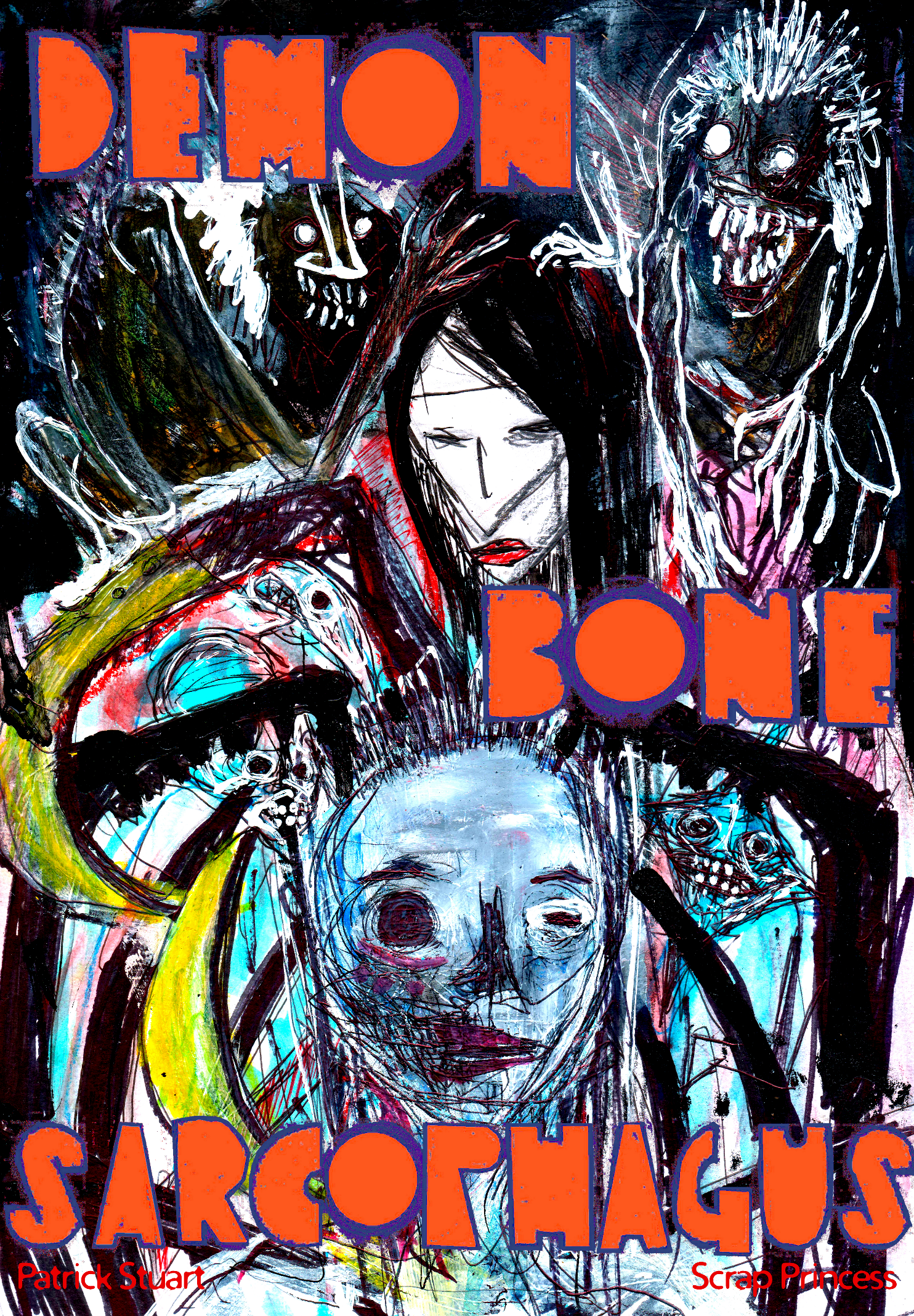
Demon Bone Sarcophagus seems a little intimidating to me. There is lots going on within this book. Lots of text to kick things off. Lots of text throughout. It all feels quite dense. Scrap mentioned that a lot of the text in the book is there to help orient the DM to what’s going on, to make it an easier adventure to run. Fair enough: let’s read this thing!
The book opens with a bunch of backstory that’s all tucked away in one place, so you can just skip past it like a true Patrick Stuart fan. The book doesn’t jump straight to the dungeon, but presents its bestiary first, like Veins of the Earth. The bestiary doubles as a nice dramatis personae for the module. Adventuring through the dungeon looks like it’ll involve a lot of mucking about with NPCs and so learning about them upfront is a good idea. Everything you need to know about the NPCs in monsters is consolidated in one place, but if there are interactions between the creatures and the dungeon, that information is repeated in the room descriptions as well. As was the case with the secend edition of Deep Carbon Observatory, this book is broken down into (mostly self contained) spreads. You should be able to run the adventure from the book without a lot of faffing about. In theory, anyway. I’ll report back once I’ve run this thing.
I’ve been reading the book on and off this weekend, making it through about half the book. Sometimes I have big plans to write about these books I like, but never get around to it because I have too much to say and the weight of figuring out what to write is too much. This time around I will share thoughts as they come to me.
BreakoutCon is this weekend. Sadly I will miss it, i’m out and about, but I did manage to meet up with some friends last night, before the convention began in earnest. It was a bit of a G+ reunion. Zzarchov drove down from middle of nowhere Ontario. Richard G drove up from Upstate New York. We rounded out the posse with some torontOSR regulars: myself, Brendan, Alex, and KYANA. What a crew! KYANA gave everyone G+ buttons she made. An advantage of meeting up with Zzarchov is you get to see what he’s been up to in the flesh. He had new reprints of several of his books, including one of my favourites, Scenic Dunnsmouth—a true classic of the OSR. The book was kickstarted as part of the Kickstarter for City of Tears. It still features Jez’s amazing art and layout. I assume you’ll be able to buy it soon. This is me giving you notice to start paying attention to Neoclassical Games wesbstore.
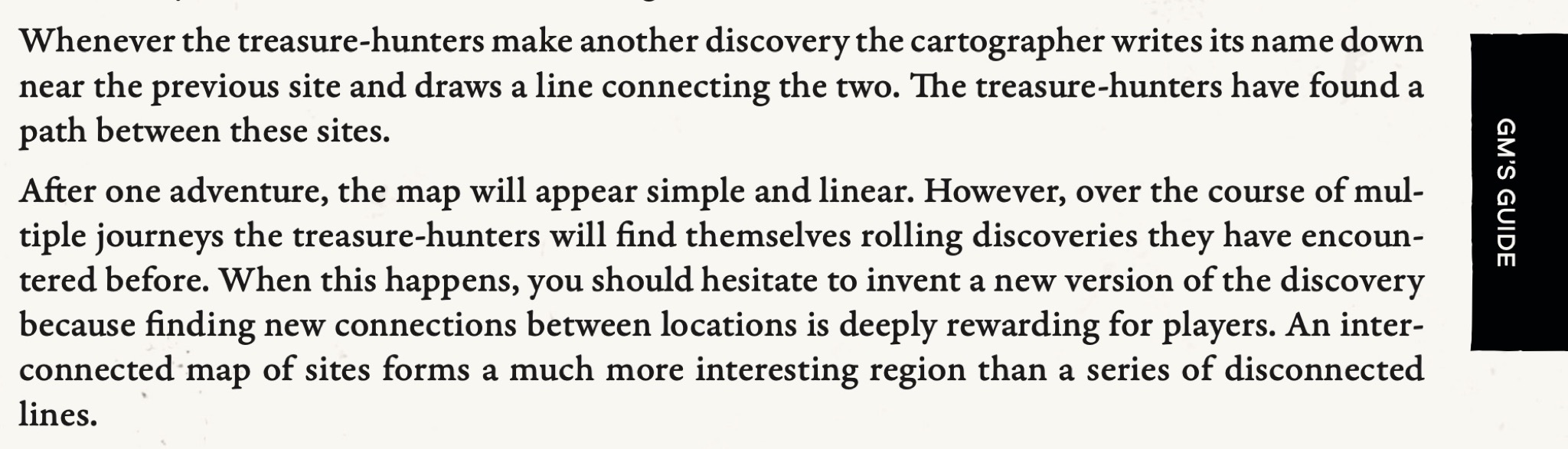
Trophy Gold has some optional light weight rules for journeys that have the players slowly building up a point crawl style map of the world. One thing I like about the suggested approach is that it feels very much like Dark Souls, where part of the fun will be discovering the unusual connections in the world. The game is very collaborative in nature, and there is an expectation that things develop organically through play, with input from the players alongside the GM. You could certainly run things with a more well defined game world, but it feels a bit counter to the spirit of the game.
I’m curious if these moments would feel the same, when the players all know they are produced through the luck of the dice rather than the world building of a DM. I’ll need to play to figure that out. My copies of Trophy Dark, Gold, and Loom arrived a couple weeks ago. They are incredible, and if you are lucky they will reprint and sell many more.
My boy Nate–the man running what sounds like the greatest 5E game ever–reviews one of the greatest video games ever, Elden Ring. I am a huge fan of Elden Ring, and plan to write about it one day. (I liked this game a lot. Nate’s feelings are a bit more thoughtful, nuanced, and mixed.) There is so much you can steal from that game for your games of D&D. If you have a PS5 I would strongly recommend you check it out.
Goonhammer writes about the history of GorkaMorka, which proves to be far more interesting than you might expect. This is a look back at Games Workshop, and how it grew into the corporate behemoth it is today, through the lens of this one game. It’s a fascinating read.
Sean shared a pretty cool project on Twitter, which has really blown up: #dungeon23. The idea is simple: grab a day planner and write a dungeon room a day. At the end of the year, you’ll have a Megadungeon. I love it! Not enough to do it, of course, but I have been enjoying seeing what people produce. If you decide to start this endevour, I suggest you follow Sean’s advice: keep things simple and have fun. Treating a project like this as if it was your second job is a recipe to give up by March.
If you haven’t read OD&D you should, it’s really wild what they thought was enough for people to play a game. And really, they were right. People figured it out and made amazing things.
I met up with Alex, Brendan and Paul last night from the #torontOSR posse. We tried to play through James’s The Cursed Chateau, but spent much of our time together drinking cocktails and catching up. Almost certainly inspired by this experience, Alex writes about one-scene adventures as another form of one-shot play.
Man, Twitter really does feel like a hot mess right now. And if we are all being honest with one another, it already felt like a hot mess, right? Warren from I Cast Light explains why you should be getting back to blogging: BLOG! Good God! What Is It Good For? When I started blogging (a million years ago) social media didn’t really exist as a thing, and people would share all the ephemera in their heads on their blogs. Some of your tweets are probably stupid, and should just disappear into the ether. Some of your tweets are probably worth simply posting to your blog: especially those that spark discussion. I wrote about “microblogging” here at Save vs. Total Party Kill some time ago. Anyone can start a blog and contribute to the wider RPG scene.
I suspect the death of Twitter is greatly exaggerated. No one pays 44 billion dollars for something only to drive it into the sun, though that’s honestly the best outcome one could hope for when it comes to Twitter. I’ve been on that site since the dawn of time—I’m twitter user 3,321—and I will be a little sad to see it go, but honestly not that sad. It’s been dreadful for many years now.
Just to get a little bit ahead of any exodus, here are a few places you might see me besides this blog:
Mastadon, which honestly kind of sucks. It’s like the Linux of social media. And I don’t mean that as a compliment. But, at least we can trust it to chug along while not selling your data to advertisers. I’m on tabletop.social, but another popular choice with open registration is dice.camp.
Cohost.org, which seems promising, but I am unsure how they plan to keep the lights on. It reminds me a bit of G+, in that you can create public (or private!) “pages” for people to follow, and you write posts with comments: no stupid threads.
At the end of the day, the OSR is about blogging, and I’m always up for more of that.
The first part of the infamous follow up to Deep Carbon Observatory is finally out, Demon Bone Sarcophagus. Time to buy while the Tories are demolishing the value of the British Pound! I’ve been reading the PDF on and off: there is so much going on it’s kind of bananas.
Sean has shared some interesting thoughts on player safety tools in RPGs, something that’s been on his mind as he writes the dungeon master’s guide for his game Mothership: Thinking about Safety Tools in RPGs. Here Sean frames safety tools as a form of hospitality.
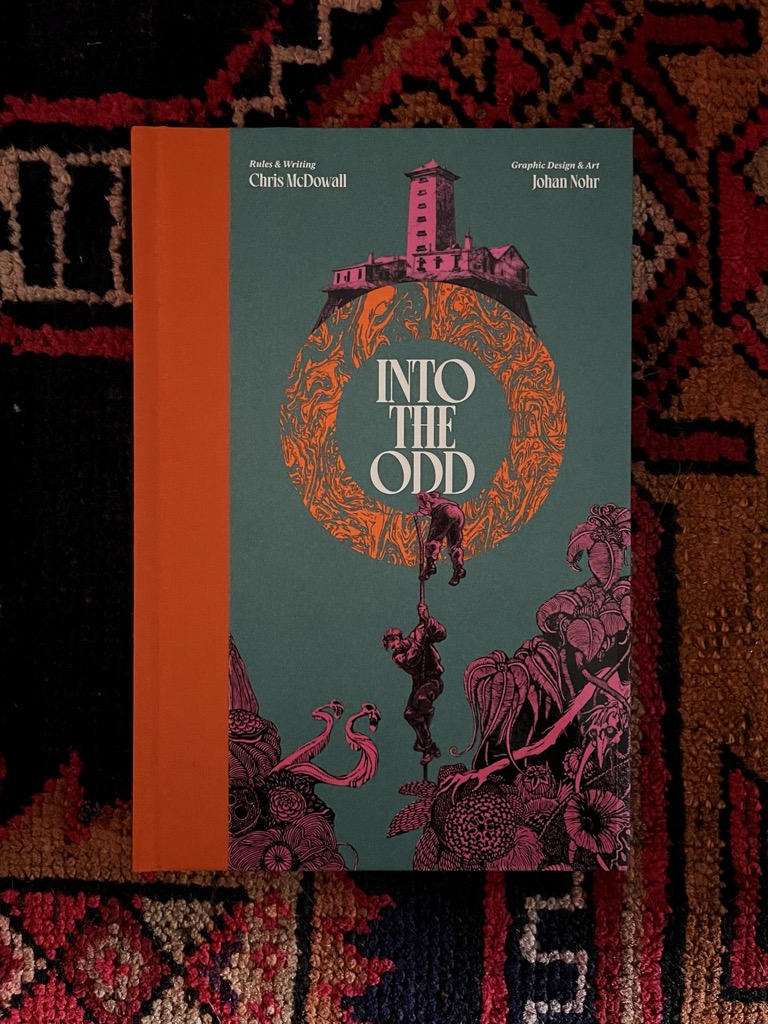
I had been not so patiently for my copy of Into the Odd to arrive. Chris teamed up with Johan Nohr of Mörk Borg fame to produce this new edition of the game. They have made a really incredible book together, it’s really quite beautiful. My love of this system has grown slowly over time. Paolo published Wonder and Wickedness and Into the Odd around the same time, but I next to no interest in the game. The implied setting seemed wasn’t really to my taste. Also, I was all about OD&D at the time. Over the years, perhaps with the release of Silent Titans, I have become much more aware and interested in Chris’s works. He’s one of my favourite OSR game designers now, and Into the Odd seems like one of the more important and influential works to have come out of the OSR.
I recently shared my Gygax 75 draft and was complimented on putting a Dragon as the last entry on the example encounter table for the region. I stole this idea from my friend Nick, who wrote I feel is the best blog post on this topic: Structuring Encounter Tables, Amended & Restated.. A nice follow up blog post is this Encounter Checklist from Prismatic Wasteland, which breaks down elements you should keep in mind when trying to build an interesting an effective encounter for your players.
Mateo over at Hex Culture has written a great post about how to make the lore of your setting more interesting and actionable for your players. He discusses an idea called Situational Narrative Design. Richard jumps in with a related discussion on how to make the player’s characters central and impactful in the wider world they play within: The PCs are a Faction. Finally Emmy has a nice short post on Environmental Storytelling, “using objects and locations in RPGs to tell a history or fiction”.
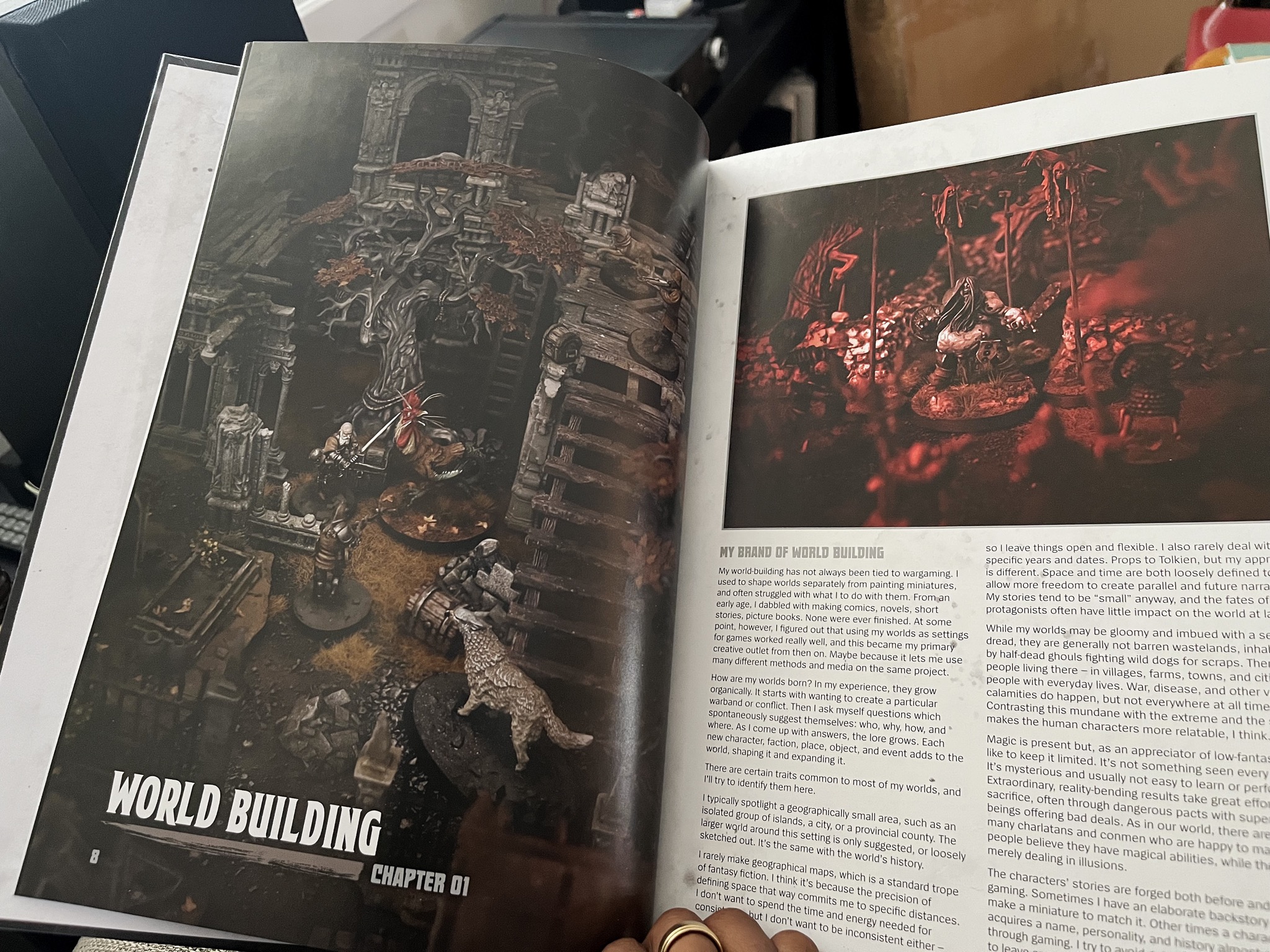
I was visiting my local game store and saw an art book featuring the work of Ana Polanšćak, the woman behind the incredible blog Gardens of Hecate. As part of the Inq28 scene, Ana produces some really unique and moody miniatures and war gaming ephemera. The art book chronicles her journey through the hobby, and is a real deep dive into her whole process when it comes to producing her work. A lot of the book is about how she thinks about world building, and is likely of interest to RPG nerds. There is a lot of overlap between narrative war gaming and RPGs, and Gardens of Hecate is the perfect example of that.
These notes and Arneson’s would ultimately become Dungeons & Dragons, but only by being codified could the game really be propagated and begin to gather a following. This same problem persists for designers today.
Gus has written a long essay on procedures in gaming, why they mater, and a mode of thinking about games he calls Proceduralism. One could call this tract of thinking the Pahvelorn School of Game Design. As it was for Gus, that campaign was so inspirational for me. It really shaped how I think and play games now, all these years later. I had bugged Gus to break this post up, there is so much here, and a lot of it could stand by itself, but he said “no way!” A man’s gotta have a code, I suppose.
An idea I read on James’s blog Grognardia long ago, which I quite liked, was what he called “D&D is always right”. Rather than assume the idiot choices the designer of some old module from the 80s made are incorrect, give them the benefit of the doubt! Try and work out how the oddly placed monsters, treasure, and traps fit into a coherent whole. Treat it like a creative exercise and you’ll end up with something good. Wayne Rossi reverse engineering the OD&D setting based on the rule books is a similar pursuit. My dilemma is I can’t actually find this blog post, though i’m sure it exists! Do any of you remember this mythical post?
[Regarding the phrase “D&D is always Right”,] my point has never been, so far as I can recall, about “recovering” the original, hidden meaning of D&D. I’m not sure there is one in many cases. Rather, my point was simply akin to Chesterton’s fence: don’t assume a rule you don’t understand isn’t workable. Assume it is and see where that takes you. — James Maliszewski, 2022, who sadly also has no idea what post i’m talking about.
Update: Thanks to Lucas in the comments, we stumble on this post, which is likely the one I was thinking about: The Glories of Incoherence.
Thanks to Sean McCoy we can enjoy this interview with James Maliszewski about Empire of the Petal Throne. They cover a wide range of topics. “I wanted to talk to James about Tekumel, long campaigns, Barker and his tainted legacy, and where true ownership of an RPG setting lies.” Tekumel is such an unusal setting. Seemingly so thoroughly divorced from your typical tolkien rooted fantasy. James ran several sessions of Empire of the Petal throne for the TorontOSR peoples before embarking on his epic campaigns, a fun experience.
Jason Tochi of 24XX fame wrote a great post a little while ago about what he calls the three layers of rules: social, fictional, and abstract. If you’re interested in game design it’s a great way to think about things, especially in more rules light games. Where do the unspoken rules go? Probably to the social and fictional layers. This post is in the news again as Jason shared a version included in the rules for his new game, Alight.
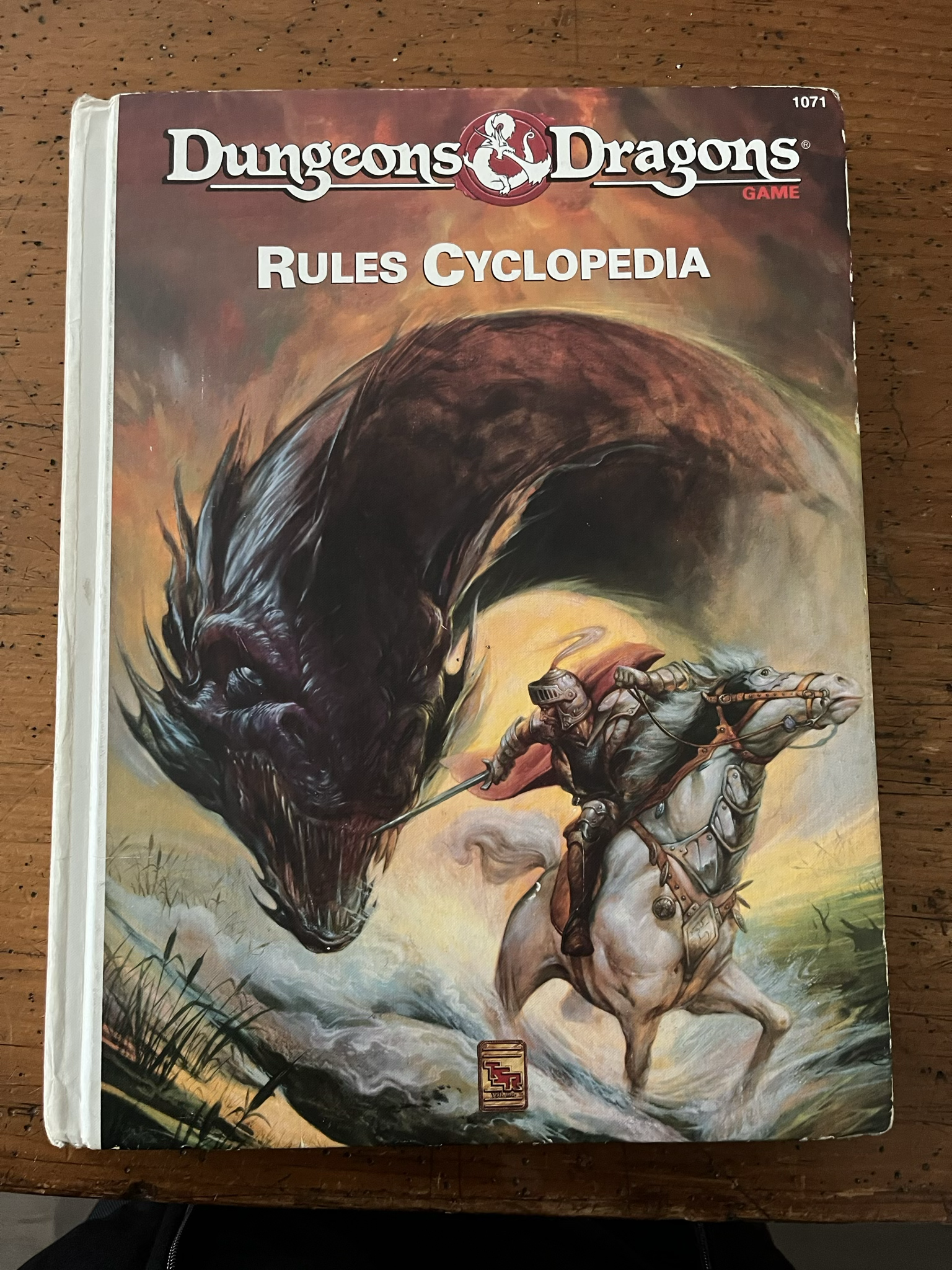
As I have discussed in the past, I got started with D&D playing with the Rules Cyclopedia. When I went to buy my own D&D books I ended up grabbing the AD&D 2nd Edition Players Handbook instead. I didn’t realize the games were quite the same, and assumed I’d want the “advanced” version anyway. I’ve wanted to track down the Rules Cyclopedia for ages, but they are often hard to find or collectables. Alex, a player from my recent Torchbearer game, was given two copies by a friend of his. He asked the group off hand if anyone wanted one. Of course I do! So he mailed it off to me. What a lovely thing to do. And it’s here now, and I am awash in nostalgia.
My friend Alex discusses Fuck You Design, an interesting response of sorts to my post about negative space in RPGs. His post in turn has me wanting to write more myself. I love simple systems, so I am always looking for a good minimalist one. The problem is so many miss the mark. It takes a lot of care to make one that isn’t just you filling in all the holes with D&D as you remember it. Carcosa is a good setting in my mind despite missing a lot of details because what’s there is enough to help get you the rest of the way. Some adventures lean so far into terseness you run them and realize you are doing all the work. OD&D doesn’t tell you what a helmet does, but there is enough to the game you can house rule something coherent. If it didn’t tell you what armour did that would be way more annoying. Anyway, this is enough for now. Read the post, it’s great!
You should check out this name generator from Elijah Mills which I discovered on the NSR discord server. This is pretty fantastic. As he describes it: “I made a post-apocalyptic name generator for an upcoming collaborative project. We combined 200+ names from the Iliad and Odyssey with hot-rod terminology to get some really whacky results that are perfect for our setting.”
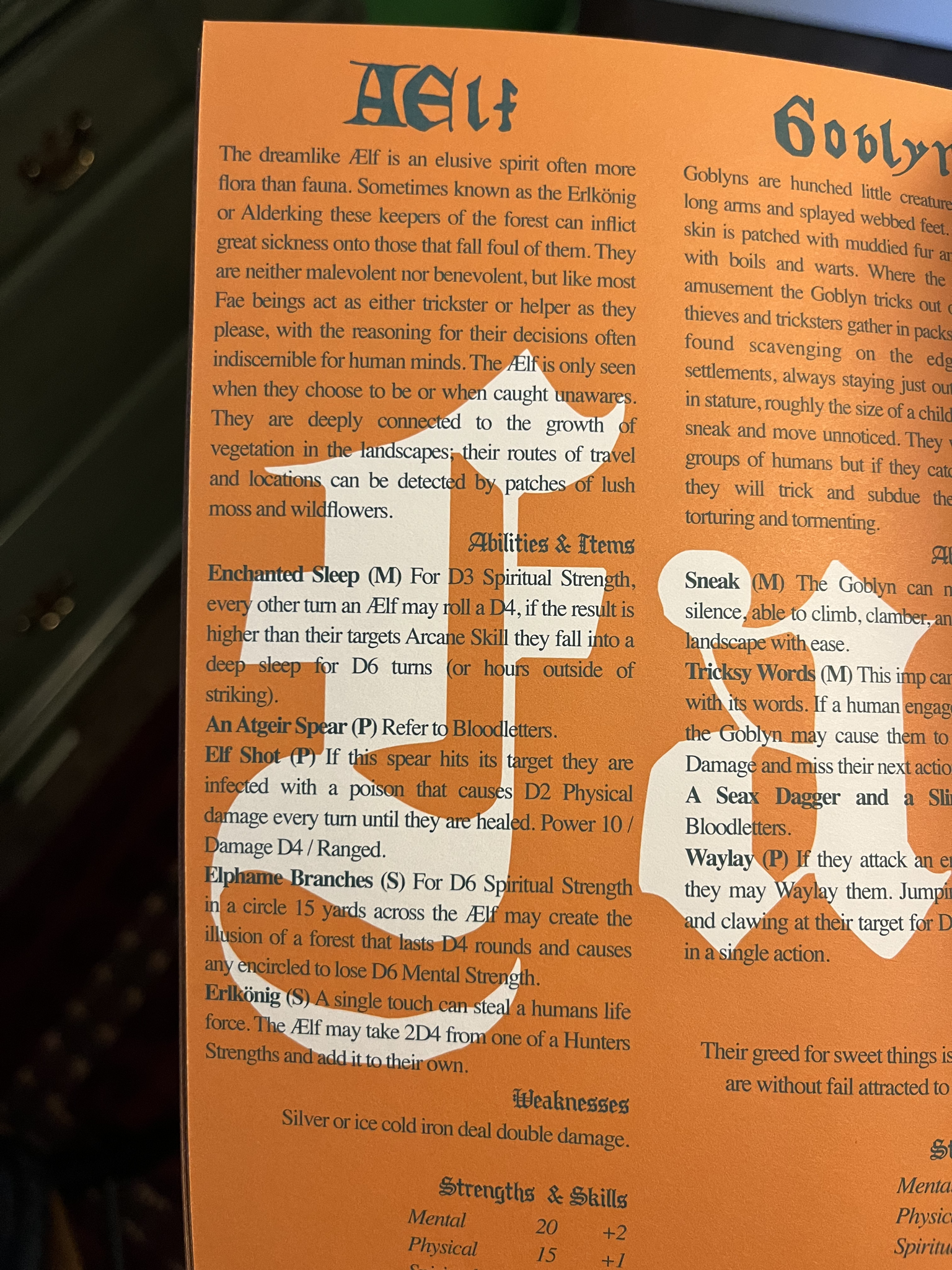
Jahtima, a new book in my mail via FourRogues. (Between them and Ratti Incantati my RPG spending has become … well more, anyway. No regrets!) I saw book and was intrigued: an RPG about hunting monsters in early “medieval” Europe, which is currently what I am interested in. The graphic design is quite pretty or bold at times, but maybe also gonna give you a headache? This isn’t a novel, though. Maybe a headache is fine if you can find the page quickly.
This is a little bit of an experiment. This post is what some might call micro blogging. If you’re reading this in an RSS reader it’ll look the same, but on my website this post is displayed a little bit differently. It should look a bit demure next to a bigger grown-up blog post. 20 years ago a lot of blogging felt short and casual. Nowadays it feels like people feel the need to say a lot, and find friction in the format. People move their casual messages to sites like Twitter or Facebook. But the ephemera you post online should belong to you as well. With the death of G+ I saw so much great stuff just vanish. So many messages from friends, interesting discussions, etc. Some of it lives in an export on my hard drive. A lot of it’s likely gone forever. I should blog more, but blogging doesn’t need to be long essays and deep discussions. Sometime it can just be sharing for the sake of sharing. Someone takes a small idea you have and turns it into something wonderful.
Evlyn’s blog Le Chaudron Chromatique is full of amazing art. There is so much great stuff i’m not even sure what to point out. Their most recent post was a lovely illustration of the Marsh Enchantress. An earlier favourite of mine was this posse of fungus monsters. There’s also the occasional post full of DIY D&D nerdism. Most recently Evlyn reimagined Gnolls as Hammer Goats. This blog is great: check it out.
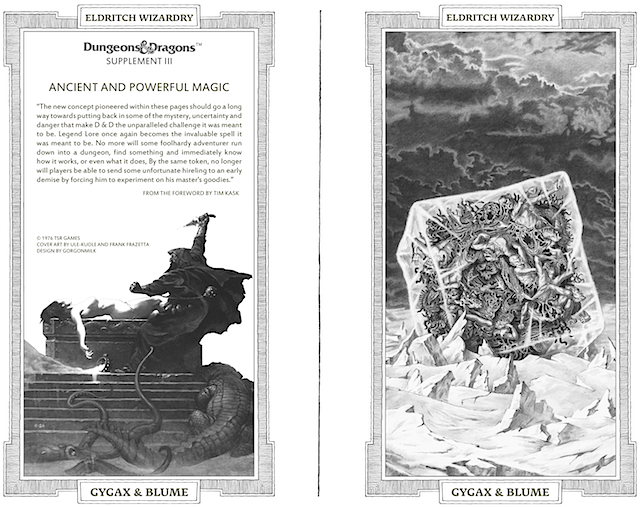
Gorgonmilk is the place to go for all your DIY D&D needs. I’m a particular fan of his alternate covers for the Original D&D booklets. I discovered the site recently, and it’s really quite excellent.
If you feel like you aren’t getting enough Final Fantasy in your D&D, Hack & Slash has you covered with this new class for your D&D games, the Blue Mage. Now you can play Gau from FF VI along side Celes.
I am moving all the discussion on this site over to Google+. As it stands most of the discussion that takes place about my posts happens there anyway, and it’s also where I go to read about and discuss D&D. If you aren’t on Google+ you might be surprised to learn it has a very active RPG community. I had thought Google+ to be a ghost town in the world of social media until stumbling upon all these people who use it to run games online and discuss table-top gaming. If you are on Google+ please add me and i’ll include you in my RPG circle.
Update 2012-12-26: And we’re back: our long national nightmare is over.
Just a heads up to my readers, and random Internet people, that my three D&D web apps: Random Carcosa, The LotFP Summon Spell, and my Random Character builder are all offline at the moment. My host seems to have broken them when moving my account to a new server. It’s Christmas so I don’t expect my host to get back to me with what’s up too quick, and i’m not sure I’ll have time to dig into this for the new few days.
Continuing my series of great D&D blogs, may I suggest the consistently good Dungeon of Signs by Gustie1. It’s hard to pick any one thing to highlight, so I’ll point out the most recent post about his demon infested ocean liner megadungeon the HMS APOLLYON. The post is a good mix of great writing, art, and creativity that is more or less the staple of each and every post on his site. Why are you still reading this? Go!
I now play D&D with him weekly, so this review isn’t completely unbiased: though I thought the blog was pretty great before we had ever met. ↩︎
There were lots of other bloggers besides myself in attendance at OSRCon. As one might imagine many of them wrote about their time at the convention. Grognardia has a post about OSRCon along with another post about running Dwimmermount with Ken St. Andre as a player and one about the game I participated in. Discourse and Dragons covers the convention as well, and in particular about playing in this infamous game of D&D with Ken. Speaking of Ken, he has a post with lots of photographs about his time in Toronto. Two Americans I met at the convention, Carter and Brendan, both wrote about their time in Toronto and their feelings around the convention. Carter ran the Labyrinth Lord game I played in on Friday afternoon. Steve, who ran the Boot Hill games, discusses the convention and the OSR from a non-D&D point of view in two posts: Reflections Part I and Reflections Part II. Last, but not least, we have Untimately and Akratic Wizardry’s comments on the convention.
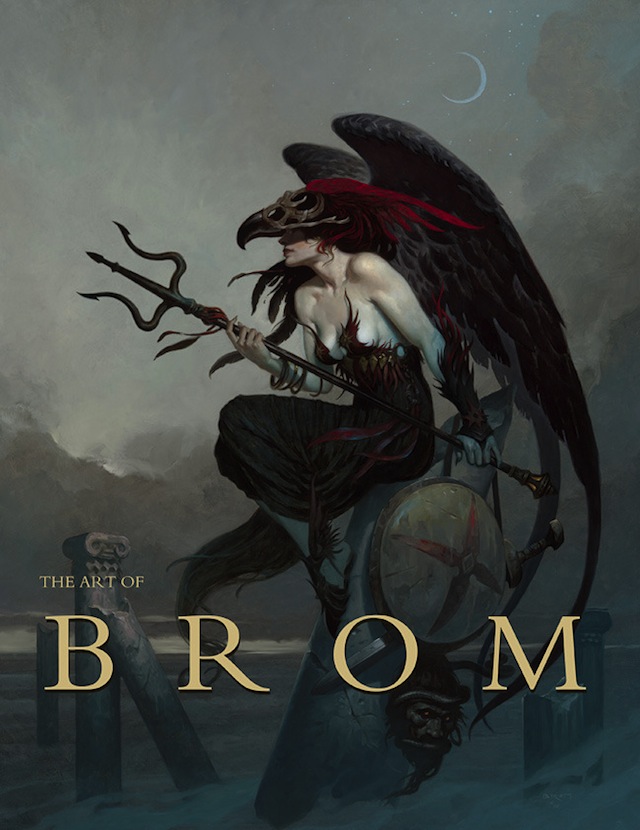
Gerald Brom’s art work shaped the way the Dark Sun game setting evolved. He would paint scenes that the game designers would then use as inspiration when building the world and the game mechanics that went with it. He has a very distinctive and I would say classic fantasy style. His work reminds me a little bit of the work of Frank Frazetta. He’s probably the greatest fantasy artist alive today–yeah I said it. He also has a Kickstarter project on right now to fund a retrospective book of his work. I’m losing my shit over here.
I recently discovered that there is a small convention that takes place in Toronto focused on old-school table-top gaming. OSRCon takes place this weekend. It sounds like it will be fairly small as conventions go, and the focus seems to be about running and playing games. If you are in or around Toronto it seems worth checking out. How easy is it to bump into people who are into old-school D&D? (That’s a rhetorical question.)
I have mixed feelings about the Dragonfoot forums. They are a pretty great resource for all things old-school D&D. On the other hand they are also filled with all the horribleness one finds in a forum of reasonable size. Still, I don’t think there is a better source for stuff like this: the “B1 - In Search of Unknown” index thread is full resources and reviews of the D&D module In Search of the Unknown. It’s probably got a link to anything of interest about that module.
Over the last few days i’ve been working on a little web application to help Lamentations of the Flame Princess players go through the motions of casting the Magic-User’s Summon spell. The spell lets players summon a demon to aid them–hopefully. The LotFP rules outline what sort of demon will show up and whether or not it will listen to the players. It’s a crazy spell. There are lots of tables and dice rolling. It’s a complicated enough procedure that it produced a thread on the LotFP forum to discuss how exactly the spell works. From the discussion there I figured turning the spell into a little web-application would be a small fun project.
For those interested, the site was created using the Python (mini) web framework, Flask, and is hosted on Dreamhost.
There are lots of great blogs about D&D out there on the Internet, but one that puts out consistently good stuff is Untimately by Toronto’s own Brendan S. His most recent post is on the rules that compromise Original D&D, distilling everything in the 3 brown books into concise lists of rules. A recent post that was particularly creative was about his take on schools of magic. If you’re into D&D you should be reading Untimately.
If you’re looking for the next Kickstarter project you should be supporting, look no further than Brave Halfling Publishing’s Appendix N Adventure Toolkits (DCC RPG Modules). For $20 you can get a copy of 5 modules and a slew of other bonus material. From the Kickstarter:
Each Appendix N Adventure provides Game Masters with a challenging adventure that can easily be dropped into an existing campaign, as well as an inspirational module map and a set of illustrated player handouts. Each also contains new monsters, unique enemies, creative traps and bizarre settings to challenge players, and inspirational ideas for expanding the campaign and launch points into further adventures for the Game Master.
The project is already funded. You have nothing to lose. If the project hits $15,000 than they plan to also release a new campaign setting.
Five years ago, I spent many months working on a unique campaign setting (“The Old Isle”) to help try and spark renewed interest in Gary Gygax’s rpg, “Lejendary Adventures.” With Gary and Gail’s blessing, I consulted with Gary frequently about the design of the setting, npc races, magic item creation, divine beings, etc. I bounced ideas off of him and he provided suggestions and critiques. It was a very special time in my hobby gaming that I still treasure. However, while Gary played a supportive but indirect role in my creation of the Old Isle Campaign Setting, he did not create or write one word of the setting - The Old Isle is 100% my creation. Maps were created and art was commissioned. With Gary’s passing and the end of his Lejendary Adventures game, I decided to not release this material. However, from the first time I read some of the early DCC RPG play-test material, I knew this campaign setting had found a new home!
If you haven’t used Kickstarter before, this is a great first project to support. Brave Halfling Publishing has been around for a long time, and has a great reputation. They already have 6 modules ready to go, so you’re really only paying to help them bootstrap their printing costs. This seems like a pretty low risk venture. By the sounds of things, you should expect modules in the mail by July or August. That’s pretty fast turnaround for Kickstarter.
Barrowmaze II is the second part of a two-part exploration-style megadungeon for Labyrinth Lord and other classic fantasy role-playing games. BMII is a continuation of the initial “dungeon sprawl” concept presented in Barrowmaze I (BMI) and is intended for mid-and-high level characters.
I own the PDF of the original dungeon. It’s a pretty creative take on megadungeons. Instead of having multiple levels, each more challenging then the previous one, Barrowmaze is basically a giant sprawling mess of rooms. The further you get from the entrances into the dungeon, the harder the encounters get. Barrowmaze is a crypt, and the room descriptions really play this side of its origin story up. For example, there are lots of sealed up tombs PCs can excavate in search of treasure at the risk of alert monsters to their presence.
Barrowmaze was created by fellow Canadian Greg Gillespie, who runs the blog Discourse & Dragons.
Today is the last day of the BarrowmazeI II funding campaign. It has already reached its funding goals, so its going to be available for purchase sometime in the future, even if you don’t have the funs to support the project right now. There are some nice perks for backers of the project, so if Barrowmaze II is something you think you’ll buy in the future now is the time to act.
At the Battle of Marignano, Swiss pikemen actually fought Landsknecht mercenaries. Because it was impossible for either side to lose, THE BATTLE IS STILL GOING ON.
It’s interesting to look at the evolution of D&D from its war gaming roots. Each successive iteration of the game seems to lose a little bit more of the book keeping.