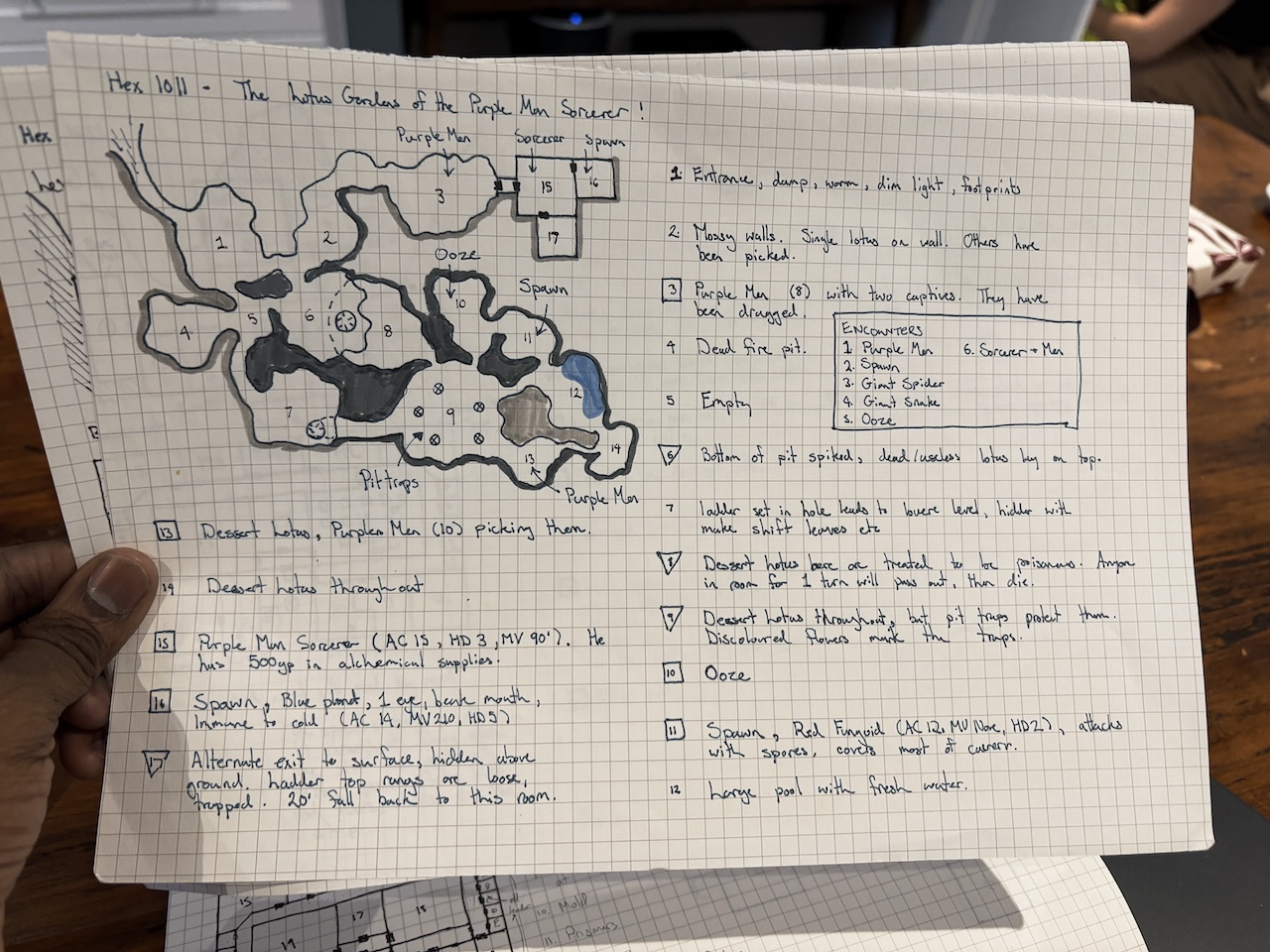
The session began with exploration and learning more about the world. This was the first time the party got lost in the wilderness, an important part of the game. My travel rules worked. The party found more caves to explore in the future, and learned of a second citadel that purportedly held a tomb of vile sorceress magic—the best kind. The party would refuse to seek it out for the remainder of the game, of course. The later half of the session was spent getting high with some stoner Carcosans. Dion joined the game this session, and was a fixture in the campaign for a long time to come, playing Ulfire Sorcerer Asha-Rea. His character used the distraction of everyone getting high off their ass to steal some Jale Lotuses to sell later. A quiet session, but they can’t all be loud.
The party is in Invak, returning after vanquishing the cultists to the North.
They elect to escort two of the bone from the the Citadel of Decline back home.
Get lost on the way there, ending up South of Invak.
Encounter Jale Slavers on the road. 17 in total and they look like bad asses.
The party books it, escaping into the wilderness. They are forced to abandon a pack animal to do so.
They spend the night in the wilderness and then head back to Invak.
Once more, the party heads North West towards the citadel.
The trip is uneventful, but on the way there hey find two caves to explore later.
The citadel is as it was before. Lots of sad sack bone men and women.
The party hears a rumour of a citadel to the south the bone men avoided when they stumbled upon this castle many years ago. This other citadel was also abandoned, but covered in sigils and markings that left everyone feeling disturbed. The scouting party who ventured within claimed to see a book of foul sorcery that so terrified them they turned and ran he moment they set their eyes upon it.
The party rests the night and heads towards Invak, stopping at cavern on the way.
It’s home to stoner brown men, who snort Jale lotus and receive visions.
The characters decide to get high with the Brown Men.
Orange Julia learns of a Sunken Temple filled with Amphibious Ones held in Stasis.
Renoir learns of a Forlorn Citadel.
Usha Ray sneaks some Jake Lotus while everyone is busy getting high.
The party returns to Invak.
The apothecary examines water from the Citadel of a Decline, and informs the party that the water is full of human filth and dead humans. He suggests they don’t drink it.
Almost a full month since our last game! The fastest way to kill a campaign is to miss games, and playing every week meant that a missed game had an oversized impact. I’m impressed the Carcosa game managed to last as long as it did, as I was a bit too quick to reschedule when I was a little busy or tired.
Reading the comments I see that at this point I still didn’t have a clear procedure for wilderness travel I was happy with. I suspect I was just using travel times from OD&D and winging it. Before the next session I would settle on Hazard Die based procedures, borrowing from how Brendan ran his games. Earlier that year (2014) Brendan wrote two seminal blog posts: Overload the encounter die and Proceduralism. I joke that I am part of the OSR that is obsessed with Adventure Time, but I’m also part of the OSR that is obsessed with procedures of play. It felt like everyone read Torchbearer, didn’t want to play it, but did want to add procedures and downtime to their games.
In this session the players decided to attack the Orange Man Citadel to the North. They were aware the citadel was an ally of their enemies the slavers, that they apparently ran gladiatorial games. Evan using his teleporting laser gun to teleport the Frog God away was great conclusion to the fight, as it meant the Frog God was now wandering the wilderness alongside the players. I added the Frog God to my encounter table. My encounter tables would slowly grow and change based on the actions of the players each session. Will the frog show up in a future session?
The players found a “strange metal collar with buttons and lights (Treasure #1)”. The players had to figure out what the magic items (or super science) they found did. I had a list of items so I wouldn’t forget. Treasure #1 was a truth collar the space aliens used for interrogation. Will the players figure out what it’s for?
I don’t recall if Nick named his character or not. He was killed this session. His previous character, Horace, was killed in the session 2, the previous game he played. The game was a bit of a meat grinder.
The rainbow connection were resting in the cavernous castle, home to the Ideal of Decline and his sad group of Bone Men. They debate heading North back to the Putrescent Pits, or South in Invak to help start some sort of alliance between the two towns.
The party suggest to the Ideal of Decline that they abandon their crazy castle and come live in Invak.
He is wary of the idea, but sends 6 of his Bone men with the party to investigate the town and report back.
In Invak the party meet with the Speaker of All Graces, and decide that it’s the red moon and they should save those slaves.
The Speaker of All Graces is always down for fucking with slavers, and provides one of his best lieutenants and 40 men to help the party.
Organina recruits another 7 Orange Men from the refugee quarter to help as well.
The party head north to the Orange Man Citadel, home to cultists famous for feeding the winners of their gladiatorial games to their spawn god.
The citadel seems strangely abandoned.
The party does some scouting, and then attempts to scale the walls.
The grappling hooks alert two Orange Men inside.
A crazy fight breaks out—I bet Zak has some rules for mass combat in Vornheim I could have used here.
The Orange Men have laser guns, but are about as good a shot as Cobra.
Things are overwhelmingly going the parties way until the interior doors to the citadel are opened, and the giant spawn god, a huge feathered frog with a beak, lets out a croak that scares most everyone in the battle.
A small number of reinforcements join the fight, but in the end they are also put down quite quickly.
Nick’s character is eaten by the terrible toad.
The Spangled Inquiry had been shooting at the frog with his teleportation ray for several rounds, finally hitting the beast when it was perhaps almost dead. The beast disappeared into the wilderness, and presumably ran off.
Searching the citadel reveals a stash of valuable gems.
The Speaker’s lieutenant gives the party the first 3 gems (100 GP, 5000 GP, 5000 GP). “The Speaker of all Graces would thank you for pushing us to finally finish these slavers off. I will do so in his stead: 100 GP a slaver to your strange troupe. The remaining treasure we split evenly. The money due to the dead will be given to our home Invak. I will keep 35 men here with me to secure the fort these slavers wasted with their idiocy. My remaining men will head south with you and he freed slaves to report to the Speaker of all Graces. Tell him to send word of what he wishes to do here.”
35 Bone Men and the lieutenant stay behind in the citadel, the party returns to Invak the next day.
Strange metal collar with buttons and lights (Treasure #1)
There are 52 people on this adventure: 368 GP each, or there about. 1100 GP for killing slavers split 4 ways is 275 GP. So each player gets 643 GP.
Monsters Defeated:
11 crazy Orange Man Cultists (and slavers)
1 Spawn of Shub-Niggurath, a huge toad
It’s funny reading all the “who will run next week” chatter. This Monday night spot was a hot commodity. You can see I didn’t have any concrete treasure rolled for the citadel, I figured things out retroactively. I was all about just in time prep, which worked until it didn’t.
Eric Boyd (2015-01-27 05:16): Player Notes: We need to write an easy-to-sing ballad about killing slavers, so our motives are clear when we show up in situations like this.
Ramanan S (2015-02-02 02:36): I still owe you guys: loot, a players map of the region, and better rules for wilderness travel!
Ramanan S (2015-02-07 20:59): Still behind on things. I asked to see if Bryan Mullins can run next weeks game as well.
Bryan Mullins (2015-02-07 21:39): Just got out of work, sorry no quick replay Ramanan S. I’ll post an invite for that game (the 9th) tonight.
Ramanan S (2015-02-10 05:24): [Ram figures out the treasure for the session, finally. There is lots.]
Bryan Mullins (2015-02-10T05:38:34.431Z): Damn, thats the one I missed!
Ramanan S (2015-02-10 05:42): They raided that orange man citadel to the north to free slaves, bolstered by a militia from Invak. My notes for that citadel were a small map and stats for the frog God, which is why I didn’t have treasure handy at the time. I wasn’t sure how to allocate it till I saw Courtney Campbell’s post about treasure types today and that seemed like the obvious thing to do.
Eric Boyd (2015-02-10 06:41): clarifying: is the party splitting 10,100 GP of gems four ways?
Ramanan S (2015-02-10 11:03): The party splits their 3 gems worth 1100 GP between the 4 of them. It’s like a bonus or finders free or something. For simplicity we can just assume the Speaker of all Graces in Invak can swap the gems for currency.
Ramanan S (2015-02-10 12:04): My current thinking is that “gold” is ancient super hardy metal coinage from some bygone era. So it all looks pristine and new, and most Carcosans don’t have the tech to mint new coins or mess with the old ones. So they are a good hard to counterfeit common currency. Thoughts?
Ramanan S (2015-02-11 04:55): Bryan Mullins Am I running stuff on the 23rd (normally when my next slot would be), or this Monday (normally your spot, but you covered for me so I don’t know if you need / want a break or not). Let me knows.
Bryan Mullins (2015-02-11 05:05): Um…lets say that I just did you a favor so you could get up to speed? Ultimately, I’d like to see Richard come into the rotation so that I can rest my Monday game more often. Sorry, side track. I’ll be ready and running for Monday the 16th, and you’ll be back on for the 23rd. Sound okay?
The party had been told rumours that there were healers to the south that could heal Gus’s character of his terrible mutations. (You may recall that was his first character’s fate in our first session of the game.) The party ignored those rumours last session, but decided to pursue them this time. Bryan’s character came out of my random generator with a tattooed map on his skin: a map to the mega-dungeon I had imagined I would run, whose name appears in Hex 1109 of Carcosa: On the northern slopes of the mounds are the yawning pits that lead down to the infamous and deadly Putrescent Pits of the Amoeboid Gods.
I would occasionally seed more rumours in the alternate future restocking tables I would create after each session, as part of my recaps. For example, in the recap for this session I wanted to let the players know that another group as aware of the Putrescent Pits of the Amoeboid Gods and would explore it even if they did not:
A caravan makes its way North. The men and women ride lumbering lizards and have several days worth of supplies. They have a map leading to the Putrescent Pits of the Amoeboid Gods.
When I would post the invites to the games on Google+ I would try and include these open threads and rumours so the players had some rough ideas for things they could do. There was no overarching “plot” for the campaign, I was curious where the players would take play. It turned out, not to the Putrescent Pits of the Amoeboid Gods, so I’m glad I only ever drafted the first level.
This session the party learned a little more about the Jale Slavers, stumbling upon some escaped slaves. I created specific encounter tables for the rough regions I had imagined the hexes could be grouped into. Because this area was home to the Jale Slavers, there were entries tied to them. The first session the players had rolled to encounter some slavers after after they had sold off their slaves. This session the rolled and encountered some escaped slaves. They wouldn’t find the slaver’s base till the tail end of the campaign.
The men on standing upon the giant plinths come from the Carcosa book. A couple sentences describe the scene, which I extrapolated from. I love the short pithy hex descriptions of Carcosa. From these men Gus learned his character could be cured by heading far to the North. I had imagined this might lead the characters out of this region, but Gus didn’t even like the character they were trying to cure, so that thread was left alone.
The party discovered The Castle of Decline, home to a group of sad-sack Bone Men. One of the first groups outside of Invak the party would end up befriending. If I recall correctly, they eventually convince the Bone Men to abandon their home and join them in Invak. (Easy enough, since their home sucked.)
The session ended with the briefest exploration of the Putrescent Pits of the Amoeboid Gods. They might have explored a handful of rooms before us having to end the session. They would never return!
The party ventures south west in search of healers for Mr. Smyth
Just before dusk they encounter some escaped slaves, orange men who have fled the slaver city.
They reveal the slaves that aren’t taken to be sold are poorly chained up outside the citadel, beaten and kept in a weakened state, and guarded by men and women who ride dinosaurs.
No one else in town is escaped from the Jale Men’s citadel, so this is a pretty remarkable situation
The party sends them on their way with food and continues south west.
They see a tall pillar reaching out toward the sky. As they get closer they can see a smaller 40’ pillar of smooth poured stone next to the matching larger one. On top of this pillar is a Jale man. The party speaks with him briefly, and he sends them East where a White Man is supposed to be.
Continuing they encounter a Black Man who they speak to briefly. They learn a little bit about his life via Brendan’s character’s ESP.
They ignore all other pillars till the teach the White man. The party pretends Mr. Smyth is a mute, for the fear his mind will be controlled by the mystic.
The mystic can’t cure Mr Smyth’s mutation, but can offer up prophetic visions via dreams.
The party sleeps for the night, and Mr Smyth learns of a dungeon to the North where his cure might be found. He sees the entrance to a dungeon, choked with dead bodies, beyond which lies a Serpent Man.
Fuck travelling to the North for a character Gus doesn’t even like. The party heads back to Invak, and plans to head North to the Putrescent Pits of the Amoeboid Gods.
Along the way they avoid a group of White Men marching away to the East, along a river to the North.
The party heads West and finds a strange citadel full of Bone Men.
The Bone Men seem to be having a shitty time: some of them have recently died due to some issue with their water supply, others from a strange cyborg to the West, and some from capture by the slavers.
The party heads to the Putrescent Pits of the Amoeboid Gods, but only explores it briefly.
They fight a Spawn of Shub-Niggurath and call it a day.
Tressure:
Spawn Guts (to be claimed for reward in Invak)
Monsters Killed:
- Spawn of Shub-Niggurath
At the time I thought the session might have been boring, but reading the recap and thinking back on everything the players managed to do, I have no idea why I thought that was the case. There is some more logistics around who will run something next. I realize now it was Bryan and I trading turns running because Brendan and Nick wanted a break. (Brendan was running his dungeon & rule set The Final Castle, which remains unpublished to this day!) Chris was a new player, who would join our games for a little while, on and off.
Ramanan S (2014-12-24 - 02:09): Sorry if that session turned out boring. My plan is to get organized over the break. I realize now that my biggest road block to being a successful DM is not a lack of rules mastery, but being really boring and/or bad at describing things. I’m having fun anyway. Hah! Brendan S You can run all my Monday games till you are busy again. So the next one (29th) is yours. (Maybe that’ll be the only one you have a chance to run again?)
Eric Boyd (2014-12-24 02:10): My character is Orange Julia — she hails from Fuudkaht.
Gus L (2014-12-24 2:12): Nah it was a great session, the stylites seemed mildly terrifying.
Ramanan S (2014-12-24 02:15): I learned a new word. They are medium tough, but there are 5 of you …. I realize that all these “tough” solo monsters are actually rarely a serious threat due overwhelming numbers on the players side. I don’t think any of the spawn for example have given you much trouble except for that plant one the sorcerer released last session.
Bryan Mullins (2014-12-24 02:42): I feel like 5 to 7 first level characters can do a lot vs pretty nasty monsters. If you account for some attrition… Also. I’m enjoying the game because the feel is that we’re all finding out what’s happening as a group. That’s a feature, not a bug … at least for me.
Brendan S (2014-12-25 22:03): For the 29th, if people are interested I would be down with running The Final Castle rules. Magic would be W&W. Probably some other dungeon though, because The Final Castle main dungeon needs more work.
Chris G (2014-12-31 05:44): When is the next session? I love the hex-key-as-session reports.
Ramanan S (2014-12-31 12:47): Thanks. This coming Monday is Brian’s game, probably. I’ll be the Monday after that. Unless Brendan is running something again. He may be less busy at the start of the term.
Ramanan S (2015-01-03 05:38): Brendan S do you want to run something again on the 12th?
Brendan S (2015-01-03 06:21): The 12th I actually have some other commitments. I might still be able to play, but it is uncertain, so I shouldn’t run that day.
My first session of Masters of Carcosa only included 2 players, Gus and Eric. I was a little worried the game wouldn’t catch on, but the next session included 6 people! This was basically the Pahvelorn crew, along with the lovely Bryan Mullins. Players would change from sessions to session. A true open table! These were all the rage in the early 2010s. The parties home base was the town of Invak, and they were expected to end sessions somewhere safe. This typically ended up being Invak, as its leader and his bounties was one of the few sources of gold in the game.
This session sees the introduction of the parties primary antagonists for the entire campaign, the Jale Slavers. There were lots of factions playing around in the background, but I was far too coy with them in hindsight. I wrote about this a long time ago, inspired by some writing from Vincent Baker: Have Them Act. I had intended to do something different than XP-for-Gold with this game, as in my mind Carcosa wasn’t a setting that fit that adventure framing. What ended up happening was I never figured out a new scheme, the leader of Invak would pay for the heads of Jale Slavers, and so the game because all about hunting the slavers and chopping of their heads. Blood Meridian, but in Carcosa. (Except the party would actually kill slavers, not any old person.) A few sessions latter the party would liberate the settlement mentioned in the note they found on the first slavers they killed. I would try and litter clues about wider world whenever I could. With a hex crawl you want to give people reasons to explore the setting.
The second half of the session saw the players exploring a little dungeon I created, looking for supplies for their towns alchemist. I made several small dungeons to litter the environment with, and I’m pretty sure I just followed to see which weird cave system they encountered.
In the session Evan’s character is shot by a ray gun and disappears. I didn’t tell him his character wasn’t vaporized till the start of the next round of combat, when he found himself on the surface, shot by a teleport gun. The sorcerer that shot him would eventually retreat to the surface as well, ending up dead at Evan’s character’s hands. I originally thought my rules for eating sorcerer brains to gain power predated Evan’s character eating some sorcerer brains, but it was the other way around. He figured a weird bone man sorcerer would eat his enemies brains for power, so I made some rules for what would happen after the fact. House rules from play: that’s the juice.
Eric’s first character was killed this session, to be replaced by the infamous Orange Julia. She would survive till the campaign ended.
The Rainbow Connection, now joined by some new friends from the town on Invak, decide to make some cash exploring the region for Desert Lotuses, which the apothecary The Falling Flower will happily buy.
2 hours out of town, to the North East, the party encounters a band of 5 over-confidant Jale Slavers while looking for Desert Lotus filled caverns.
They initially parlay, but then realizing that slavers without slaves are probably carrying currency decide to attack.
They make reasonably quick work of the slavers, with minimal injuries. They find manifest for 14 sold slaves and 700 GP in the Citadel of ???? to the North.
For their efforts they are rewarded by The Swift and Silent Beginning, the leader of Invak, with an additional 500 GP for each dead slaver and 100 GP for recovering this manifest.
The rest for the day—for no mechanical benefit, harsh Ram—and head out again in search of caverns.
Heading South West they come across a small opening that leads into a bigger cavern. It’s damp and dewy, and seems like a prime candidate for being filled with weird flowers that don’t need light to grow because they are so magical of course.
Venturing South they find an empty camp site, that seems to have been recently used.
To the West they stumble upon an obvious pit trap. Exploring the cavern below they find what they thought were flowers, but turned out to be some strange plant that would knock out those who lingered too long.
Resting in the room with the pit trap after all this exertion, some strange insectoid beasts ambled down off the ceiling.
The party retreated to the North, the creatures uninterested in pursuit.
Heading west the party finds their first Lotus, a blue flower.
Further West still they stumble upon Purple Men cultists, dragging an Orange couple.
There is some arguing, cut short by a blast from a Bazooka.
A purple man sorcerer enters the fray from a room to the West. He shoots Evan’s character with a ray, and he is teleported to the surface.
As the tide turns the sorcerer retreats into back into his room. He frees a giant plant Spawn and then shoots himself with his ray.
The purple men turn to flee. Two manage to escape.
On the surface, Evan’s character and the sorcerer grapple, but Evan’s character is victorious. He feasts on the brain of his foe.
The battle is long and hard, Horace is cut down by a Purple Man, Gux is killed by a strange plant Spawn.
The party explore the sorcerers abode, and find strange alchemical supplies and a ladder and hatch that lead to the surface.
They return back to town!
Treasure:
5 whips (how many did you guys keep?)
5 swords (ditto)
5 pieces of armour (10 x 5 = 50 GP)
700 GP from slavers
600 GP reward for killing them
Blue Lotus - 100 GP
6 White Lotus - 100 x 6 = 600 GP
Dead Spawn Guts - 100 GP
Alchemical Supplies - ???
Reptilean Armour - Looks badass, and grants 16 AC
Teleportation Ray
Unknown number of charges remain, if any.
Unclear if the ray sends someone to the same place, or some fixed distance.
Monsters Killed:
5 Jale Slavers
7 Purple Men Cultists
1 Purple Man Sorcerer
1 Spawn
I’m not sure I’ll always include the comments from the session recaps, but in this case you can see us discussing rules, world building, etc.
Ramanan S (2014-12-02 05:47 UTC): So glad to play with you all. If you have ideas for what I should be doing differently let me know. I’m still trying to figure stuff out. Let me know your characters names, or if there is anything of note I missed in the recap. I will let you guys know what’s on the map Bryan Mullins’s character started with. And I’ll give you the name of the citadel the manifest mentioned. You are all aware of the place: “A castle of Orange Men to the North run a gladiatorial arena of sorts: there are no prizes and the winners of the games are fed to the Spawn of Shub-Niggurath the Orange Men worship as a god.”
Eric Boyd (2014-12-02 05:47 UTC): My dead character was Gux, a ST17 IN7 Yellow Man. New character is Orange Julia, WI17 CO16 and Cell Adjustment. No pic yet.
Beloch Shrike (2014-12-02 06:01 UTC): My new character’s name is Alfred.
Ramanan S (2014-12-02 06:05 UTC): The apothecary will pay 200 for the alchemical supplies, though he already has everything he needs to work with these plants.
Bryan Mullins (2014-12-02 07:34 UTC): Gloss-o-lalia. or Lalia
Eric Boyd (2014-12-02 08:07 UTC): I DECLARE THAT ORANGE PEOPLE ARE OVERSIZED OOMPA LOOMPAS.
Bryan Mullins (2014-12-02 08:25 UTC): Lalia kept a whip, she likes the reach as an option. Still, she was obsessed with her battle axe this session.
Ramanan S (2014-12-02 14:37 UTC): I think a few people have whips. Anyway, they are probably a few GP each so they aren’t going to have a big effect on how much XP/GP you end up with.
Gus L (2014-12-02 17:32 UTC): I kept a obsidian sword as a backup weapon.
Gus L (2014-12-02 17:34 UTC): As a possible rules tweak have you considered weapon traits? To differentiate them? Cleave for axes, armor pen for maces etc? It doesn’t really matter, but is an idea.
Mike Davison (2014-12-02 19:52 UTC): Are you open to new players Ramanan S ?
Ramanan S (2014-12-02 19:53 UTC): Yeah, though the people we normally play with would have preference. I’m basically just filling in DM duties while Beloch Shrike and Brendan take a break. Bryan Mullins is doing the other week.
Beloch Shrike (2014-12-02 19:56 UTC): Despite the deluge of players we had last night, attendance on Monday night has been flagging for awhile. We could use a new player or two in the group.
Ramanan S (2014-12-02 19:58 UTC): Not too keen about adding too much in terms of additional rules. I don’t mind if people have weird weapons that are mechanically identical, honestly. One of the things I like about OD&D. Though, could steal rules from 5e about that. (Could also just run 5e really, but I thought it’d be good to run something turbo simple to start.)
Gus L (2014-12-02 20:28 UTC): Yeah totally get that, the question I have though is how does this interact with fumble as weapon breakage? If a broken weapon is functionally the same as a good one how does the fumble work?
Ramanan S (2014-12-02 22:07 UTC): Yes, good point. I mean, in this game Brendan’s weapon just shattered and that was that. Need to think of clearer rules. Was thinking of just stealing from Dark Sun, where some materials cost more and do less or more damage, and are less or more likely to break. Though doing things based on costs seems to scale poorly, people end up with cash quickly. So could probably have things balance against each other. (Bone is +1 to hit, but more prone to break or something.) Need to think more about money in general. Should maybe switch to XP for CP recovered, and keep costs besides room and board the same GP values. So most stuff is rare and very expensive. Not sure if that actually makes sense or would be playable.
Eric Boyd (2014-12-02 22:44 UTC): XP for copper ceramic pieces worked for Dark Sun. You do need a nice big price list with plenty of cheaper items on it.
Ramanan S (2014-12-02 22:48 UTC): Yeah, that’s what i’m thinking. I need to figure out what the rules we are playing with actually are. Then it’s go time! Hah.
Bryan Mullins (2014-12-02 22:55 UTC): I have the same feeling, for the Blackmash game…I’d never used LotFP…but it looks simple. I think by the end, I’ll be running some other system because the LotFP is going to get hacked up pretty bad.
Eric Boyd (2014-12-02 23:23 UTC): We’re all pretty adept at swapping between systems at this point; DMs, please don’t feel a need to cast the rules in stone.
Ramanan S (2014-12-02 23:25 UTC): Yeah, no doubt. I mean, I think we are all used to playing something vaguely “D&D”. It certainly makes DMing much simpler.
Gus L (2014-12-03 01:39 UTC): You could do something like the upkeep rules and carousing I’ve been using. Like basic upkeep is near free and spending more get session only bonuses (rerolls, extra HP, etc) it eats the money of the cautious.
Eric Boyd (2014-12-03 02:32 UTC): I really like Gus’ Apollyon upkeep rule. It scales nicely with level: the 15gp for +1 HP options are awesome at 1st, not so much at 3rd or 4th.
Eric Boyd (2014-12-03 02:38 UTC): [a bunch of math splitting all the gold for XP]
Brendan S (2014-12-03 03:13 UTC): By “stumble upon” I think you mean cleverly find.
Brendan S (2014-12-03 03:15 UTC): For a rainbow connection there’s a lot of yellow going on. I think we need to buy recruit some followers to up our diversity before we are found out as frauds.
Brendan S (2014-12-03 03:18 UTC): I think dCarcosa would overwhelm any mundane weapon differentiation so why bother? Also we will soon all have space alien ray guns. Right?
Brendan S (2014-12-03 03:20 UTC): Thanks for the XP summary Eric Boyd (also: note to self, XP incorporated).
Eric Boyd (2014-12-03 03:50 UTC): Count’s Dolm, Bone, 2x Yellow, 2x Orange after battle casualties. Also I’ve got Telsa the Yellow Woman and Bolgo the Black Man from the funnel still, and Gus has one more surviving funnel dude I think.
Gus L (2014-12-03 04:30 UTC): Yeah Mr. Smyth, the greedy radiation poxed white man in carved wooden demon armor.
Evan Webber (2014-12-09 04:12 UTC): My bone man sorcerer is named The Spangled Inquiry, and I’m wearing that snake armour now, and I didn’t tell anyone about the ray gun though I assume someone would have noticed. And I consumed the brain of the Purple sorcerer and I’m assuming that yields great benefits but you can let me know, Ramanan.
Evan Webber (2014-12-09 04:15 UTC): But since I’m travelling and need to miss the next session someone can borrow the ray gun.
Ramanan S (2014-12-09 04:16 UTC): The teleportation ray? Yeah, i’d assumed people would know it was on the guys person when he died. I’ll think about the benefits of eating sorcerer brains.
When I was running my Carcosa campaign, I would post session recaps on my blog in the form of hex descriptions written as if they came straight from the book. Each session had additional descriptions for each hex the characters explored, and I also included a random ‘restocking’ table. Three of the entries in the table would present alternative endings to the session the players just played, with the forth being the true ending. This was all very cute, but I also kept traditional notes of what happened so myself and the players could refer back to them later. These were posted to G+, where you can still read them today.
Oh wait.
I’ve been meaning to repost these session reports for a while. Nick downloaded my Carcosa community before G+ imploded, and the export has been sitting on my computer for ages as XML & JSON I never had the time to turn into Markdown. But now computers can do a so-so job programming for you, so I have text that’s pretty close to cleaned up Markdown. I’ll take it.
This is the first session of my Carcosa crossed with He-Man campaign. I ran it for a little over a year, playing every other week, give or take. The rules were OD&D, and we all were figuring out how to run a hex crawl as we went. It was a lot of fun. Perhaps the most fun I’ve had running a game?
This was my first time DM’ing since I was a teenager. I was certainly nervous. Brendan took a break from running Pahvelorn, and I took over the spot every other week. (I think Nick might have been running the other week.) Pahvelorn was certainly a hard act to follow. Brendan’s megadungeon campaign was incredible, and really inspired how I ran this campaign.
Carcosa is a hex crawl, and my expectation was players would wander the wilderness session to session. This happened for the most part, but party didn’t stray too far from their home base. The party were called the Rainbow Connection, a travelling acting troupe. (This was rolled up using my crowdsourced “why are we together” table.) During the first session the players explored a dungeon I created, an abandoned space alien outpost. They released one of the main antagonists of the game, a Bone-Man sorcerer. He would get more and more powerful while they were distracted by the faction they would come to hate the most, the dirtbag Jale Slavers.
The Rainbow Connection, a travelling acting troupe, were attacked and captured by a strange spherical robot while travelling through the wastes of Carcosa. They awake outside an alien outpost surrounded by bodies in various states of decay and mutation. Behind them lays a mysterious alien outpost, in front of them more nondescript wastes.
They feel woozy and lethargic. Searching the area they find random knickknacks, but also quickly realize everyone now dead is horribly mutated in some way.
Lacking proper supplies for an aimless overland trip they venture into the outpost.
Opening some large garage doors the party comes face to face with their captor. The robot rests in what looks like a bay of some sort, ignoring them. They back away and leave the robot alone. The second door into the base takes them into a small room.
The base is quiet, and seemingly empty.
There is still something powering it: the hallways are lit, and random computer screens flash strange inscrutable messages.
Venturing further into the base the party finds a large open work area that looks to be unused.
The party quietly explore. A room that looks to be another entry way to the complex contains nice warm furs for everyone to wear, but is otherwise bare.
The next door the group opens reveals a room full of rock specimens: some look to be quiet valuable. They are all stored behind glass, that feels a bit warm to the touch. The greedy Mr. Smith opens up the glass to get a closer look, and suffers a terrible mutation for his trouble: he now stinks thanks to some newly grown boils on his body.
The next room the party discovers is filled with crates, but also a strange Spawn—a blue hexapod with a gaping circular maw. They make quick work of it, and end up with a Bazooka of some sorts for their efforts.
The party avoided one Jale Slime and killed another with fire.
The party released a seemingly mad Bone Man into the wild. He was apparently imprisoned by the other Bone Men, though the party does not know why. He looked to have been left to die: he smelled terrible and was starving when discovered.
The Green Man Greenox was killed trying to grab a weapon from the weapons cache. The room filled with poison gas. Mr. Smith quick closed the door to the room, so the rest of the party was safe.
The alarm that was triggered startled the Bone Men that lived in the basement of this outpost.
the Illustrious Prince of the Bone is the leader of the Bone Men, who decided to spare the party if they put on a show.
The party promised to never reveal the location of the outpost, or ever return.
the Queen of Autumn leads the party from the outpost towards Invak.
a merchant caravan takes party the rest of the way, grudgingly. The party gives them a wide berth, and follows at a distance.
They arrive in the town on Invak late at night.
Treasure:
6 large furs: they are very warm (you can sell each for 15 GP to the traders currently in town).
Bazooka: you don’t know how many charges it has, or what it does, but its clear it still works.
I am usually in and out of London to see my brother. In past years I’ve returned to Toronto disappointed to learn if I had planned my trip a little bit better I would have been in the city for Dragonmeet. So this year I planned better: I booked a trip around the weekend Dragonmeet was taking place.
Dragonmeet is one of the big RPG conventions that takes place in London. Smaller and more indie that the bigger UK Game Expo. I was in attendance for the first Dragonmeet at its new home, the totally soulless Excel convention centre. Past attendees told me they missed tight narrow hallways of the hotel in Hammersmith that used to be the conventions home. Breakout in Toronto feels like it might be a bigger convention, but Dragonmeet has a far bigger OSR presence. I got to see all my G+ bros!
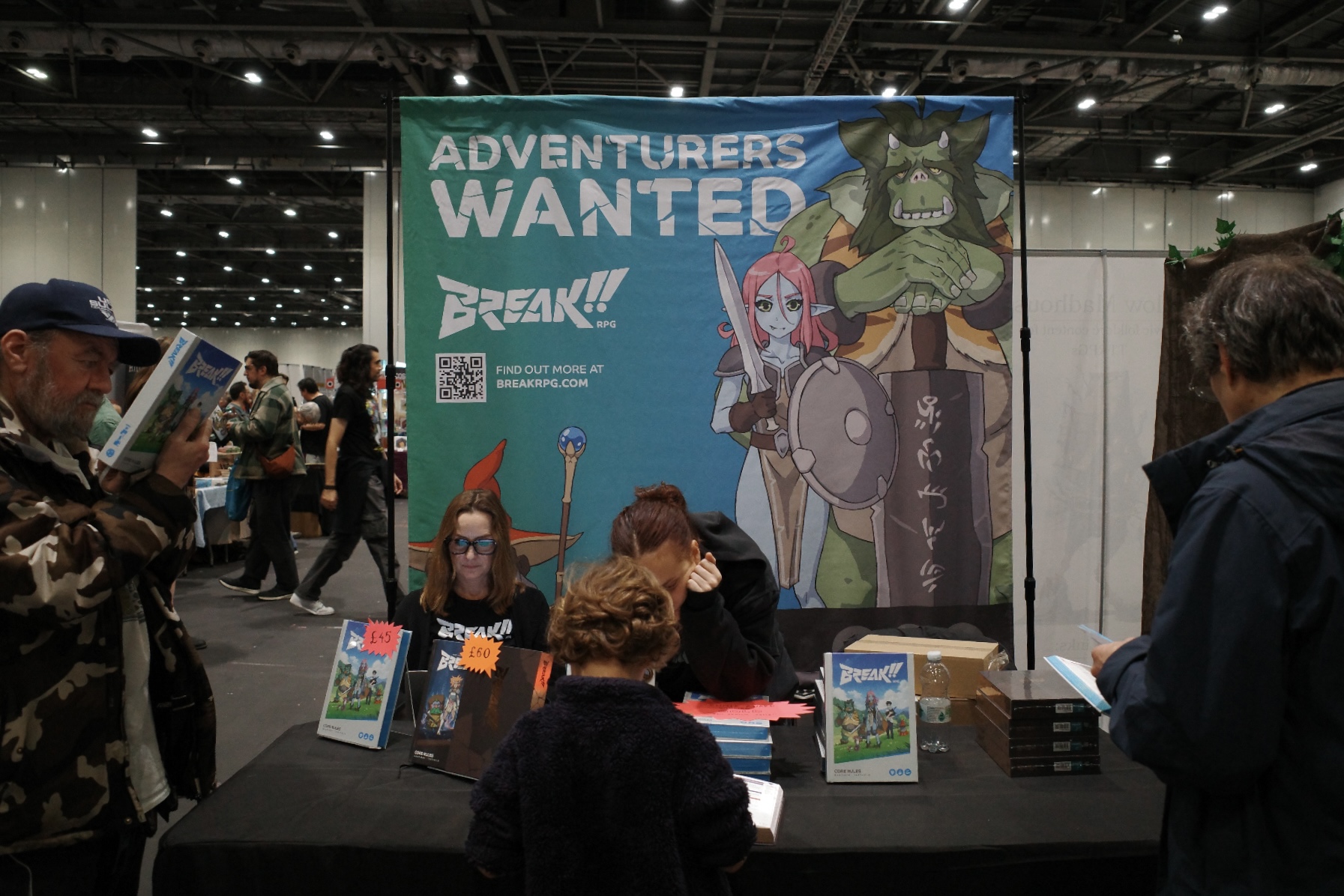
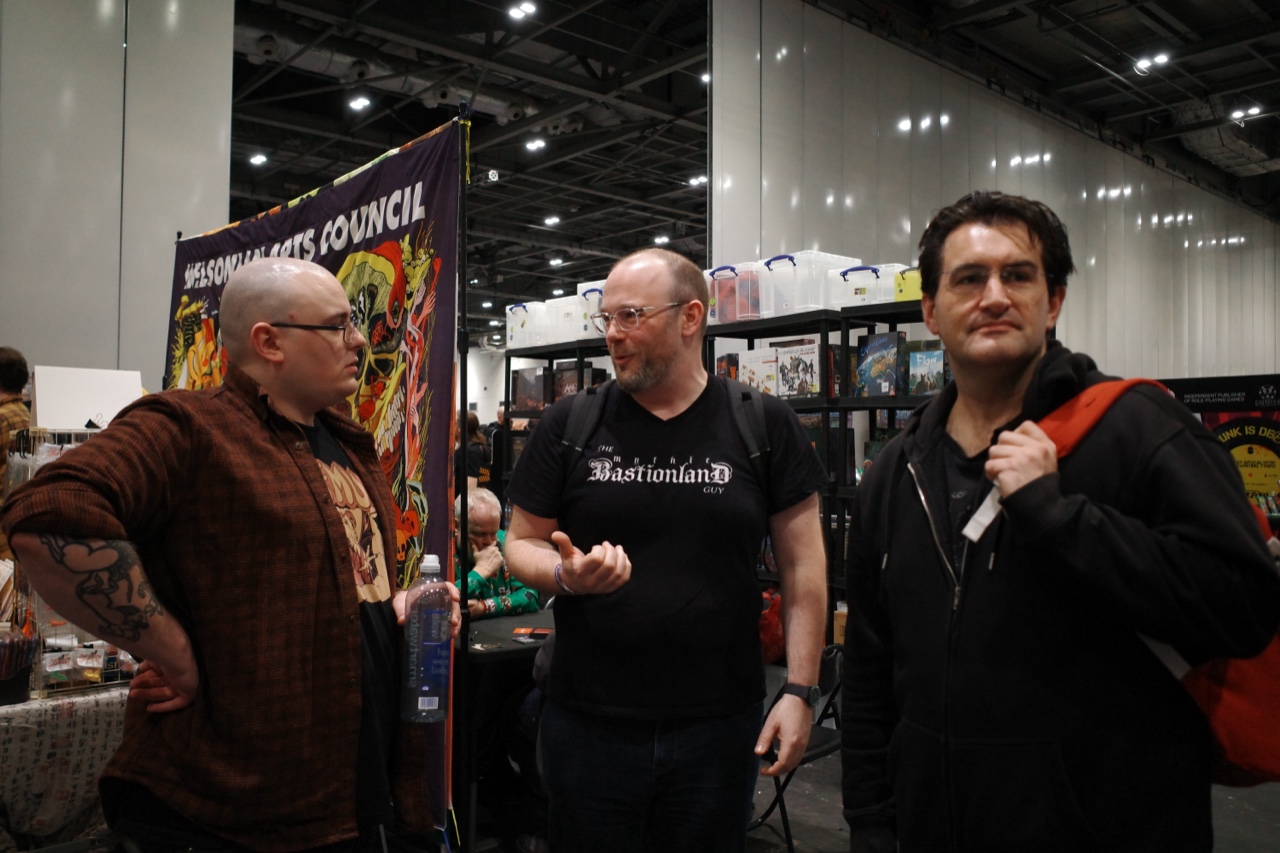
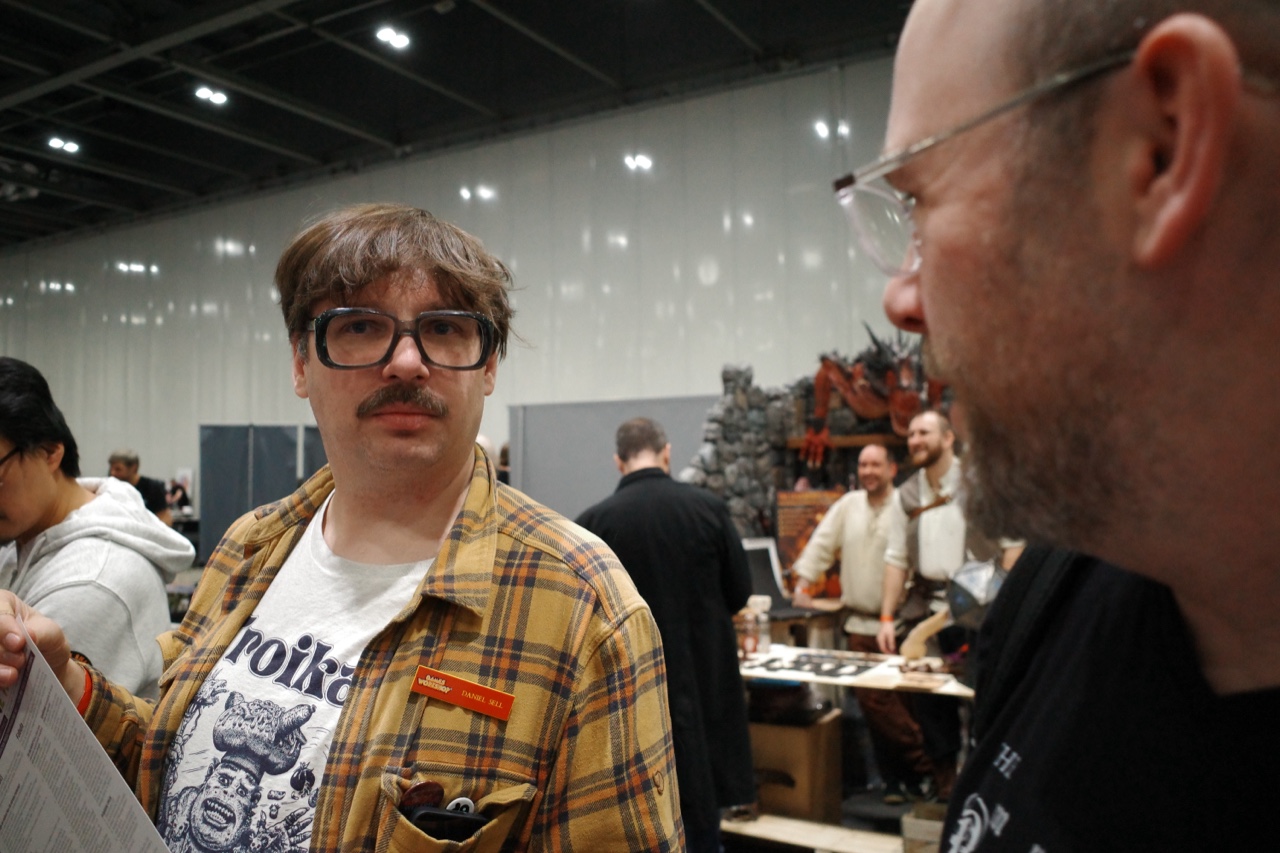
Dragonmeet has far more vendors that Breakout. Apparently it was twice as big as past years. They had two big rooms of the Excel centre filled with stands. The vast majority of vendors in attendance were indie. It was nice being able to wander around and see people I know in attendance. I was excited to finally meet the infamous Grey Wizard. Paolo and Eric were sharing space together, the first people I saw when I arrived. Just a little past them was Zach from Soul Muppet Games. I got to see their cowboy game in the flesh, and am now wondering I made the wrong call not grabbing a copy. The book was gigantic and looked cool. Daniel was working the Igloo Tree & Melsonia Arts Council, which was where I also finally met Luke Gearing. We discussed the whacky world of Over/Under.
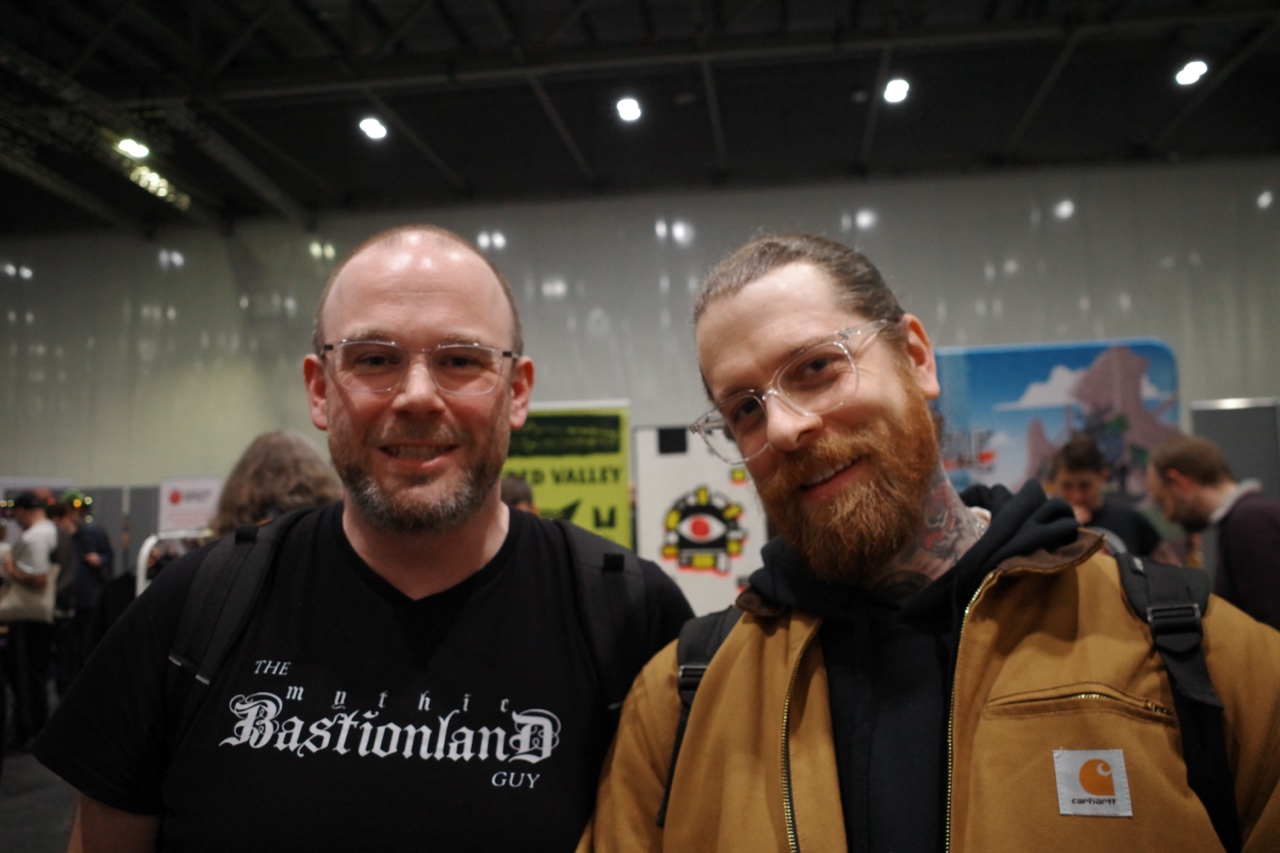
I was mostly hanging out with my Warhammer World posse of Chris and Patrick, wandering the convention with the two of them, watching people muscle Patrick out of the way to tell Chris Bastionland changed their lives. James Young was there with some of his gamer crew, and we would stop and chat whenever we saw him again. David Black arrived a little after lunch with his wife, and joined us for a short while. I stumbled upon Johan Nohr. Next to him was Chris Bissette! I saw so many people I’m already starting to forget them all. The whole convention was the fun experience of wandering a little bit and seeing someone you know.
Would love to come back for Dragonmeet again, certainly a good reason to find yourself in London. Salute in April is the other convention that seems exciting, and is conveniently in the Spring. Paolo’s LasagnaCon in August is probably the most tempting—if only for the food.
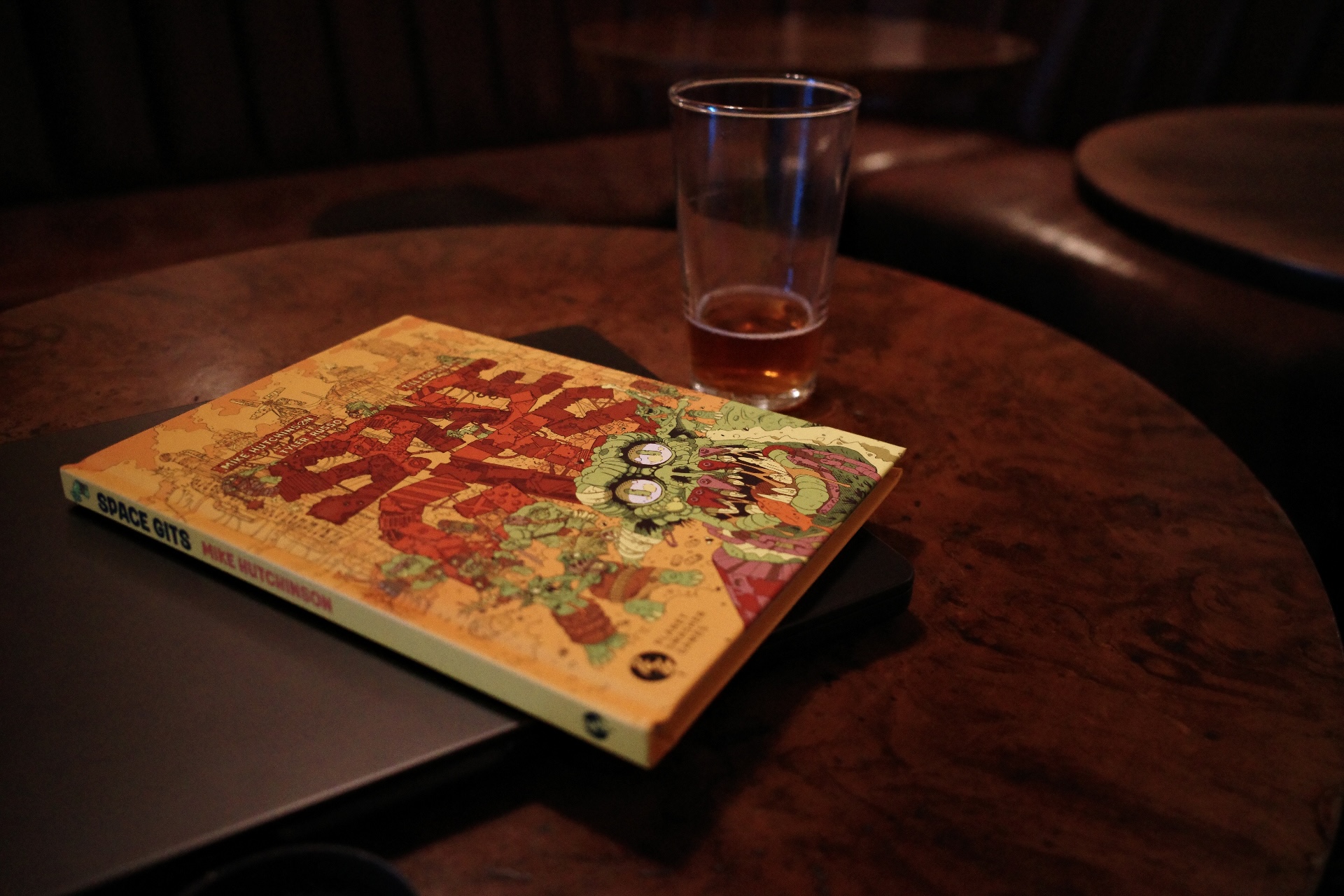
Space Gits an odd duck of a game by the man himself Mike Hutchinson. Mike asks the question, “can you model a game around drunk-ass orks being drunk asses?” I would have to say the answer is a resounding yes: this game is inspired.
Before we get to the game, let’s talk about the rule book. This was another book waiting for me in my brother’s flat. A small A5 hardcover I’ll be able to smuggle back to Canada with whatever I end up grabbing at Dragonmeet. Mike did the layout himself and it’s impressive. The book is neat and tidy, easy to read, but with lots of flourishes that give the impression of drunken ork messiness: crumpled paper backgrounds, edges and borders that are almost always some sort of torn paper effect, etc. The miniatures and their photography by Tyler Russo (Billion Dollar Clown Farm) are fantastic, as one would expect if you’ve seen his YouTube channel. He did a great job converting minis for this game. Till Förster’s illustrations complete the package. Absolutely frenetic art. I’m happy I grabbed the book.
Mike opens the rule book with a discussion about what he was going for with the game. He does something similar with Hobgoblin, though the discussion comes at the back. I suspect he appreciates his audience is likely a non-trivial number of indie gaming nerds who want to know how the sausage gets made. You can read the rest of the rule book with their goals in mind. Perhaps the clearest form of expectation setting. (I am reminded of Apocalypse World and its progeny that love to make the point of the game particularly explicit.)
Players take turn alternatively activating models. Each model can scoot, shoot or boot. The games central conceit is centred around dice moving dexterity. Your orks will build a tower of dice when they activate or take hits. When you move your orks around you must move their dice tower along with them. Knock over their tower, the ork has fallen on their ass and their activation ends. Opponents can steal bottle caps from fallen orks, the games currency and how you score to win. This is the boot action. Bottle caps are scattered over the board when you start the game. Scooting is how you move. It will involve dexterity as well, though more likely luck. You roll your orks movement dice into the play area. The ork will move the number of inches indicated on the dice, directly towards the dice. Movement neatly models the drunken meandering motion of the orks. If you bump into a bottle cap you will pick it up. If you bump into an orc you will fight. Shooting is a similar sort of action. You roll dice into the play area, and your ork will fire their gun in the direction of the dice, but this time the distance their bullets travel are dictated by the weapon they use. The die’s value needs to beat the target’s toughness to score a big hit, otherwise the target takes a weak hit. Hits cause an ork to gain more dice for their dice tower.
After 30 minutes to police show up to break up the party. Players create a siren dice pool that starts with 2 dice. Before players activate they’ll add a dice to the pool and roll all them all. If they roll triples the game ends immediately. (The game will certainly end after 13 activations, as it’s impossible not to roll a triple after that point.) You can pour yourself another beer and play again.
Space Gits is such a unique and unusual game. I can’t think of another skirmish game I own that attempts anything like this. I won’t pretend to have been interested in a dexterity based skirmish game, and likely wouldn’t have picked it up if not for the fact it was made by Mike Hutchinson. Everything he’s produced seems particularly interesting. I’ll need to write about Hobgoblin at some point. A game I’ve actually played! As it stands I was at a pub drinking an ale and reading this book, so this is the review you get.
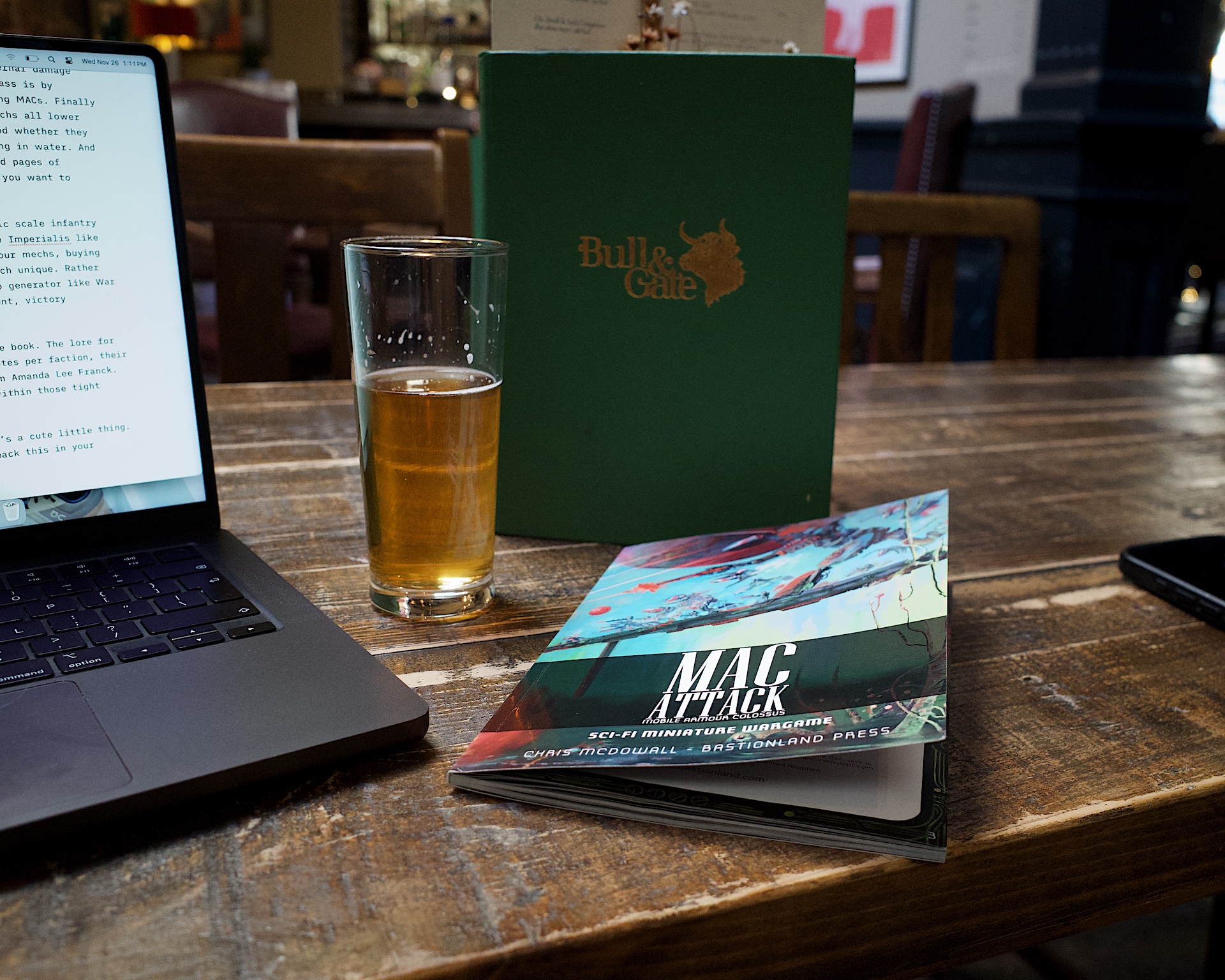
I mail a lot of books to my brother in the UK. There were a few books waiting for me when I arrived in London this morning. One of those books was Chris McDowall’s latest war-game, MAC ATTACK. This is a 6mm scale sci-fi war-game, essentially Chris’s take on the venerable mech game. These sorts of games are typically quite crunchy, so it’s interesting to see how Chris distills battling mechs to its true essence. I had expected the book to be bigger. It’s a cute little thing. An A5 perfect bound softcover. You can pack this in your backpack without breaking a sweat.
The rules for MAC ATTACK are captured over four pages that open the book. The first introduces some core concepts of the game, in particular motion and heat, two attributes of each mech. (Or should I say MAC? I won’t, but these things are called MACs.) Motion tracks the sort of movement the mech has made: faster movement makes you harder to hit, but also makes it harder for you to hit other mechs. Heat tracks how hot your mech is getting. If it hits 6 you overheat! The second page explains how battlefields and terrain work. The third and forth page are effectively the rules for the whole game. He’s done it again!
A turn in MAC ATTACK is broken up in to 4 phases. An initiative deck is created with each unit being assigned a card. Draw cards to see who gets to activate. During the move phase you’ll move your mechs, and in the process assign them their motion dice. Depending on the sort of movement action they take, they might gain some heat. The movement phase is followed by the attack phase. The initiative deck is shuffled and the players once again draw cards to see which unit will activate and fight. To fight you will roll a number of attack dice dictated by your mech’s weapon. The target number to be rolled on each dice is determined by summing both units motion dice. The roll can be modified if the target is crashed, in cover, or inside a building. A 1 is always a miss, a 6 is always a hit. Hits are assigned to the various modules that make a mech, which will destroy them over the course of the game. Hits that would hit a destroyed module instead cause internal damage to the mech. This feels like a pretty elegant combat system. Once all the mechs have had a chance to activate in the attack phase, you will destroy any mechs who have taken more internal damage than their class. You’ll learn what a mech’s class is by turning the page and reading the rules for making MACs. Dealing with damage in this way means you’ll never have your mechs blown off the board before they have a chance to cause some damage themselves. The turn closes with a cooldown phase. The mechs all lower their heat score based on their mech’s class, modified by whether they have radiator or coolant modules, or are sitting in water. And that is that! The book concludes with pages and pages of advanced rules, variant ways to play, etc, if you want to expand on this simple base.
The next few pages cover building your mechs, buying the weapons and hardware that will make each unique. There are several factions described in the book. The lore for the setting is basically a couple pull quotes per faction, their example units, and the (amazing) art from Amanda Lee Franck. It’s impressive how you can get across within those tight constraints. Like the Doomed, the expectation is you’re kit bashing your mechs, taking Battletech minis and mixing them with junk you have laying about your house. The game also has rules for taking your little epic scale infantry and tanks, perfect if you’ve picked up Legion Imperialis like myself.
Rather than bespoke scenarios, Chris has a scenario generator like War Cry, where you will generate your deployment, victory conditions (for each side) and a twist. You could use the generator, and the advanced rules at the back of the book, to come up with interesting narrative scenarios.
I’ll need to figure out the simplest way to get this game to the table. Maybe I can find some mechs in the used bins at the Sword and Board? Maybe I can use some Tyranids as Kaiju? I’ll have to report back once I’ve played the game. (It does have solo rules, so you don’t even have to play with any other dorks.) This is the first mech game I’ve read that feels compelling enough to play. Most feel way too fussy. I think that’s the mouth feel most people want with these sorts of games, but this feels like it might be a good compromise. You have a lot of granularity still, but seemingly without a lot of the complexity. Will have to play and see if that is how it all pans out.