I created Osrik, an (Essentials) dwarf paladin, to play at D&D Encounters this week after the untimely death of my deep gnome cleric Gretzlyn. I was thinking this Paladin would on the tail of his friend the cleric. I won’t get a chance to flesh out his story, because I managed to kill this character as well. Two deaths in two weeks? For shame.
I’m enjoying D&D Encounters, but the last couple battles have been hard. I don’t have any of the D&D Essentials books, so I also don’t understand what’s up with the Essentials versions of the characters I’m playing. The cleric couldn’t turn undead, or do half the things I thought clerics were all about. The paladin couldn’t heal. At all. What kind of paladin can’t do a Lay on Hands?
All is not lost. I have a felling a Kobold Warlock is going to wander into this mess and start doing some avenging. And I know how to play a warlock. In theory, anyway.
My first gaming session using the D&D Next rules was also my first gaming session playing virtually. Rebecca, of Dungeons and Donuts fame, mentioned on Google+ she was planning on running a play test of D&D next online. I was expecting a quiet night at home anyway, why not try and cram in a game of D&D?
I had written off Google+ a while ago, but people more imaginative than myself saw the possibilities the Hangout feature opened up in terms of tabletop gaming online. Skype has supported multi-user video chat for some time now, but it’s a feature you need to pay for. Google+ hangouts are free, and the social network side of Google+ makes it easier to connect with other gamers. D&D is basically collaborative storytelling, so multiuser chat is really all you need to get going. The video helps stop people from talking over each other, since you have those visual cues, and gives you the ability to share images when needed. This has probably played some part in Google+ becoming a wild success in the D&D community.
I wasn’t sure what to expect with an online game. Though the stereotype of a D&D nerd is probably someone antisocial, the game itself is a social activity. It’s all about human interaction. I wasn’t convinced that side of the game would translate well if you weren’t sitting next to the people you were playing with. D&D is also inherently silly. In a game you might be pretending to be a Half-Orc Wizard or some other nonsense: it takes a certain level of comfort to do that with strangers.
My concerns were unfounded. I had a lot of fun playing online. I don’t think it beats playing in person, but the play experience is still pretty damn good. It certainly beats not playing at all, which is the alternative for me more often than not. My friends and I play our 4th edition campaign incredibly infrequently. I think playing online might be able to help us play for often. Video chat is a good enough approximation of sitting next to someone, at least in this case.
Beyond the social side of things, managing the mechanical side of the game was also painless. D&D Next is similar in style to older editions of D&D in that combat can be run without tracking precisely where everyone is. Not having to move minis around a board got rid of one possible impediment to the online experience. In our game we also rolled our own dice and announced the results. Assuming you aren’t playing with dirty liars, this works well.1
The best example of what you can do with video chat and D&D nerds is ConstantCon. Someone posts that they are going to host a game online, and other people can sign up to play. By the looks of it you should always be able to find a game of D&D whenever you want to play. Rebecca runs a game of D&D Encounters using Google+ once a week as well. She’s an excellent DM, so I would definitely try and scam your way into one of his games.
Ultimately what made the night fun was that the actual adventure was a lot of fun.2 By the end of the night the adventuring party consisted of: Pickles the horse, two dwarves, an elf, a halfing, a robot cleric of Pelor, and a (demon?) baby called Hope. That’s what i’m talking about!
There are tools available to aid with running more precise combat, and for online dice rolling: Tabletop Forge and roll20. ↩︎
Barrowmaze II is the second part of a two-part exploration-style megadungeon for Labyrinth Lord and other classic fantasy role-playing games. BMII is a continuation of the initial “dungeon sprawl” concept presented in Barrowmaze I (BMI) and is intended for mid-and-high level characters.
I own the PDF of the original dungeon. It’s a pretty creative take on megadungeons. Instead of having multiple levels, each more challenging then the previous one, Barrowmaze is basically a giant sprawling mess of rooms. The further you get from the entrances into the dungeon, the harder the encounters get. Barrowmaze is a crypt, and the room descriptions really play this side of its origin story up. For example, there are lots of sealed up tombs PCs can excavate in search of treasure at the risk of alert monsters to their presence.
Barrowmaze was created by fellow Canadian Greg Gillespie, who runs the blog Discourse & Dragons.
Today is the last day of the BarrowmazeI II funding campaign. It has already reached its funding goals, so its going to be available for purchase sometime in the future, even if you don’t have the funs to support the project right now. There are some nice perks for backers of the project, so if Barrowmaze II is something you think you’ll buy in the future now is the time to act.
Wizards of the Coast have spent the past few months hyping up their plans for the 5th edition of D&D, something they have been calling D&D Next. They announced a public play test, which I signed up for, a couple weeks ago. The first batch of rules were released to the public to read over, play, provide feedback on.
The new rules are a pretty refreshing change from the 4th edition rule books. The “how to play” booklet is incredibly short. Everything you need to know to play the game fits on 25 pages and a handful of pre-generated character sheets. (The current play test rules don’t include anything about character generation, so I imagine the actual rules will be a little bit longer.) The character sheets are amazing because they are all 1-2 pages long and include almost everything you need to know about your character. To contrast, the character sheet for the first level character I play in D&D Encounters is 5 pages long.
D&D Next is a much simpler game than its predecessors. It takes the D20 rules from 3rd and 4th edition and strips them down even more. Saving throws are now done using your ability scores. (For example, Save vs. Magic is now an intelligence check.) Similarly there aren’t separate list of skills or proficiencies to manage. The only stat blocks on the character sheets are your six ability scores, HP, and AC. It feels nice and light. There is much less to explain to a new player, and much less to look up.
The plethora of modifier bonuses found in previous editions of the game have been replaced by a simpler advantage/disadvantage system. Instead of getting bonuses stacked on top of bonuses, you either end up being in an advantageous situation or a disadvantageous situation. When this happens you roll two D20 dice when performing an action, and take the higher roll in the case of an advantage, and the lower roll in the case of a disadvantage. In play I felt it worked quite well, and it’s an easy system to teach and understand.
D&D Next, at least in this initial ruleset, feels like a good mix both old and new D&D. There are still (optional) feats and powers and junk like that, but it’s been toned down a lot. For the most part I think the game feels very old-school. Combat is reasonably quick to resolve and fairly free form. The DM was rolling for random encounters, something you’d probably never want to do in 4th edition. The play test I participated in1 was run without miniatures. I think that makes a huge difference in how quickly combat plays out.
D&D Next is looking quite promising. If I have any gripes it is that the player characters felt a bit overpowered. Original D&D has very weak starting characters, while 4th edition has fairly powerful starting characters. Figuring out a way to balance between both extremes will be tricky.
I know a lot of people have written Wizards of the Coast off, but it’s clear they still have some ideas to share.
My first game of D&D Next was also my first game playing online. A DM I met at Duelling Grounds ran a game online using Google+. Playing online actually worked surprisingly well. ↩︎
Lamentations of the Flame Princess: Weird Fantasy Roleplaying is a roleplaying game by James Raggi. (The game will be referred to as LotFP hence forth, because Lamentations of the Flame Princess: Weird Fantasy Roleplaying is a lot to type, and that seems to be the acronym of choice on the Internet.) The Grindhouse Edition boxset collects: the rulebook for LotFP, a book for dungeon masters on how best to run the game, and a tutorial book for players and dungeon masters about role playing games in general. The boxset also includes some (tiny) dice and some very well designed character sheets. If you bought this boxset you would have everything you need to play the game, you’d just need to find some players.
The boxset is (surprisingly) small. (It’s smaller than your typical hardback novel.) The three books within are all A5 in size, half as big as your typical 8x11 D&D book. Because they are perfect bound softcovers they feel even smaller. Unlike your usual gaming product these books are ideally suited for use while playing: they take up next to no space, they are light, and they are easy to flip through. The rulebook actually has a bunch of important tables for the game right on its back cover, so even while closed it serves a useful purpose.
I do have two small complaints about the books as objects: the three books are quite nice, but I think they would have been nicer with thicker covers and softer paper; the title font, while appropriate for the contents of the book, is a bit hard read. It’s a very nice boxset, but after seeing Carcosa I can imagine a future edition of the rules that will truly be epic.
The first book in the boxset is the Tutorial book. It begins with a discussion of what a role-playing game is and what the deal is with all the funky dice. It then proceeds to a sample adventure that steps through some of the the mechanics of the game. The adventure also sets the tone for LotFP: it’s dark, creepy, and full of death. This is then followed by a choose-your-own adventure game that walks you through even more of the game’s mechanics. The second adventure is a sequel to the first: it’s your very first LotFP campaign!
After the adventures Raggi discusses RPGs in more detail. There is some exposition on how role-playing games work, in a most general sense. There is a lot of discussion that ultimately boils down to a look at the relationships between players and their characters, and players and the dungeon master. It’s a short section of the book, but I think it manages to convey a lot about the sort of role-playing games Raggi feels are most effective. More than anything this section seems to be about letting players and DMs know that they shouldn’t play like assholes.
Finally we get to an example of a group playing LotFP. These sorts of dialogues are found in most role-playing games books, and they usually preset a far too idealized example of play. The example presented here works well because it’s funny, and is a pretty accurate look at what a role-playing game is like. There is petty squabbling, people complaining about dice rolls, people being inattentive, people forgetting the rules, etc, etc.
The books ends with an Appendix N of sorts. There are a series of essays on a few authors that Raggi felt best exemplify “Weird Fantasy”. I thought the essays were interesting, presenting a little bit of background on each author, pointing out what makes them important to the genre, and also suggesting good first books to look into.
The Tutorial book is pretty great. The whole tone of the book is really friendly and positive. This book, like the others in the set, features some pretty explicit art work. This makes for an interesting juxtaposition with the text. I don’t think the artwork in the Tutorial book is nearly as gruesome as the stuff found in the Rules and Magic book, but it almost feels more gruesome because it’s sandwiched between feel good advice about having fun with your friends. The Tutorial book almost seems out of place in a boxset such as this. I can’t imagine anyone buying this game who isn’t already intimately familiar with Dungeons and Dragons. That said, i’m really glad Raggi thought to write it. It makes the Grindhouse Edition boxset a surprisingly good introduction to roleplaying games.
The Rules and Magic book is the meat of the boxset. The two sections of this book contain what you actually need to know in order to play a game of LotFP.
LotFP is basically a simplified (and extended) version of the rules found in the original Dungeons and Dragons books. It’s certainly not a retroclone, but it’s also not a big departure from the system it’s clearly built upon. You have your usual six ability scores, you have saving throws tables, you have armour classes and hit points and all of the minutia that makes up D&D.
I haven’t played old-school D&D in a very long time, so I really can’t pick out every rule change that Raggi has made. The most obvious would probably be the change to the rogue class, called the specialist in LotFP. The common thief skill checks from D&D, and a few additional skills new to LotFP, are decided by rolling a D6. For most characters there is a 1 in 6 chance for success. Specialists can spend points that they earn every time they gain a level to improve their odds. The specialist is a much more broad character than your typical D&D thief.
There are other more subtle changes throughout the rest of the rules that I noticed. The only one worth pointing out is that AC is ascending: just the way it god damn should be.
The magic portion of the book outlines the various spells the cleric and magic user classes can use in a LotFP campaign. There is a mix of your typical D&D spells, like magic missile, along with all sorts of new stuff. The changes here seem to add to the tone of a LotFP game. For example, you can summon a crazy-ass demon you probably won’t be able to control as a 1st level magic user. What? Magic in LotFP is dangerous and probably a little bit evil. The spell lists help reinforce that.
The last book in the boxset is the Referee book, LotFP’s Dungeon Masters Guide. It similar in tone and style to the Tutorial book. James Raggi is preaching to the reader about what it means to be a dungeon master, and what makes for an enjoyable and successful role-playing game. The book is full of advice for the rookie DM.
Beyond the advice, the book also focuses on explaining what makes a fantasy game ‘weird’. There is no bestiary in the boxset.2 Instead, there is a discussion about how monsters should be as unique as possible, and that their use in your game should be kept to a minimum to highlight the fact that monsters are in fact pretty strange. Similarly, there are no long lists of magic items. In an LotFP game there should be no such thing as a generic magic +1 sword. Besides being boring, items like that take away from the mystique that surrounds magic. (More so, who are these wizards churning out +1 swords?) Magic is a dangerous thing. A magic item should be a creepy-ass artifact, not some Vorpal sword.
One thing I liked about the book is that it acknowledges that there are other RPGs out there. There is a section of the book that looks at how you can incorporate material from other games into an LotFP game. The book explains possible rules changes that a DM might need to make when using material from other books, or when using LotFP material within the ruleset of another game. (There’s also a short table to help convert between the slightly different AC rules everyone seems to use.) This section ends with a shout out to some indie game publishers putting out old school D&D modules that would work well with LotFP.
The referee book closes with a short adventure, A Stranger Storm. This boxset really does include everything you need to start playing a game. The Referree book rounds out the boxset nicely.
I would be remiss not to mention the artwork in the Grindhouse Edition. It is probably what has earned LotFP the most notoriety. The art is amazing and unique, but also particularly violent and explicit. I never thought I’d see a dudes schlong in a RPG rule book, but here we are.
The books are all in black and white, so for the most part the artwork is black and white illustrations, sort of reminiscent of the stuff you’d find in old D&D books, but much more dark and twisted. The rules and magic book has a few pieces of colour art work separating the two sections of that book. My favourite piece of art in the book appears here: a medusa has just turned a man who was in the middle of enjoying himself with her into stone; throughout the rest of the room you can see other petrified men, clearly frozen in the middle of some sexual act. Another piece that’s pretty great is a woman whose fingers and a leg have been melted off by some sort of ooze. I have heard Raggi on a podcast talking about how he felt the art work presents a more realistic look at the life of an adventurer. If you go spelunking in dungeons filled with monsters and traps that story is probably going to end kind of bloody. Another theme of LotFP is that the players aren’t playing superheroes. The art with all the death and maiming really reinforces this.
To properly appreciate a game you really need to play it. Hopefully i’ll get a chance to do just that soon, and can then provide a fuller review of the game. Putting that aside, I have no qualms with recommending the Grindhouse Edition to anyone looking for a simple old-school D&D role-playing game system.
Expect blog posts on Carcosa and Vornheim in the coming weeks. ↩︎
When someone makes fun of me for playing D&D I now know that makes then a bit of an asshole. Different people have fun in different ways. A lot of people find different things fun. Most people I interact with nowadays don’t care one way or the other that I play D&D: this is because I’m an adult who now interacts primarily with other adults. Most adults are mature about these sorts of things. The only people I encounter nowadays who mock this outlet for fun are in fact other gamers.
I’ve played every other edition of D&D: original D&D as a kid, 2nd edition as a high school student, and now 4th edition as an adult. Did you know that if you are playing 4th edition you are doing it wrong? I didn’t either till I took to the internet–always a mistake.
For my friends and I 4th edition was the success Wizards of the Coast was probably hoping for: it got a few of old school gamers playing Dungeons and Dragons again. I don’t think any of us had really paid much attention to the game in well over a decade. It’s certainly quite different than the previous editions I’ve played, but having missed 3rd edition I thought many of the rule changes were mana from heaven. (No more negative AC! Even when I was 12 that seemed like a stupid idea.)1
After playing 4th edition for a while I was pretty delighted to discover the community that surrounds old school D&D. There are lots of great articles, books, and modules being put out by an engaged group of people. I’d argue the most interesting stuff happening with hobby right now is a result of the old-school renaissance and all the indie and DIY publishing that surrounds it.
With the noise from Wizards of the Coast around D&D Next I now get to witness the arguments and complaints I wasn’t privy to when 4th edition was first released. It takes real energy to get angry over a game you don’t play, and aren’t interested in playing in the future. People can get defensive about their hobbies. For some I suspect enjoying the game they are playing takes a back seat to justifying to others why it’s the one to play. Those sorts of arguments can be interesting, but it takes a level of effort and maturity that doesn’t seem to come across in much of what I read about 4th edition and D&D next on some of my favourite OSR blogs.
In many ways hardcore D&D fans remind me of hardcore indie music fans. Reading responses to D&D Next reminds me of reading reviews in Pitchfork. Both groups fandom is so transcendent it can only be expressed by hating all music, in the case of hardcore indie music fans, and all tabletop gaming, in the case of your hardcore D&D fan.
There is enough room in this hobby to accommodate everyone and the wide variety of things that draw them to the game. Rule 0 in role playing games is that the DM is always right. I would suggest a Rule 0’: don’t be an asshole.
I don’t think 4th edition is perfect by any stretch of the imagination, but those thoughts will have to wait for another post. ↩︎
At the Battle of Marignano, Swiss pikemen actually fought Landsknecht mercenaries. Because it was impossible for either side to lose, THE BATTLE IS STILL GOING ON.
It’s interesting to look at the evolution of D&D from its war gaming roots. Each successive iteration of the game seems to lose a little bit more of the book keeping.
At today’s D&D Encounters session my poor cleric Gretzyln was vanquished by those most evil of elves, the Drow. He was supposed to be a hardboiled deep gnome ex-dungeoneer turned fanatical cleric of Pelor, the sun god. I thought it was a cute idea: a guy who spends his whole life living underground leaves that life behind to worship the sun.
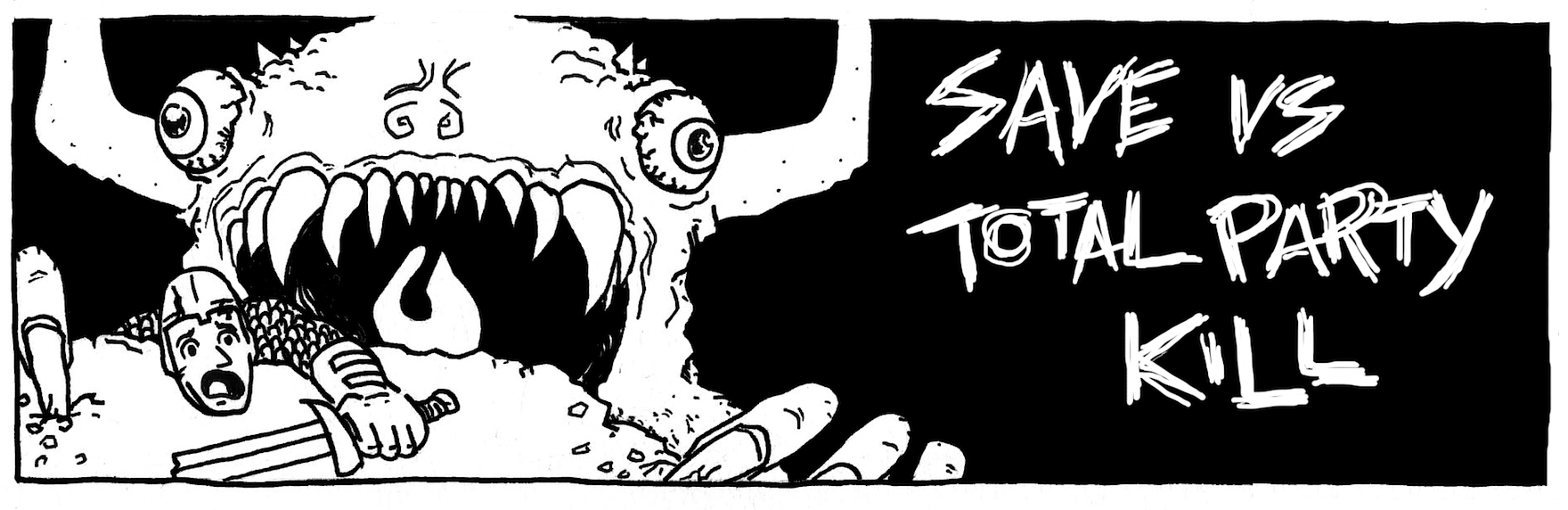
Gretzyln was not alone in his fate: it was a total party kill. I didn’t think this blog would earn its name so quickly.
There were 5 people playing at session today: two wizards, an avenger, a vampire, and my cleric. It’s probably not an ideal mix for a party, but that’s always a possibility when you play in these sorts of pickup games. I didn’t think it was particularly out of whack. We were facing off against some sort of Drow necromancer, her henchmen, and some skeletons she animated during the course of the fight.
I’m not completely sure what went wrong. The monsters were all higher up in the initiative order then us, so we did spend a lot of time reacting to them rather than getting out there and messing them up. I had to heal two of our party members (back from death’s door) very early on in the encounter. The skeletons, though there were a lot of them, never really gave us any trouble. Our wizards were well suited to deal with them. We probably could have done a better job trying to avoid the Drow and all their ranged attacks, but I didn’t feel like we were ceding that much of the fight to them. Then our DM started rolling like a man of fire, and our attempt to chase down the Drow and finish them off ended in ruin.
Dungeon’s Master has a more detailed write up of the week 3 encounter. In the game he DM’d the party of 6 players defeated the Drow, but barely survived. That DM is a player in my game, and he mentions our defeat at the bottom of the post. He felt our lack of ranged attacks and a defender were the two biggest obstacles we failed to overcome.
Still, it was fun. And all is not lost. No doubt next week another of Pelor’s followers will wind up chasing down some Drow to avenge their old friend and companion, that foolish cleric Gretzyln.
I played in my first D&D encounters session last week. These are pickup games run by people at your local games or comic book shop, using episodic adventures published by Wizards of the Coast. Each adventure runs for 12 or so weeks. Wizards of the Coast set up the Encounters program to introduce new gamers to D&D, and to get people who might have stopped playing back into D&D. It’s been going on for a few years now, so I’m going to assume Wizards has decided it is a success.
The Encounters adventures usually tie into the current set of books Wizards is pushing. The adventure I am playing in is about The Underdark and the Drow. Conveniently there are a couple books about these very things out right now.
It’s been an interesting experience participating in the games. The groups are a strange mix of people. At my local gaming store there are a bunch of little children and a bunch of adults. They split the two groups up for the most part, though both games I’ve played in have included kids. The first game included a quiet girl who I assume was the daughter of one of the other players, while the second game included a boy who was full on into D&D. (He played a Thri-kreen whose family’s knees were all broken by raiders when he was young, so now he is evil and goes around destroying other people’s knees: seriously.) Kids are the best. (Though I suspect playing with a whole table of them would be tiring.)
One of the dungeon masters from Dungeons Master is a player in the game I participate in. He has write ups for the game he runs at another gaming storing in the city, if you’re curious about the specifics of the adventures and how they play out. I’ve enjoyed both games I’ve played in thus far.
Encounters really distils 4th Edition down to its core. So far there has been a little bit of role playing followed up with some full on tactical combat. I suspect depending on the group you play with you’d end up with a different experience week to week. The great thing about D&D is that everyone can approach the same situation very differently. When I read about other Encounters sessions they are nothing like my own.
If you are looking to satiate your urge to play role-playing games D&D Encounters is certainly worth a look. (You can even play online!)
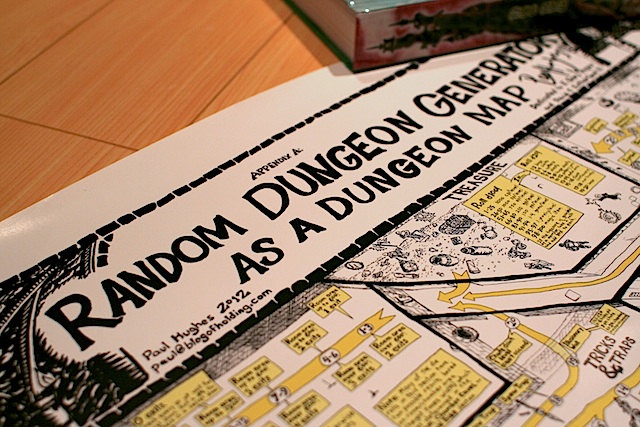
The Random Dungeon Generator as a Dungeon Map by Paul Hughes was the first D&D product I backed on Kickstarter. It’s really through this project that I ended up discovering the community that surrounds old-school D&D. I have since spent far more than I ever thought I would on other D&D crowd funded projects. There is something so earnest about these projects I just can’t resist.
The poster arrived today and it looks really great. It’s massive, so I’m not sure how well it would actually function as a game aid, but as a piece of art is is definitely cool. I really need to frame it so my wife tell me I can’t hang it up on our walls.