The Reward
by Ramanan Sivaranjan on January 25, 2013
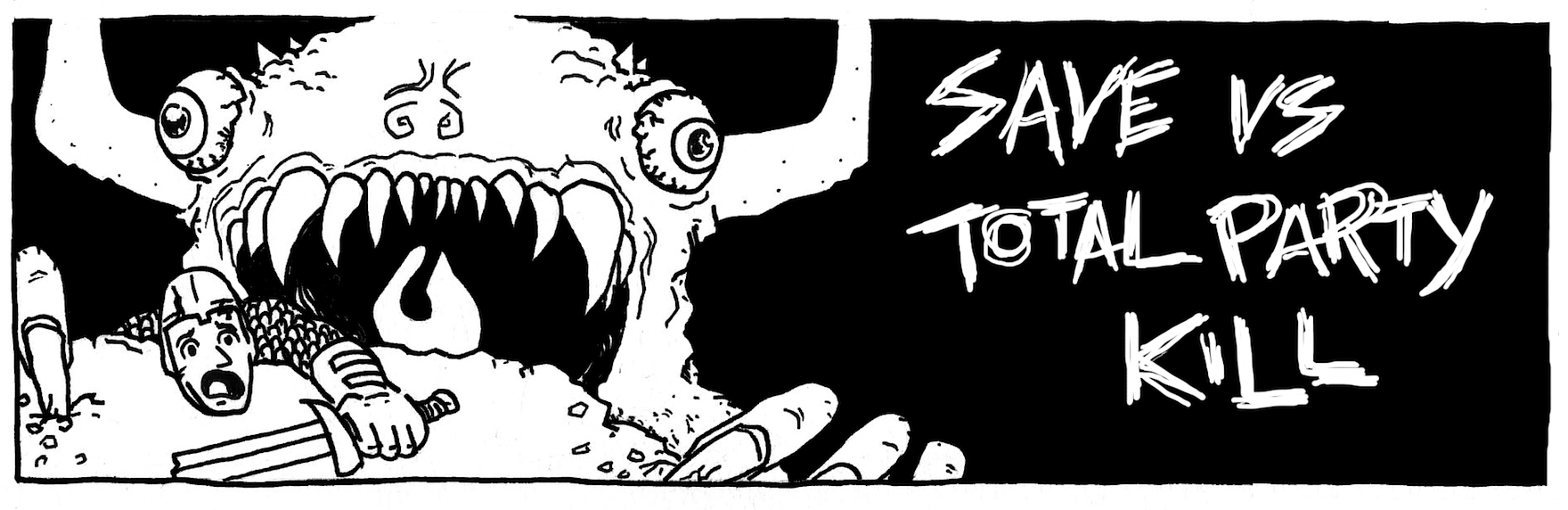
This short–a Bachelor film project from The Animation Workshop, Viborg, Denmark–is amazing. It’s 120% D&D.
by Ramanan Sivaranjan on January 25, 2013
This short–a Bachelor film project from The Animation Workshop, Viborg, Denmark–is amazing. It’s 120% D&D.
by Ramanan Sivaranjan on January 24, 2013
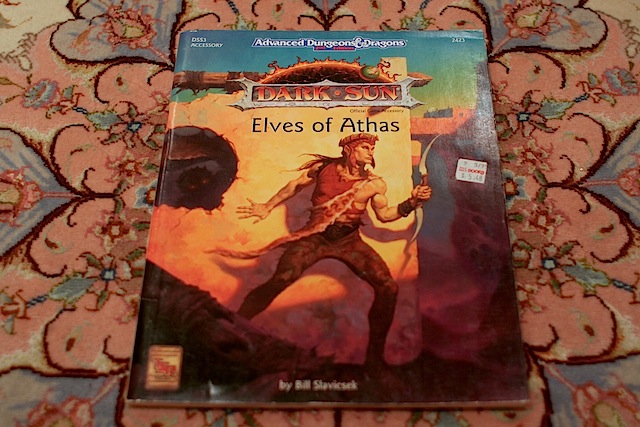
Elves of Athas is an early supplement for the AD&D 2nd Edition setting Dark Sun. The book pulls in details from the Troy Denning Dark Sun novels to present a fuller picture of what makes Elves different on Athas from those found in other typical fantasy campaigns. Most of the book is what people refer to as fluff: setting description and flourish. As such it can be used with a variety of rule sets beyond 2nd Edition.
The first half of the book is about Elf culture, physiology, miscellaneous new rules, and minutia. This part of the book fleshes out a lot of what was already said in the Dark Sun box set. I didn’t think it was that interesting on the whole. It’s probably more useful for people who haven’t read any of the Dark Sun novels.
I found the later half of the book more compelling: it describes various Elf Tribes found on Athas. The tribes are described in a good amount of detail: what their motivations are, their history and current situation, how they treat outsiders, who their allies and enemies are, what regions of Athas they live in, and finally some important NPC. This section is all plot hooks and adventure seeds. It also makes for a good example of how to describe a faction in your game world, though for your own game you probably aren’t trying to hit page count goals and could be more terse in your presentation.
Unlike many of the Dark Sun books, there is no art by Tom Baxa to be found in this book. The interior art for Elves of Athas was done by Tony DiTerlizzi, who would go on to illustrate Planescape. The art work is quite good, but also feels quite different from the coarse line art of Baxa and Brom. My copy of the book was bought used, so it was sadly missing the poster map featuring some DiTerlizzi that was supposed to come with the book.
As supplements go I thought this book was pretty good. Like most TSR splat books, it uses more words than it needs to in order to make its points, but there is still a lot of fun stuff for DM and players here.
by Ramanan Sivaranjan on January 21, 2013
Tagged: 4e encounters
I would be remiss not to touch on the last season of D&D encounters, as it felt like a vast improvement over the previous two seasons I have participated in. You may recall my previous complaints about D&D Encounters and its overemphasis on combat. This season tried hard to showcase the other aspects of D&D. There was a lot going on each session.
This adventure in this season of D&D Encounters was reminiscent of the sorts of adventures you would see during the hey day of 2nd Edition AD&D. The story is as follows: there is some crazy evil magic turning the sky black in the Forgotten Realm; the PCs are travel all over the realms collecting artifacts, seeking allies, and doing the sorts of things one does in an epic fantasy adventure; things conclude with a crazy boss-fight. The adventure was still ultimately a rail-road, as each weekly session needed to lead into the next, but each individual session was also a lot more free-form. At the store I play at we often have 2-3 tables playing, and each week the path through the adventure would vary greatly between tables. In the previous D&D seasons the only variety came from how the different groups approached combat. The big win this season was that each session featured a lot more to do beyond fighting monsters.
Ameron from Dungeon’s Master has an extensive write up about what he liked and didn’t like from the last season. I’m curious to hear more from fans of 4th Edition about how they found the changes made to Encounters this season.
I’m looking forward to what they do in the next season of D&D Encounters. The teaser for the adventure sounds like just my sort of thing:
This D&D Encounters season takes inspiration from classics such as Village of Hommlet and Against the Cult of the Reptile God. Not only does this new story feature characters and locations from beloved past adventures, but there’s another compelling reason to participate.
Players will be able to choose to play using the D&D Next rules or the 4th Edition rules. I’m hoping there is enough interest at the Silver Snail—where I play—to try out the new edition.
by Ramanan Sivaranjan on January 15, 2013
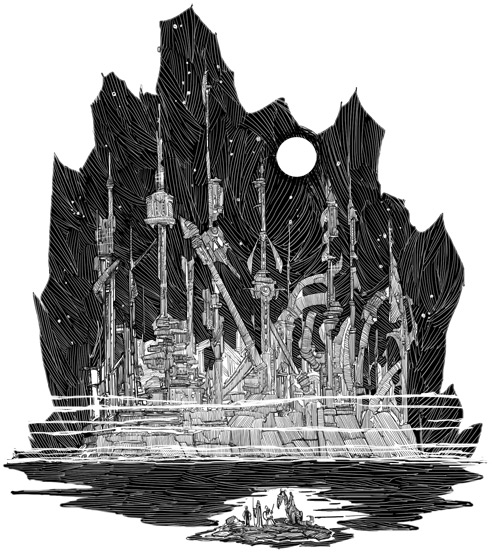
I quite liked Carcosa by Geoffrey McKinney. I enjoyed it so much I wrote a very long review of the book split over several blog posts. To make sharing the review with other people easier I’ve collected links to each blog post below:
I followed that up with a discussion of the book after using it to run my OD&D campaign set in Carcosa: Carcosa Review Reprise.
If you aren’t interested in reading all of that noise just go buy the book already. There isn’t anything else quite like it.
#
15
January
2013
I am moving all the discussion on this site over to Google+. As it stands most of the discussion that takes place about my posts happens there anyway, and it’s also where I go to read about and discuss D&D. If you aren’t on Google+ you might be surprised to learn it has a very active RPG community. I had thought Google+ to be a ghost town in the world of social media until stumbling upon all these people who use it to run games online and discuss table-top gaming. If you are on Google+ please add me and i’ll include you in my RPG circle.
Update: Google fucking killed G+. God damn it.
by Ramanan Sivaranjan on January 14, 2013
Tagged: dndnext
This post from Mike Mearls has me once again quite excited about D&D Next. The recent play test packets for D&D Next have struck me as overly complicated, and I had thought maybe the game would move in a direction I wasn’t too keen on. I quite enjoyed the early play test rules for their simplicity. Those rules were easy to grasp, with the game mechanics really stripped down to a minimum. The more recent play test packets have added more rules to the game and a lot of extra complexity.
One thing I dislike about 4th Edition is the amount of stuff a new player needs to know right from the get go. A 1st level character in 4th Edition has lots of powers and needs to understand fairly complicated rules about how combat works. Character creation is a very slow process, so complicated you really need to use an online tool to create characters. This all makes teaching someone how to play D&D using the 4th Edition rules a pain. It was starting to look like D&D Next was moving in this direction.
Mearl’s makes it sound like one of the goals for D&D Next is to have a basic version of the game that’s stripped down and simple to understand and play. What he’s describing sounds pretty great to me, and much more inline with what we saw in the initial play test rules. In terms of past rule sets, it sounds like they are hoping to put out something similar to Basic / Expert D&D from the 80s. That’s what i’m talking about.
by Ramanan Sivaranjan on January 12, 2013
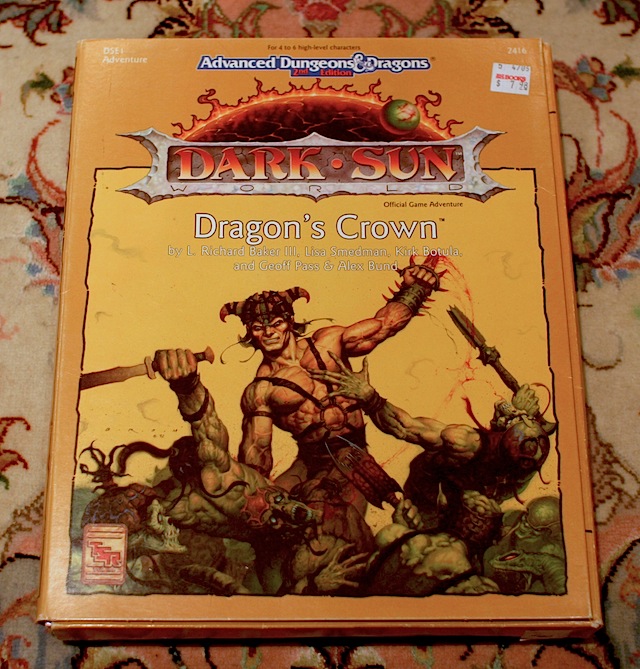
Over the holidays I decided to pick up some Dark Sun books I missed out in my youth: Elves of Athas, Dune Trader, and the adventure Dragon’s Crown.
I remember wanting Dragon’s Crown when it was announced by TSR oh so many years ago. It was probably the last piece of D&D I lusted after before I stopped playing the game. There were ads announcing its arrival in Dragon magazine and in the back of some of my other Dark Sun books. I’m guessing I didn’t buy it for one of the following reasons: it wasn’t stocked by Ron’s Comic Shop, my source for D&D in the 90s; it was too expensive; or I had stopped playing by the time it came out. The fact I probably didn’t need a high level adventure for a Dark Sun campaign I wasn’t actually running would have never entered into the equation.
Dragon’s Crown is a high-level epic adventure set in Athas. It involves psionics, sorcerer-kings, secret orders and other nonsense, and is exactly the sort of crazy boxed set adventure you could expect from mid-90s TSR. It’s actually made up of 7 interconnected mini-adventures. There is an 8th adventure that is full of little encounters you can intersperse throughout the series.
It’s interesting looking at an adventure like Dragon’s Crown after buying and reading so many “old-school” modules. Dragon’s Crown expects things to play out in a certain way, and there is a fair amount of exposition on what to do if your players try to get off the rails. Still, there are lots of maps and set pieces: I feel like you could use a lot of the adventure in a giant sandbox game.
You can get used copes of Dragon’s Crown for $20-$40 dollars by the looks of things, depending on what condition you want your copy to arrive in. When I was 14 that was some serious walking around money. Now? Not so much. It’s a shame I don’t have the spare time I did when I was 14 now.
#
23
December
2012
Update 2012-12-26: And we’re back: our long national nightmare is over.
Just a heads up to my readers, and random Internet people, that my three D&D web apps: Random Carcosa, The LotFP Summon Spell, and my Random Character builder are all offline at the moment. My host seems to have broken them when moving my account to a new server. It’s Christmas so I don’t expect my host to get back to me with what’s up too quick, and i’m not sure I’ll have time to dig into this for the new few days.
by Ramanan Sivaranjan on December 21, 2012
I recently purchased both of the modules put out by Chaotic Henchmen: F3: Many Gates of Gann and the F1: Fane of the Poisoned Prophecy. The modules are a throwback to AD&D adventures of yore, but with much better typesetting and layout. In fact my main impetus for picking up the adventures was to support someone who took the time to put together a good looking well laid out product. This is something sorely lacking in a lot of RPG books I buy.
And now for some spoilers.
The F3: Many Gates of Gann describes a fairly large dungeon built by a wizard to house a terrible weapon. The wizard has since moved on, but left a small army of servitor apes to run the place. Oh hells yes. The layout of the dungeon makes it perfect for round about exploration. There are all sorts of ways of interacting with the apes that manage the compound. In addition to the apes there are a faction of snake monsters that have snuck into the compound through a lower level and a few of their minions. There are plenty of groups in the dungeon to befriend or fight. There is lots to love in this module. It’s a little bit quirky and different than your typical fantasy dungeon.
F1: Fane of the Poisoned a Prophecy is another interesting setting. An oracle who has set up shop in an ancient crypto-moon temple has been kidnapped by werewolves who have descended into the temple from the moon via a lunar staircase. Read that again and tell me you don’t want to play that game! This dungeon is smaller than The Many Gates of Gann, but it is surrounded by a few smaller environs for players to explore. The main dungeon itself is also well laid out, and like F3 encourages some round about exploration.
Both modules have some interesting traps and mechanics that take them a step above your typical dungeon crawl module. Chaotic Henchmen have done a great job with two modules. I think I like F3 more than F1, but they are both worth checking out.
by Ramanan Sivaranjan on December 01, 2012
Last June I emailed my cousin, asking him if he could draw me a banner for this website. He can draw, and I can’t. And so I patiently waited. The old banner for this site was an image by Earl Norem. I love He-Man more than most anything, but it was very much a place holder for an image I new was on the way. Yesterday night I got an email saying he had finished drawing my banner. Now it’s time to write some blog posts.

Good bye He-Man, you will be missed.