Review: Tephrotic Nightmares
by Ramanan Sivaranjan on March 12, 2026
Tagged: morkborg lukegearing johannohr osr hexcrawl
Is Luke Gearing too powerful? Joined by Johan Nohr and Jarrett Crader, Luke has written a hex crawl adventure for Mork Borg, Tephrotic Nightmares. That’s a solid posse of RPG people. I had impossibly high expectations for this book.
Tephrotic Nightmares is about the sea of ash, a region that was ruined by The Arsonist. Dark Sun had a Sea of Silt, so perhaps I am already biased towards liking this book. The very first thing we learn about this place is water is the currency of note, letting us know what is important and valuable up front. (I was reminded of light in Veins of the Earth.)
The order elements of an adventure are presented in is something I find intriguing. After the introductory page explaining you are exploring a sea of ash, we jump straight to rules for sailing this silt sea in Mork Borg. Luke writes about the various modes of transport available to the players, Mad Max like boats, and the various weapons and defences available to trick them out. The book came with a map and chits so you can play a wargame. Hells yeah!
Factions come next. There are several. Their bases are placed on the hex map of the region. Each faction is described briefly, with a goal, their current challenges, offerings and rituals. These are a sentence or two, and hint at how players may end up interacting them. None are presented in a way that they are explicitly in conflict with one another. The typical units that make up the faction are described, with stats for Mork Borg, along with the vessels each faction uses for travel. Between Luke’s writing and Johan’s art, we get a vivid picture of these groups without too much faffing about.
A bestiary follows. Everything is flavourful, starting with a small and vicious dog, the ash mink. Luke lets you know people are harvesting bodies for water, like Dune. Johan draws some cool witches.
The back half of this book are locations of varying sizes found in the ash sea. There are 22 places in all, starting with the headquarters of 5 of the 6 factions. The region is fairly large, most hexes aren’t described. As this is a sea, that makes sense. Ships move 1-3 hexes per days, so there will be a fair bit of multi-day travel to get from location to location. There are random encounter tables, but I think a GM would want to think about how they want to run the parts of the game that are sailing between locations.
The Bloodhunter Fortress has NPCs who can let the PCs know where to find various monsters. Perhaps the campaign becomes a monster hunter game for a while? The Urniversity will pay PCs to go map a region of the sea. Perhaps the its a game of exploration for a while. The Pyromancers of the Cold Hearth, home of the Burnt Offering faction, will reward players if they find the holy book secreted away within the hidden fortress of the Arsonist, the person who created the ash sea. The Necromancers of the same faction want that book as well. More adventure for the PCs. Locations can feel a bit disconnected from one another, but I found them cool all the same.
The first big dungeon detailed is the faction headquarters of the Cannibal Count. His mount-manse is detailed over 12 pages, with art and maps by Johan. Maps are repeated so you don’t need to flip pages when running, a nice touch. Room descriptions are short and punchy, as I like them. Luke informs the reader that unless the players are hostile encounters should be social, but these people are cannibals: there’s gonna be tension there. These are strange bureaucratic cannibals. Lots of departments and assistants to assistants, working despite their boss seemingly being long gone.
Hex 11 describes a shipwreck, a creature within may take a character hostage and demand the captain of the boat return. But where is the captain? I thought this might be an exercise for the reader. The GM will make something up, maybe some random NPC in one of the faction bases is the captain. Reading ahead, we learn he is a prisoner in Hex 18, The Grinding. So this is still an exercise, just not the one I thought: make note of where they are!
The book concludes with another big dungeon, which takes up 20 pages of the book. The “big boss”, the Arsonist, is found here. As with most everything in this book, there is nothing pushing the players here, though I imagine through the course of play they may find their own reasons.
I was reminded of a False Machine joint based solely on the amount of cannibalism in this book. It feels like every other group you meet eats people.
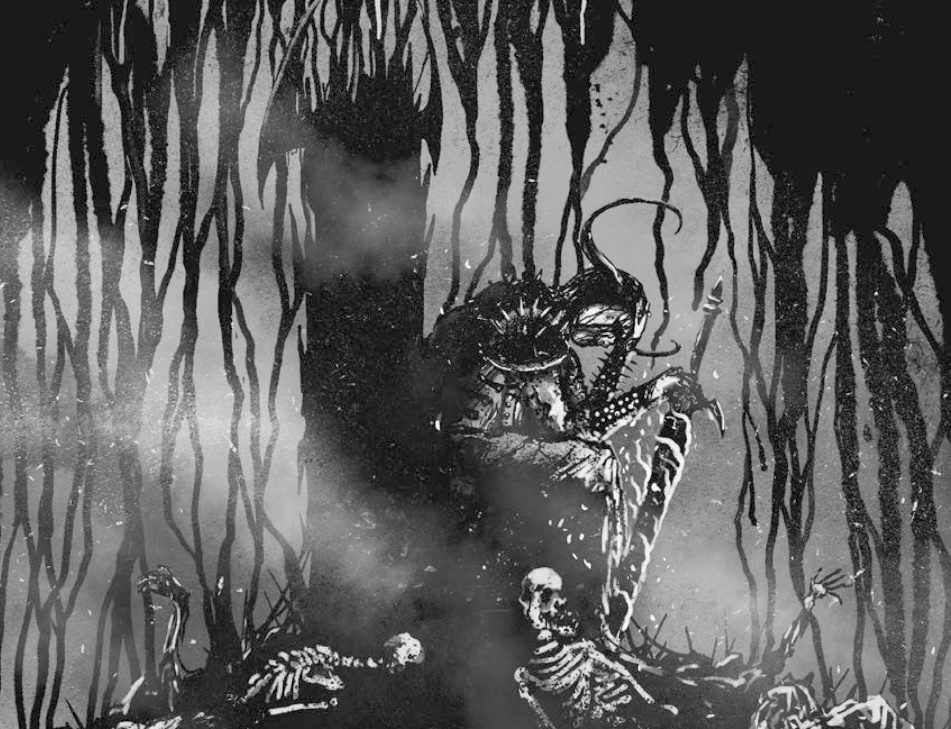
Tephrotic Nightmares is interesting object: the spine is exposed: you can see the stitched binding and it will lie perfectly flat. The other pages aren’t cut, you need to peel them apart as you read. Your first encounter with the book is a bit of an experience. The hardcover book is genuinely lovely, and if you can afford its price I would recommend it wholeheartedly over a boring PDF. Johan has done an incredible job with the art and graphic design—unsurprisingly.
It was interesting to read this book after reading His Majesty the Worm. In contrast to the exposition and support in HMtW, Tephrotic Nightmares really doesn’t hold your hand. Here are rules for sailing around, here are a bunch of weirdo factions, here are some monsters, here are some places. How you thread it all together is left up to you. Proper OSR nonsense! I really love books like this. A sandbox of stuff. The writing is strong. The art is great. It’s all very atmospheric. But is it too static? If there is criticism to be had, I suspect it will fall here. I think this sort of adventure is perfectly fine. The GM will figure out what’s up, along with the players, through play. From running adventures like this, stuff gets messy when the players get involved.
Discuss this Post on BlueSky