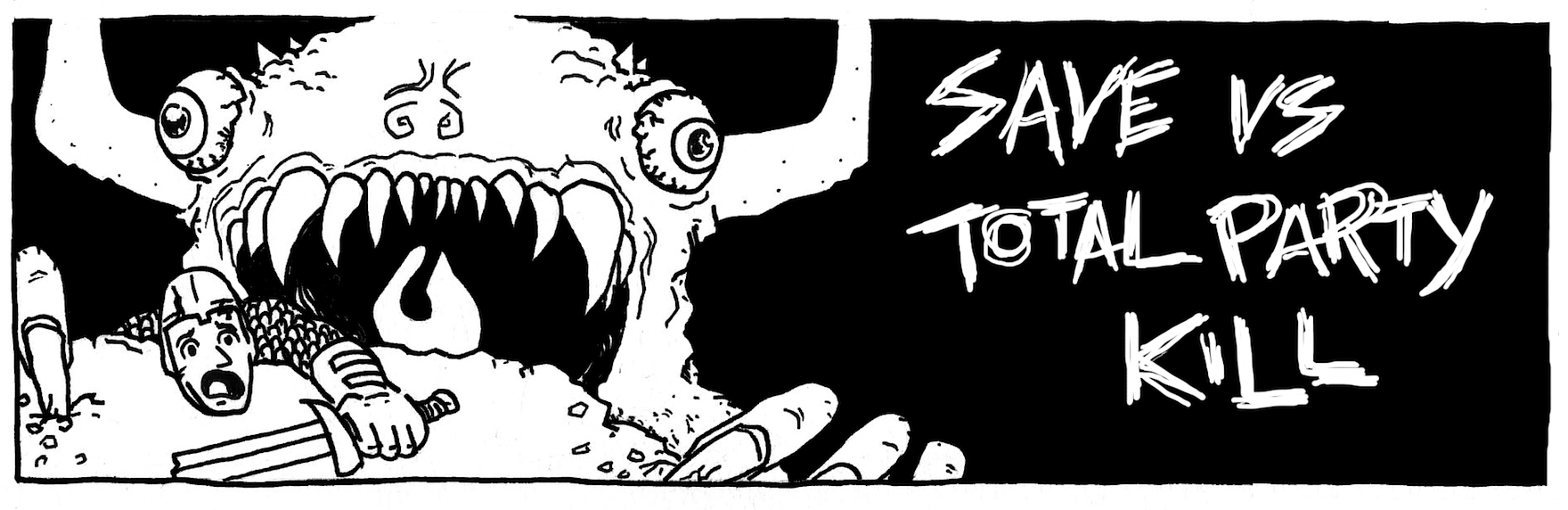
I woke up the morning following the death of Osrik, my dwarf paladin, realizing the character had a power that would let him re-roll a missed hit when bloody. I’m not sure this would have turned the fight that cost the character his life, but it certainly would have helped. This got me thinking about 4th Edition and its pantheon of classes and powers a little bit more.
Playing–and killing–a few characters in 4th Edition will teach you that the combat mechanics of the game are important to grasp.1 With the Encounters game I participate in I had been playing characters whose abilities the official character builder picked for me. I found I spent the down time between my turns in a battle scanning my list of abilities, trying to pick the one that seemed most appropriate for the situation at hand. This is a sure fire recipe for death and destruction. It can also be kind of boring.
Looking around the table I could see that I was not the only one suffering from this problem. D&D is ostensibly a game where you can do anything you can imagine. That’s what makes it so much greater than a video game: the possibilities are endless. The way 4th Edition has been designed really discourages that sort of play. This is probably the biggest weakness with 4th Edition. When playing my Warlock in my regular 4th Edition game, I spend most of my turns in combat doing some permutation of: moving at least three squares to gain concealment; cursing my nearest enemy; casting an eldritch blast. No matter what the situation may be this is almost always my best choice of action.
The flip side to this is that the enumeration of all these classes and powers is 4th Edition’s biggest strength. You can quantify the challenge of a battle in a way you really can’t with any accuracy in earlier editions of the game. If you’re interested in tactical combat 4th Edition is really unrivalled when it comes to simulating a battle. I don’t think you could do something like Forth Core Death Matches with any of the older versions of D&D. I’m not getting the most enjoyment out of 4th Edition because I haven’t invested the time in learning what options my character has, and how they best work with those of my fellow adventurers. The question for any 4th Edition gamer is whether this is something they even want to do.2
People often compare 4th Edition D&D to a video game. Certainly Wizards of the Coast used a lot of modern video game language when describing character classes and the mechanics of the game, but I suspect that’s because that language is going to be most familiar to new D&D players. I think 4th Edition has more in common with Magic: The Gathering.3 You and your fellow adventures are working together to produce a winning mix of classes and powers–this seems analogous to deck building in Magic. The focus on game balance is a natural extension of this. Magic is a successful collectable card game because there is no one deck to rule them all. Wizards of the Coast seem to have taken what they learned making Magic and tried to apply that to D&D, with mixed results.
I’m curious to see if Wizards of the Coast, or the wider D&D community, do interesting things with 4th Edition once the 5th Edition of D&D has been released. I feel like there is a lot to 4th Edition, if you can get past the fact it’s not exactly the same as every version of D&D that proceeded it.
Some might say they are the only thing to grasp in 4th Edition. ↩︎
Wizards of the Coast even sell the various powers available for the various classes as packs of cards! ↩︎
Rebecca of Dungeons and Donuts recently made a little hand-out for generating 4th Edition characters. Rather than bothering with classes or powers, she decided to ask players to pick a role and pick from a list of abstract powers. Players could then make up all the fluff that goes along with the role and powers they’ve picked. I’m a big fan of this idea. ↩︎
There are lots of great blogs about D&D out there on the Internet, but one that puts out consistently good stuff is Untimately by Toronto’s own Brendan S. His most recent post is on the rules that compromise Original D&D, distilling everything in the 3 brown books into concise lists of rules. A recent post that was particularly creative was about his take on schools of magic. If you’re into D&D you should be reading Untimately.
As I have mentioned in previousposts about Carcosa, Geoffrey McKinney seems to be working quite hard to say as little as possible about the nature of his “official” game world. There is very little exposition about Carcosa’s history, people, culture, etc. Each section of the book reveals a little bit of Carcosa’s story. The books bestiary reveals the most about the setting, hinting at the nature of the world and some of its history.
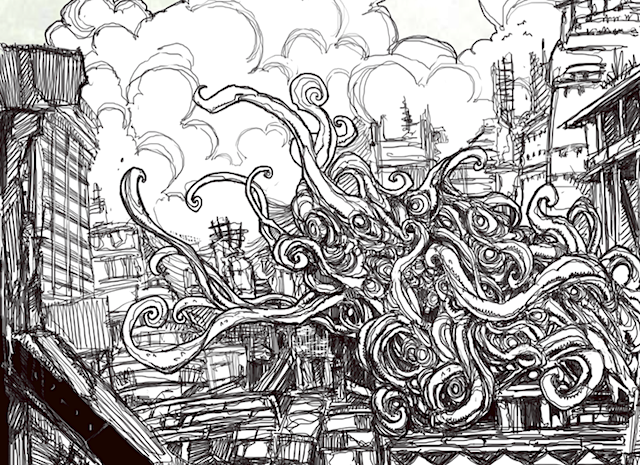
The vast majority of the monsters discussed in the bestiary are unique. They are crazy grotesque beasts one might find in a H.P. Lovecraft story.1 The gods of Carcosa are for the most part absolutely terrifying. These creatures have stat blocks and descriptions, like your typical kobold or goblin, so they are ready for your players to battle to the death. I mean, why give a monster hit dice if its not meant to be killed?
A few these monsters reside in particular places (hexes) in Carcosa. In the PDF version of the book, this is mentioned in their description.2 In the hardback you only learn of their home on the planet when reading through the hex descriptions later in the book.
Here looms the great and extinct black volcanic Mount Voormith’adreth, honeycombed with weird and outré caverns, and beneath which bubbles and heaves Shub-Niggurath. – The description of Hex 0402, Carcosa
Of all the old ones that reside on Carcosa, Shub-Niggurath appears to be the most important. Two of the races mentioned in the first section of the book, The Great Race and the Primordial Ones, are spawns of Shub-Niggurath. In addition, 4 other races mentioned in the bestiary are his children, so to speak. The most typical monster found on Carcosa is a Spawn of Shub-Niggurath, which can appear as almost anything. (A disgusting mutant tree? Why not. A horrible giant fish? Of course.) There is an appendix at the back of the book that contains random tables to help the DM with generating these spawns. This one monster description provides a lot of clues into the cosmology of Carcosa.
The remaining monsters of Carcosa provide further insight into what’s happening on the planet. One of the few non-unique monsters are dinosaurs. Of course, this being Carcosa they are expected to be of a crazy mutant variety. Similarly one finds giant jungle ants wandering from hex to hex. Lakes in Carcosa are likely home to to giant lake monsters. These sorts of beasts paired with the descriptions of the 13 races of men hints at a King Kong style world.
As mentioned at the start of the book, there are space aliens. From their description we learn that they originally crash landed on Carcosa a millennia ago, but since then they have established bases and come and go as they please. It’s their presence and their technology that makes the world a little bit less King Kong and perhaps a bit more Flash Gordon.
There are all sorts of slimes, puddings, and oozes similar to those encountered in your typical game of D&D, but with a Carcosa twist. Many of the unique monsters discussed in the bestiary are also some variation of disgusting ooze-like thing with tentacles. If it’s not a giant-mutant-monster it’s probably a creepy slime.
The illustrations by Rich Longmore really bring this portion of the book to life.
The bestiary ends with a brief description (without stats) of the long extinct snake-men. Here we learn some more of the history of Carcosa.
For tens of millions of years the civilizations of the Snake- Men were mighty upon the planet of Carcosa. They delved deeply into the arcane mysteries and laid the foundations of the systematic practice of sorcery. From shambling man- apes the Snake-Men bred the various races of humans to be sacrifices efficacious for their sorcery. At the height of their powers, the Snake-Men destroyed themselves by releasing ultratelluric forces impossible to control.
What else is there to say?
Finally we get to the hex descriptions, which is what it’s all about.
As I had mentioned when discussing the sorcerer rituals, each set of rituals deals with one of these unique monsters. The two sections work together to provider a fuller description and background of the monster in question. ↩︎
The level of cross-referencing in the PDF is one big advantage it has over the physical book. Figuring out how everything fits together is much easier when browsing the PDF. ↩︎
The last campaign he ran raised $16,240 to fund a hardcover book edition of the LotFP rules. Prior to that he raised $6,241 to fund two adventure modules. Clearly there are people out there interested in LotFP. My fear is that there are not enough people to fund such a large body of work in a single month. That would be a real shame, because the more I learn about the people involved in the campaign the more disappointed I’ll be if some of these adventures don’t get funded.
Today I was listening to an episode of the Jennisodes, a podcast about role-playing games, which featured Kevin Crawford, another participant in this campaign. I had never heard of him before, but after listening to him wax-poetic about sandbox gaming for a half hour I now want to fund his campaign as well. It sounds like it will be amazing. (Oh, and the host of the Jennisodes is also hoping to write an adventure for LotFP.)
I read Jeff’s Gameblog, by Jeff Rients, another participant in this campaign. I assume his campaign will do well as he seems to have a bit of a following in the OSR community. His writing on D&D is all quite fantastic. He posted a video today] about what he wants to do in his adventure. Guess what? It sounds pretty fantastic too.
I assume if I learn anything about most of these writers I’m going to want their adventure. As far as I can tell there are no B-team participants. Everyone seems to bring something interesting to the table. Monte Cook is writing an adventure! One of the dudes from mother-fucking members of GWAR is writing an adventure! It’s ridiculous.
I don’t have $114,000 to spend on adventures. Most people probably don’t. I suppose the hope then is that in aggregate fans of LotFP and of these individual writers can get a few things funded. This is certainly feels like the golden age of crowd funding–every other post on this blog seems to be about a kickstarter project–but this project might be a bit too ambitious. Still, I wish Raggi the best of luck. He has $20 of my dollars–so far.
A complete list of all the adventures in this campaign follows:
Carcosa is an impressive piece of writing, but people seem to get fixated on the small portion of the book that is filled with all sorts of rape and human sacrifice. Wait, what?
Magic in the world of Carcosa is (literally) all about the Cthulhu monsters. The planet is apparently filled with Cthulhu monsters of one sort or another. You can summon them, torment them, commune with them, and banish them. There’s no Magic Missile. There is no Fireball. If you want to play a character who shoots stuff at people you will need to find some laser guns.
Flip through the sorcerer rituals presented in Carcosa and it’s a sea of human sacrifice. When I first read the book I quickly skimmed this section and decided it wasn’t worth looking at in detail. The descriptions can be repetitive, clinical, and a bit of a downer: kill these Green men; rape and kill this Blue woman. Magic in Carcosa is evil and generally unpleasant. A whole chapter saying as much seemed unnecessary.
The only spells that don’t involve sacrifice are the rituals that exist to banish the Cthulhu monsters. This suggests one option for playing a lawful sorcerer: only cast banishment spells. I had assumed this was done on purpose, that McKinney didn’t expect players to actually use the spells outlined in the book, that they would be reserved for evil NPCs. In a recent interview I learned this wasn’t the case. In his home game he did have players who ran around the planet rounding up men and women to be sacrificed all the while looking for rare ingredients for their spells. That’s definitely a departure from traditional D&D.
There is another level to the rituals that is easy to miss because they are so repugnant. In Carcosa the rituals are another way Geoffrey McKinney shares his fantasy world with us. They hint at quests to embark on, monsters to fight, and sorcerers to vanquish.
Many rituals mention specific regions (hexes on the map) of Carcosa. They might discuss some rare ingredient that is required for the ritual that can only be found in a particular hex. They might mention a monster that can only be found in a particular place. Often times a ritual’s description of a hex is more detailed than the hex description itself. The description for hex 1513 is, “Ulfire Mold.” (I mentioned the writing was terse, right?) If we look at the ritual that binds the Fetor of the Depths, we learn that there is a “vile cave in the swamps of [the hex],” which is where that spell needs to be cast. The description for hex 416 is “7 Giant Frogs.” Looking at the ritual that conjures the Fetor of the Depths we learn that this hex contains the subterranean lair of the monster. Here I’m looking at two random rituals that relate to one of the old ones. This sort of thing happens throughout the chapter. There are numerous examples where the ritual description adds a whole other layer to what otherwise might sound like a pretty boring hex in Carcosa. This is all easy to miss if you dismiss this chapter as I had initially.
When Carcosa was first released it was mired in controversy because of this section on sorcerer rituals. The warning on the not-quite-a-dust-cover of Carcosa is no joke. The book is filled with depictions of vile black magic: buyer beware. Some of the ritual descriptions are particularly disgusting, but that is clearly the point. McKinney never explicitly tells us, “magic in Carcosa is evil.” Instead he shows this to the reader by outlining what it costs to cast a spell. Some people might not care one way or another about killing fictional alien space men, so McKinney goes the extra mile when it comes to some of the rituals: there is rape, killing babies, torture. These things are all upsetting, but Carcosa isn’t about a real place where real people are committing real crimes. The way these rituals are described is not gratuitous. As far as I can tell, McKinney isn’t trying to come off as edgy by mentioning a sorcerer needs to kill a baby to cast a spell; he’s not trying to express his anger towards women by mentioning a sorcerer needs to rape and kill a women to cast a spell. If you read Carcosa it seems clear that McKinney wants you to close the book knowing that magic in his world is evil. I think he succeeds here. Reading anything more into this section of the book is disingenuous.
If you skip ahead in the book you can read about aliens riding dinosaurs and shooting laser guns. How are people taking anything in this book that seriously?1
As with the sections that proceed it, the chapter on sorcerer rituals subtly reveal more about the world of Carcosa. There is a lot about the rituals that is left unsaid, leaving a lot of room for a dungeon master and players to make them and the world of Carcosa their own. I should add that the hex descriptions that come later in the book do mention potions and other magic items that perform the same function as some of the sorcerer rituals. This presents another avenue for players to conjure and torment monsters without some of the unpleasantness associated with doing so the traditional way. One can imagine quests that involve trying to reproduce a ritual via some other means.
And yeah, there are crazy mutant dinosaurs on this planet. They deserve their own blog post. My epic review of Carcosa will continue.
I submitted two questions about the controversy around these rituals for an interview of Geoffery McKinney that was being conducted by Gamerati. The first, “Has the controversy surrounding Carcosa had any influence on the subsequent writing you have done, or did it have a chilling effect on your work?” was answered with what amounts to a “No.” The second, “Have you read any criticisms of the rape and other controversial parts of Carcosa that you felt were interesting, valid, etc. (As opposed to shrill, knee-jerk, etc.)” was also answered, more or less, in the negative, and touches on the point I raise about not taking the work too seriously. ↩︎
If you’re looking for the next Kickstarter project you should be supporting, look no further than Brave Halfling Publishing’s Appendix N Adventure Toolkits (DCC RPG Modules). For $20 you can get a copy of 5 modules and a slew of other bonus material. From the Kickstarter:
Each Appendix N Adventure provides Game Masters with a challenging adventure that can easily be dropped into an existing campaign, as well as an inspirational module map and a set of illustrated player handouts. Each also contains new monsters, unique enemies, creative traps and bizarre settings to challenge players, and inspirational ideas for expanding the campaign and launch points into further adventures for the Game Master.
The project is already funded. You have nothing to lose. If the project hits $15,000 than they plan to also release a new campaign setting.
Five years ago, I spent many months working on a unique campaign setting (“The Old Isle”) to help try and spark renewed interest in Gary Gygax’s rpg, “Lejendary Adventures.” With Gary and Gail’s blessing, I consulted with Gary frequently about the design of the setting, npc races, magic item creation, divine beings, etc. I bounced ideas off of him and he provided suggestions and critiques. It was a very special time in my hobby gaming that I still treasure. However, while Gary played a supportive but indirect role in my creation of the Old Isle Campaign Setting, he did not create or write one word of the setting - The Old Isle is 100% my creation. Maps were created and art was commissioned. With Gary’s passing and the end of his Lejendary Adventures game, I decided to not release this material. However, from the first time I read some of the early DCC RPG play-test material, I knew this campaign setting had found a new home!
If you haven’t used Kickstarter before, this is a great first project to support. Brave Halfling Publishing has been around for a long time, and has a great reputation. They already have 6 modules ready to go, so you’re really only paying to help them bootstrap their printing costs. This seems like a pretty low risk venture. By the sounds of things, you should expect modules in the mail by July or August. That’s pretty fast turnaround for Kickstarter.
Carcosa, by Geoffrey McKinney, is ostensibly a campaign setting for Dungeons and Dragons. Carcosa was originally released as a stapled booklet entitled Dungeons & Dragons Supplement V: Carcosa. Both the name and its form were a homage to the original 1974 D&D books. As I understand things, McKinney would print off copies of Carcosa on his laser printer when he got an order for the book. When his laser printer broke he stopped selling Carcosa. This re-release by Lamentations of the Flame Princess is a much grander affair. As a physical object Carcosa is nothing short of perfection.
Carcosa describes a fictional alien planet of the same name. I’m used to campaign settings of the 2nd Edition variety, where anything and everything a dungeon master could possibly need to know about a place and its people is revealed. For example, I have a very good sense of what the fantasy world of Dark Sun is like from reading all sorts of splat books. If you approach Carcosa expecting that same level of detail you are going to be sorely disappointed. The world of Carcosa is hinted at obliquely. That’s not to suggest the book is light on material: it is both dense and terse.
Carcosa opens with a discussion of various changes to the D&D rules. In the world of Carcosa there are no non-humanoid player characters. There are instead 13 races of men, each identified by a different skin colour. Three of these colours don’t exist on Earth: ulfire, jale, and dolm. (And here skin colour is quite literal: a Blue man is blue like the dance troupe.) There are only two classes players can play on Carcosa: fighters and sorcerers. The difference between the two is that sorcerers can cast rituals1 that were devised by a long extinct race of Snake-Men.
There are no magic items in the world of Carcosa. Instead one finds all sorts of crazy technology scattered over the planet. The book presents example artifacts from: the space aliens, the Great Race, and the Primordial Ones. The technology of the Great Race and the Primordial ones is so foreign to humans that most people will have no hope of understanding what an item does or how to use it. (Mechanically, you need an INT score of 17 to have a 5% chance to use one of these artifacts.) I should point out that at this point in the book, there has been no real discussion whatsoever about space aliens, the Great Race, or Primordial Ones.
After reading this opening of the book, which is something like 30-40 pages long, you do have some sense of what the world of Carcosa is like despite the fact McKinney has explicitly said very little about it. We have a blighted world where humans are clearly the weakest in a long line of civilizations that have inhabited Carcosa. There is a gonzo sci-fi element to Carcosa: your characters might encounter space aliens in their travels, and the plater’s only hopes for “magic” weapons come in the form of space bazookas and ray guns. There is also a Lovecraftian undercurrent to to the world and its people. Everything you learn about Carcosa in this opening section of the book is gleamed through sideways glances.
Carcosa really comes alive in the sections that follow. The bestiary helps the reader visualize what populates the world of Carcosa now. The hex descriptions are often single sentence affairs, but they too give some colour to the world. The sorcerer spells are almost all tied to particular Chuthulu-esque monster found on Carcosa, and often discuss specific hexes in the world. I found how deeply interconnected these three sections of the book are surprising. I haven’t encountered another D&D supplement structured this way.2
I have so much more to say about Carcosa, but we have to stop somewhere. For now, anyway.
Oh, the rituals. They deserve a blogpost to themselves. They seem to be what people fixate on when they first read (or hear about) the book. Not that I can blame people for that, I suppose. ↩︎
I have since learned on Google+ that this style of presentation was used with Judges Guild Wilderlands modules. ↩︎
Vornheim: The Complete City Kit was the last book in my recent LotFP shipment I read.1Zak Smith has packaged some of the things he’s learned running city based adventures into this short treatise. The book is more or less clearly delineated in to two parts: the book begins with the Vornheim of Zak’s adventures, a crazy-ass city; the book ends with how to build your own Vornheim. Both sections work well together to produce a terse look at city adventuring.
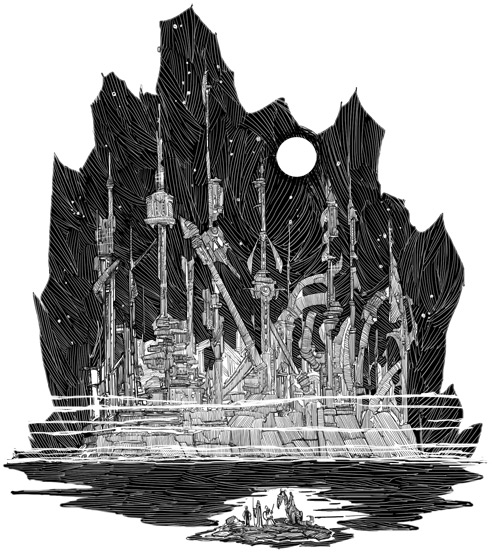
To quote Zak, “This book is not about Vornheim, it’s about running Vornheim.” The city is described at a high level. After reading the book I know that Vornheim is a sprawling city of towers and bridges with a massive palace (called the Palace Massive!), a giant cathedral, and a wyvern that lives in a well who answers questions. There is the sort of detail about the city and its culture you might find covered in a few pages of a guide book. You learn enough about Vornheim to have a rough sense of what it’s like, but not so much you feel like you’re memorizing names and places.
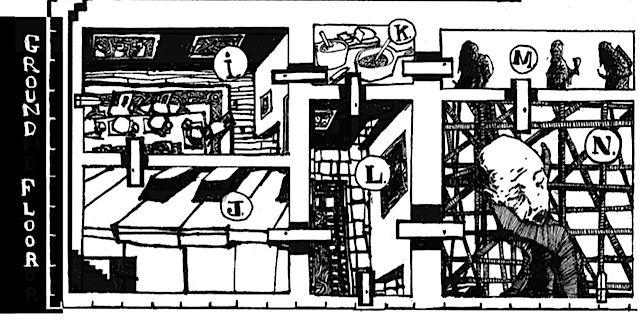
The opening of the book is followed by a detailed look at three buildings/areas in the city: the home of a medusa, the Immortal Zoo of Ping Feng, and the Library of Zorlac. These are presented in much the same way a small dungeon would be presented in an old school D&D module: maps, room descriptions, monster stats, and some background. I feel these mini-modules serve two purposes: they provide more insight in to what Vornheim is like, and present good examples of what traditional dungeon crawl adventures would look like when moved to a city. All three set pieces are unique and interesting. Even if you have no interest in adventuring in the city, they’d probably bo worth stealing and injecting into your campaign.
Smith presents just enough flavour for the reader to extrapolate what other parts of the city would probably be like, how NPCs not mentioned probably would behave. If you want to play a game in Vornheim, there is enough information for you to make the city your own. You can have your own “official” Vornheim that grows organically from play.
What makes the book work is that Smith then goes on to show you how to go about running a city game. The later half of Vornheim is where it really shines. The book ends with procedures and tables to aid a GM when running a city adventure. It’s quite clear Vornheim is meant to be used at the gaming table: it’s nice and small; all the tables for the DM are at the very back of the book, one after another; the book’s cover itself is a gaming aid, meant to have diced rolled on it. In the D&D Next play test I participated in, our DM used the “I search the body” table to good effect. I’ll have more to say once about this side of things once i’ve actually used it in a game.
I actually can’t think of another book that fills this niche. The Advanced Fighting Fantasy book Blacksand is certainly similar. (It outlines a fictional city and discusses running city adventures.) Blacksand seemed to encourage building out your city before hand.2 As such, it doesn’t lend itself to helping you creating a realistic sprawling mess of a city the same way Vornheim does. Still, if you’re looking for something else about this subject it’s definitely worth a look.3
I do have one complaint with Vornheim, and that is its solid black margins.4 There are other layout choices that probably would have helped make the book more legible. It sometimes feels a bit too dense. Smith’s paintings also seem to be particularly dense, so in some ways one can view the book as an extension of his artwork. You can definitely tell it is his book.
I don’t think I’ve read a bad review of Vornheim. It’s something like $15 so i’m not sure why you wouldn’t have bought it already. If you’ve been waiting patiently for my opinion on the matter, now you have it: go buy this book.
I finished reading Carcosa a few days ago, and I feel like I have so many things I want to say about it I don’t know where to start. Vornheim is a much easier book to grok. Expect one or more posts about Carcosa in the coming days or weeks. ↩︎
I recall drawing out a small “city” and listing what each of its 100 or so buildings were back when I was a boy. ↩︎
The rights to this book, and others in the Advanced Fighting Fantasy series appear to be owned by Arion Games now. ↩︎
Saturday June 16th was Free RPG Day. If the name didn’t give it away, the basic idea is that you show up at your local game store and you collect free RPG swag. Goodman Games was giving away a DCC RPG module that I was looking forward to grabbing. Different stores have different rules about how to distribute the items various publishers send them to give away. Duelling Grounds, my local gaming store, was giving away stuff to anyone who participated in games that were being run that day.
There were two busy games of Pathfinder taking place when I arrived at the store, each with 6 players. DCC RPG doesn’t quite have the same mindshare I suppose, so only I had arrived specifically to play in the DCC RPG game. Another fellow, Richard, who came to Duelling Grounds unaware it was Free RPG Day also joined us. We each played two characters: I grabbed a fighter and a halfling, while he took a thief and a wizard. The Jeweler That Dealt in Stardust is a fun little adventure. It’s a jewellery heist story with some demonic twists. How did we fare? Well if you’ve been reading this blog you can probably guess. To our credit, we had absconded with a ton of jewels and had defeated a demon, so we weren’t slackers by any stretch. The adventure was a lot of fun.
We managed to get through it all in about 2-3 hours of play. I felt like we accomplished a lot in that time. DCC RPG plays quite fast. I was also impressed at how quick the game is to pick up. I had read through the rulebook, but never played the game. Richard had never even heard of the game before. We occasionally had to pause the game so Daniel could explain how the rules worked, but for the most part things work the way you expect them to. Though the game requires funky dice we made due with a ’normal’ set of gaming dice and a D30.
Free RPG Day was a big success. I left Duelling Grounds with the DCC RPG module I was hoping for, a module for 4th Edition D&D from Wizards of the Coast, and a map of some fictional world called Harn. I finally got to play a game of DCC RPG, and meet a fellow DCC RPG fan. It was a good day.