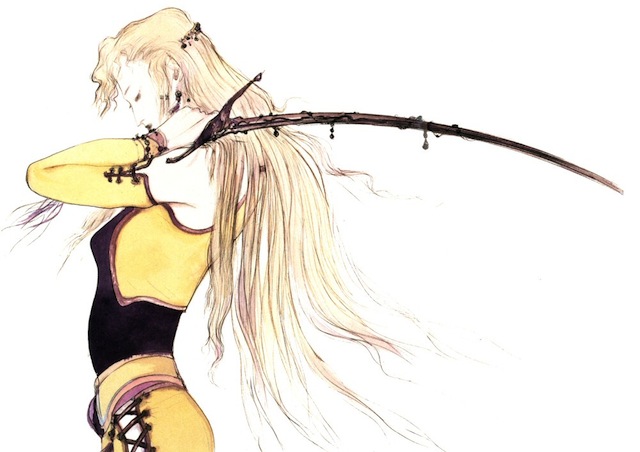
I’ve revised the Rune Knight I wrote about earlier this month after getting some feedback on Google+ about the new class. Briefly, the goal here was to recreate the character Celes from Final Fantasy VI for use in Reynaldo’s D&D campaign world Baroviania. Whether by design or by accident, making your own class for his game seems to be the thing to do. The rune knight is a slightly re-skinned B/X D&D elf.
Rune Knight
Rune knights are genetically enhanced warriors from the Dark Capital. They are artificially infused with magic, which grants them some magical ability. Their ties to the dark forces of the world leads others to regard them with suspicion and mistrust. Rune knights are often introverts and loners.
The prime requisites for a rune knight are Strength and Intelligence. They receive a 5% bonus to earned experience points if they have a 13 or more in both skills. They receive a 10% bonus to earned experience points if they have at least a 13 Strength and an Intelligence score of at least 16.
Rune knights progress in levels at the same rate as Elves. (In other words, slowly.) They share the same saving throws.
RESTRICTIONS: Rune knights gain 1D6 hit points per level. Rune knights gain all the advantages of fighters. They may use shields, can wear any type of armour, and may fight with any kind of weapon. A character must have an intelligence score of at least 9 to be a rune knight, and must have a charisma score of no more than 9.
SPECIAL ABILITIES: Rune Knights can cast spells using Rune Magic. A Rune Knight gains spells per level as an elf, and this is the exact number of spells the character knows. The character gains these spells as soon as they level-up, and may choose from any magic-user spell of the appropriate spell level. Rune Knights do not require spell components to cast any of their spells. The spells are a part of the character, infused into their very DNA. Rune Knights can not research new spells, create scrolls, or otherwise act as magic-users.
Rune Knights can dispel any magic cast in their vicinity using the Runic ability. After a magical spell or ability is used the player may declare they are using their Runic ability. They may only do so if they have not yet acted in the round. The Runic ability will replace the action the character had declared they would make. (So the character may only nullify one spell per round.) The character makes a Save vs. Magic: on success the spell or magical ability has no effect whatsoever, and the character gains 1 hit point for each level of the spell; on a fail the spell or ability proceeds as usual. Note: this ability is not a dispel magic spell. The character can’t disenchant a wand, but they could try and prevent the spell a wand casts from working; they can’t dispel a magical trap, but could try and stop any magic the trap itself casts; they can’t unlock a magically sealed door.
As I mentioned in my previous post on OSRCon, I got to wander through the dark halls of Dwimmermount on Saturday morning in a game run by James Maliszewski. What follows may ruin the surprise of some of the rooms in the dungeon: you have been warned.
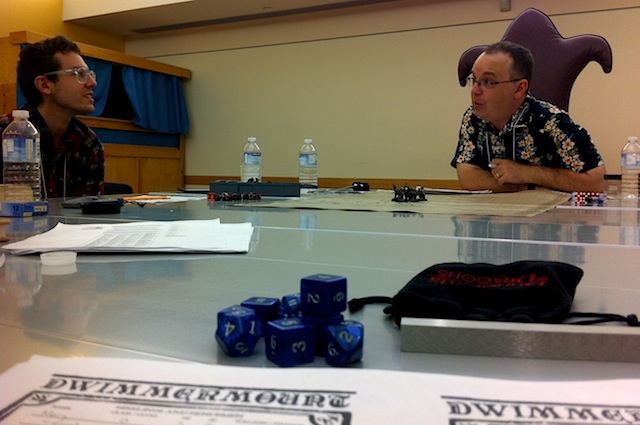
We began with 5 players. We rolled up characters using the original D&D rules, and for a change my rolls weren’t half bad. Strength was my highest score so I decided to play a fighter. We used Brendan’s random equipment lists to pick items, so this whole process was very quick. Buying items is probably the slowest part of the character creation process in D&D. I think we all had characters ready to go in about 10 minutes. The bulk of that time was probably spent trying to find the saving throws tables in the old D&D books.1 When all was said and done we had three fighters, a magic user and a cleric ready to go. We also brought two hirelings with us: Mary the Torchbearer, known for her ability to carry a torch, and a porter of no real repute.
Like all good one-shots ours began at the foot of a dungeon. Our group had marched into Dwimmermount in search of gold, presumably. The stairs into Dwimmermount entered into a room with 5 statues. Thankfully they weren’t booby trapped. Neither was the room. When playing the previous day in Ken St. Andre’s Tunnels and Trolls game, our group spent a very long time trying to get into the dungeon. It’s possible that in James’ actual Dwimmermount game this room is full of machine guns, but if you only have a few hours to play it probably doesn’t serve you well to kill all your players a few minutes into your game. We had 4 doors to choose from, one for each direction, and we chose to go East.
I was ready to just walk into the next room, but Brenden, a more patient and prudent player, thought we had a better chance with this dungeon crawl if we proceeded a bit more cautiously. From this point on every door we opened (that had a circular pull) was opened by looping rope through the pull and tugging the door open. Before we ventured into any room we’d listen for noise first. In this fashion we ventured East till we came across a circular room with a set of masks hanging on the wall. One mask was missing, and in front of where it should have been there was a long dead man, now just a pile of bones. I know what you’re thinking: it’s a trap! And you’d be right. Examining the skeleton revealed the missing mask. There wasn’t any indication on his body that he’d been hit by some sort of projectile. Looking at the wall we could see a small hole where the mask would have sat, so we guessed there was some sort of poison gas trap protecting the masks. Now I was ready to just move on, happy I’d avoided the booby trap. Smarter and/or greedier heads prevailed. We decided to carefully loop our rope through the eyes and mouths of the masks and then tug them all off the wall from a safe distance. Sure enough we could hear the room filling up with gas as the masks hit the floor. Our first “loot”: who wouldn’t want creepy death masks from a dungeon?
From here we ventured South. We ended up on the Eastern edge up of a long corridor. There were plenty of doors to open. We ignored the double doors to the East: never trust double doors. The first set of doors to the South eventually led us to the stairs down to the next level. We weren’t quite ready to head down yet.
We walked back to the long corridor and checked out the next room to the South. We found a library with some books and maps that looked like they might be of value. More loot!
Further South was another door behind which we could hear the muffled voices of something, we couldn’t be sure what. One of the other fighters and myself got in place, and we busted that door open. We encountered a bunch of monsters, who looked monstrous and maybe vaguely dwarven. They were small, anyway. We shouted, “surrender!” but they weren’t having any of that. Myself and the other fighter made short work of the first wave that approached us. The rest started to flee. The magic-user in the group thought we just weren’t speaking the right language. He shouted “surrender and join us”, but this time in dwarven. That didn’t go over too well. The ones that were fleeing ran back, angrier than they already were. Lucky for us we were wearing plate mail.2
At this point we could have continued South. We had heard some noises coming from that direction. Maybe we would have encountered more of these crazy definitely-not-dwarves. We decided the best course of action was to start making our way down as deep as we could into Dwimmermount. We were being a bit too cautious for a convention game. I mean, I hadn’t even named my Fighter.
And this play report is already longer than I thought it would be, so you’ll have to wait for the excitement of level 2!
James has a very slick hardback version of the little brown books that he built using his copies of the old Wizards of the Coasts PDFs and Lulu. I was surprised and how good the hardbacks Lulu produces are. It made me want to print up some PDFs. ↩︎
It costs next to nothing in OD&D. I think by the time you get to 2nd Edition it’s thousands of GP. ↩︎
I wasn’t completely sure what my schedule this past weekend would be like: I knew I was quite busy. When I discovered OSRCon was a thing happening in Toronto I bought tickets anyway. Even if I couldn’t go it felt like a worthwhile event to support. I was hoping I’d be able to participate a little bit, at the very least. As it turns out I managed to do much more than I thought I would over the two days the event ran.
I arrived a bit late on the first day hoping to watch Ken St. Andre running a game of Tunnels and Trolls. I wasn’t signed up for any games, and I knew Ken’s game was full, so I didn’t feel like waking up early on my day off. I arrived a half hour after his game was set to start, but managed to avoid missing any of the action. As I settled into a chair away from the gaming table I realized Ken was still discussing the finer points of Tunnels and Trolls. He spoke at length about his game. He’s clearly very passionate about T&T, and happy to proselytize about it when given the chance. Brendan from Untimately had a similar idea as myself, showing up shortly after me planning to watch the game. Ken saw both of us just sitting there and offered to let us join in. Brendan took him up on his offer and picked a troll to play. When he had to duck out for lunch–which was more or less when the game got going–I took over the character. The adventure was interesting, even though we didn’t get too far into the “Dungeon of the Bear”. Our party had a series of misadventures trying to venture down into the dungeon itself. Failing is often as much fun as succeeding with role playing games. Ken is definitely an old-school DM, out to kill his players. (Or as he put it, out to create situations where the players kill themselves.) He is a certainly character, and I’m glad I got to meet him. It was an experience.1
In the afternoon I played a game of Labyrinth Lord run by a Carter Soles of The Lands of Ara, who had made the trip to Toronto from Rochester. I had to duck out early (the reason I hadn’t signed up for anything in the afternoon), but I did get to do a fair amount of adventuring before my departure. Our party was off to investigate a presumably haunted keep, and investigate we did. The thief I rolled up had 2 hit points, so he was a little bit of a coward. Sometimes 3d6 in order works in your favour and sometimes it doesn’t. This character was all kinds of meek. You have to love basic D&D characters: they are the true everyman. I suppose that is part of the charm of playing basic D&D. Our first encounter was against some undead rats. When rats are a scary threat you know you’re playing old-school D&D.
My second day at OSRCon began with the only game I had actually signed up to play. James Maliszewski of Grognardia fame was running an Original D&D game, taking players through his megadungeon Dwimmermount. We actually managed to get through a fair amount of dungeon in a small amount of time. There was a lot of exploring and the occasional fight. I plan on doing a play report shortly. Suffice it to say I had a lot of fun.2
There was a panel discussion in the afternoon, featuring Ed Greenwood of Forgotten Realms fame, Ken St-Andre, Lawrence Whitaker from Runequest, and James from Grognardia. It was interesting hearing how these guys all ended up where they are today and their thoughts on writing and gaming. Ed Greenwood is particularly engaging. He explained that his professional writing career began by writing letters to Penthouse for $25 a pop. Apparently Dragon magazine paid $20 a pop for monsters and was more prompt in paying him. The rest is history. The talk probably would have worked better with a moderator leading the discussion and keeping people on point. The talk went a half hour or so longer than it was supposed to, and it felt like no one really knew when it was supposed to stop. Ed Greenwood and Ken St-Andre sitting next to each other discussing the game was definitely quite the scene, so I suppose we shouldn’t complain too much.
The day concluded with another round of games. Like the day before I had to leave early, so I elected to watch Ed Greenwood run a Forgotten Realms game. That guy is amazing. He puts the role in role-playing. I don’t think I’ve seen a DM quite so animated. He would literally act out the part of every NPC the players encountered–even the monsters that can’t actually talk. It was great to watch. I’m not sure how well i’d handle having to actually play in a game like that. He clearly approaches the game as shared story telling. Often I find I just want to kick in doors and kill goblins.
These last two days were the first time I had played basic D&D in a very long time, at least 15 odd years. I was surprised at just how much of the rules I had forgotten. Say what you will about 3rd and 4th edition, but they did a great job at rationalizing the game system. One success of those games is that you can more or less guess the mechanic needed to resolve any action. With basic D&D some situations call for a d6 roll, others 2d6, others a d20; sometimes you need to roll high, other times low. The game is simpler, but at the same time maybe not as simple as it could be. Of course, old-school D&D is simple in ways that that 3rd and 4th Edition don’t come close to competing in. I rolled up characters a few minutes before both the games I played in. If my characters died and I had to start again, I feel like I could have rolled up a character in a few minutes tops. These early games feel light and easy to get in to. 4th Edition feels needlessly complex with all its classes and options.
OSRCon was a lot of fun. I got to meet a bunch of fellow table top gaming enthusiasts and play a bunch of games. I don’t get to play that much D&D, so it was a nice change of pace.
I had backed the project to get them printed on Kickstarter. I don’t know if I’d ever want to run Dwimmermount myself, but I supported the project anyway as a thank you for writing such a great blog. I actually have copies of the levels of the dungeon we traveled through. I had avoided reading any of this material in the hope I would get a chance to actually go through the dungeon as a player. ↩︎
My favourite character from the game Final Fantasy 6 was Celes. The character was a warrior crossed with a magic user. Her special ability was called Runic: when used as an action it would negate the effect of the next spell cast in combat; Celes would gain hit points equal to the magic points the spell cost to cast. I could write pages and pages about how FF6 is the greatest game ever, and even more about the fact Celes is the best character in that game, but I won’t. You’ll just have to trust me.
I wanted to make a Rune Knight class for Reynaldo’s D&D campaign world Baroviania so I could play some variation of Celes in his game. I was originally thinking a Rune Knight would be some sort of cleric, but Reynaldo suggested I look at the elf from D&D. I always forget about the demi-humans in D&D. Elves are actually a pretty good fit for the class: a plate wearing magic user does sound like Celes.
Rune Knight
Rune knights are genetically enhanced warriors from the Dark Capital. They are artificially infused with magic. This grants them the ability to cast spells like a wizard. Their ties to the dark forces of the world leads others to regard them with suspicion and mistrust. Rune knights are often introverts and loners.
The prime requisites for a rune knight are Strength and Intelligence. They receive a 5% bonus to earned experience points if they have a 13 or more in both skills. They receive a 10% bonus to earned experience points if they have at least a 13 Strength and an Intelligence score of at least 16.
Rune knights progress in levels at the same rate as Elves. (In other words, slowly.)
RESTRICTIONS: Rune knights gain 1D6 hit points per level. Rune knights gain all the advantages of both fighters and magic-users. They may use shields, can wear any type of armour, and may fight with any kind of weapon. They can also cast spells like a magic-user, and use the same spell list. A character must have an intelligence score of at least 9 to be a rune knight.
SPECIAL ABILITIES: Rune Knights can dispel any magic cast in their vicinity using the Runic ability.
Runic
As mentioned above, in FF6 Celes’ Runic ability dispels the next spell cast after it has been activated, regardless of its strength. An anti-magic ability like this in D&D seems quite powerful, though this is in some ways balanced out by the fact the ability must be used before a spell is cast (it’s preventative) and that most low-level D&D monsters don’t actually cast a lot of magic.
Option 1: One take on the Runic ability is to use the exact same mechanics from FF6, more or less. On a character’s turn they may declare they are using their Runic ability. Any magical spell or ability that is used before the characters next turn is immediately dispelled and has no effect whatsoever. The character gains 1 hit point for each level of the spell. The ability may only nullify one spell per round. The character may activate the ability again on their next turn.
Option 2: An alternative take would be to make the ability more useful in combat by making it reactive, at the cost of making it less reliable. After a magical spell or ability is used the player may declare they are using their Runic ability. They may only do so if they have not yet acted in the round. The Runic ability will replace the action the character had declared they would make. (So the character may only nullify one spell per round.) The character makes a Save vs. Magic: on success the spell or magical ability has no effect whatsoever, and the character gains 1 hit point for each level of the spell; on a fail the spell or ability proceeds as usual.
Another idea would be to make the player and the monster do some sort of opposed roll, rather than a save. You could also add critical success and failure results: on a critical fail (a roll of 1) the character takes 1 damage for each level of the spell, on a critical hit (a roll of 20) the spell is reflected back at the caster.
One thing I was thinking of doing was requiring a rune knights have charisma scores lower than 9, so they always have a negative reaction roll. That seems inline with how Celes is treated in FF6. I don’t think I’ve seen classes with maximum requirements on their ability scores, though. I also need to figure out how the character would fit in the actual game world.
If you have any thoughts about the class, let me know.
I recently discovered that there is a small convention that takes place in Toronto focused on old-school table-top gaming. OSRCon takes place this weekend. It sounds like it will be fairly small as conventions go, and the focus seems to be about running and playing games. If you are in or around Toronto it seems worth checking out. How easy is it to bump into people who are into old-school D&D? (That’s a rhetorical question.)
There are so many old D&D modules out there that sound a little bit interesting. I decided to write out exactly what older D&D modules and books I want. The goal here was to stop myself from spending money like an idiot on anything and everything I might stumble upon, but also have enough books to buy that I can spend money like an idiot. I don’t consider myself a collector of D&D books, but there is certainly some aspect of collecting at play in my behaviour. I also have a (bad) habit of buying more books than I could possibly hope to read in a reasonable amount of time. I wanted to pick a small set of old books and then forget any others exist.
In the end I decided to look for the following books:
D&D Basic Edition
D&D Expert Edition
B1 - In Search of the Unknown
B2 - Keep on the Borderlands
B4 - The Lost City
T1 - Village of Hommlet
I1 - Dwellers of the Forbidden City
D1,2 - Descent into the Depths of the Earth
D3 - Vault of the Drow
X1 - Isle of Dread
X2 - Castle Amber
I’ve picked up a few of these books already, finding them used on eBay and Amazon. I have a question for you: have I missed any obviously amazing D&D or AD&D 1e books?1
I have no interest whatsoever in anything from 3rd Edition. There is a part of me that wants to buy up all the 2nd Edition Dark Sun books, but for now that’s not something I plan to do. ↩︎
I have mixed feelings about the Dragonfoot forums. They are a pretty great resource for all things old-school D&D. On the other hand they are also filled with all the horribleness one finds in a forum of reasonable size. Still, I don’t think there is a better source for stuff like this: the “B1 - In Search of Unknown” index thread is full resources and reviews of the D&D module In Search of the Unknown. It’s probably got a link to anything of interest about that module.
Over the last few days i’ve been working on a little web application to help Lamentations of the Flame Princess players go through the motions of casting the Magic-User’s Summon spell. The spell lets players summon a demon to aid them–hopefully. The LotFP rules outline what sort of demon will show up and whether or not it will listen to the players. It’s a crazy spell. There are lots of tables and dice rolling. It’s a complicated enough procedure that it produced a thread on the LotFP forum to discuss how exactly the spell works. From the discussion there I figured turning the spell into a little web-application would be a small fun project.
For those interested, the site was created using the Python (mini) web framework, Flask, and is hosted on Dreamhost.
I picked up copies of the new Premium AD&D 1st Edition reprints earlier this week at Hairy Tarantula here in Toronto. I was on the fence about getting them as I don’t have much interest in actually playing AD&D 1e. I decided to buy them because I heard they were great books on role-playing games in general, and an important part of the history of the game. I’m also a big fan of the art from that era–back when no one working for TSR really knew how to draw. The reprints are really well done1 and I’m quite happy with my purchase.2
The Dungeon Master Guide is the biggest of the three books that comprise the core AD&D 1e rules, and it is fascinating. I plan to post little snippets from the book as I make my way through it.
A word of warning. Many products might purport to be satisfactory for use with ADVANCED DUNGEONS & DRAGONS, but only those noted as OFFICIAL or AuthorizedAD&D items should be accepted. Do not settle for substitutes or second-rate material in your campaign; ask for approved AD&D products only!
I can only imagine what was happening in the table top gaming community back in the 70s, but clearly Gygax was unimpressed with the work being done by 3rd party publishers. I wonder what his thoughts about the OSR community would be. Gygax’s writing is full of exuberance and passion, but the start of the Dungeon Master Guide is full of talk of official rules and playing the game properly. It seems to run counter to ethos of old school gaming, as I understand it.
Of course, we then get to a table about contracting parasites while adventuring so why are you griping about Gary Gygax? Please!
Wizards of the Coast wrote about the process they went through to create these reprints, and it’s really quite incredible. All three books pre-date digital typesetting, so they had to redone by hand. The designers at Wizards of the Coast had to recreate the layouts from scratch. It’s actually quite amazing when you look at a page from the original books and then the reprints. ↩︎
I’ve added a new page to this site, listing the D&D books I currently own.1 I like seeing what books (and PDFs) other people own, as it’s a good source for finding new books that might be worth reading. That page will also be a good place to link back to reviews i’ve written about the books I’ve bought. For someone who doesn’t actually play that much D&D, I own a lot of books on the subject. I suppose this page also exists to shame myself into not buying more D&D books.