#
04
October
2012
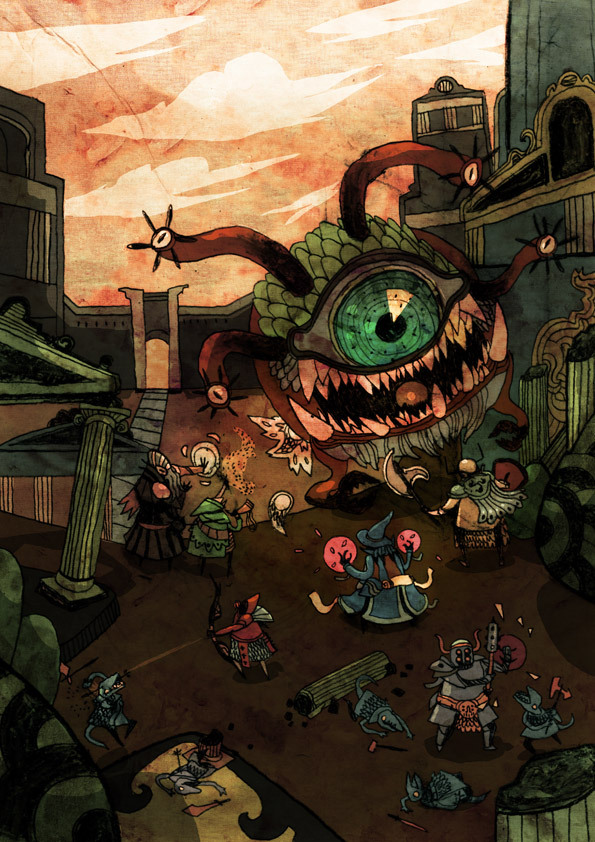
Guy-Pascal Vallez is an artist and D&D enthusiast who has a blog you need to go look at right this very minute. Stop reading and go!
#
04
October
2012
Guy-Pascal Vallez is an artist and D&D enthusiast who has a blog you need to go look at right this very minute. Stop reading and go!
by Ramanan Sivaranjan on September 23, 2012
Tagged: carcosa lotfp osr hexcrawl
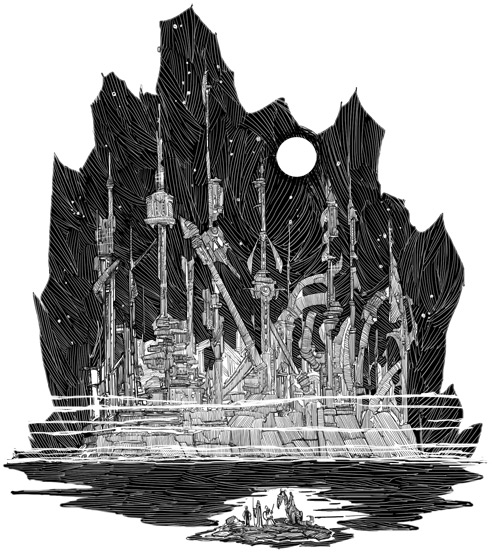
1507: On a lifeless island of black stone stands the alien city of Carcosa.
A silhouette of this city is featured on the cover of Carcosa. The city is only mentioned once in the book, in this description. It’s certainly an evocative sentence.
Carcosa concludes with a tour of its world via a hex map and descriptions of those hexes. As has been a running theme in my reviews of the book1, the details of each hex are quite terse. Geoffrey McKinney continues to say the bare minimum needed to convey anything at all about the world he has created. There is definitely something old-school in this sort of presentation.
Each hex description includes two possible things the PCs could come across. The first description is written by McKinney, and was the only description presented in the original booklet version of Carcosa. The second set of descriptions were created by fellow gamer and fan of the setting Chris Robert; he had previously published these descriptions as a free PDF, Strange Sights of the Doomed World Carcosa.
McKinney’s descriptions are very matter of fact. There is a village here; there is a disgusting monster there. Occasionally he will hint at something sinister or exciting, but it’s just a hint. Robert’s descriptions are somewhat similar in tone, but are a bit more varied in their execution. I can imagine coming up with my own set of encounters, using Robert’s take on things as a good example of how to proceed.
The hex descriptions of Carcosa can be split into three types of encounters: villages and citadels, spawns of Shub-Niggurath, and the “weird”. That last category is broad, clearly.
402: Here looms the great and extinct black volcanic Mount Voormith’adreth, honeycombed with weird and outré caverns, and beneath which bubbles and heaves Shub-Niggurath.
This is a pretty important place in Carcosa. It’s home of Shub-Niggurath, the creator of almost all the important species on the planet. Spawns of Shub-Niggurath are one of the most common creatures encountered on the planet. This little passage is all that McKinney dedicates to their creator’s home.
1610: Village of 370 Red Men ruled by “the Lover of Peace,” a lawful 5th-level Sorcerer.
This is your typical village description: here are some men and this is their leader. You can often get a sense of what the village will be like based on the leader’s alignment and title.
1609: Citadel of 83 Bone Men led by a chaotic 6th-level Fighter.
Some times descriptions are even more terse. Who knows what this village is like? The village is 6-12 miles from the citadel. Maybe there is a relationship there? Carcosa encourages thinking like this.
1513: Ulfire Mold.
The tersest hex description possible? The alternate encounter for this hex, by Robert’s, is a bit more meaty.
1513: The undying and practically invisible brain of a chaotic Bone Man Sorcerer lies shallowly buried in the reeking fens of this hex. It is eager to find new flesh, though discriminating enough to consider only a fellow Bone Man as an acceptable vessel. Any Bone Man coming with 100′ of the brain must make a saving throw vs. magic. Failure indicates that he is compelled to unearth the brain, tear his own brain from his head, and replace it with the Sorcerer’s brain. If this occurs, the Sorcerer will take the first opportunity to escape to his secret lair in hex 0715, there to resume his experiments into the forbidden.
There are lots of interesting little encounters to be had throughout Carcosa. Even if you weren’t interested in running a game in the settings there is definitely stuff one could steal here.
The book concludes with a short adventure and random tables to aid a DM in running a hex crawl on the planet. The adventure is presented as a keyed dungeon and a mini hex-crawl. Besides wandering monster tables, we also get a table for creating alien technology, one for making spawns of Shub-Niggurath, and one for making random robots.
If it’s not clear by now, I really liked Carcosa. The book is physically fantastic. It’s definitely worth buying for Rich Longmore’s art alone. His illustrations of the setting are incredible. The pictures i’ve used in my reviews are a small sampling of the stuff in the book. The fact the material itself is also quite good was a nice bonus. I didn’t expect to enjoy this book as much as I did. I had no real interest in hex-crawl adventures, Lovecraft, weird sci-fi in my fantasy, or half the things that Carcosa is all about. McKinney has done a great job in sharing the things that he likes about D&D. You should buy this book already.
Previous reviews: Carcosa, Carcosa’s vile black magic, and The monsters of Carcosa ↩︎
by Ramanan Sivaranjan on September 22, 2012
I bought a copy of Isle of Dread from Dueling Grounds several weeks ago. (They have a good selection of overpriced beat up old modules and books.) My main reason for buying the book was to support the store, since they host the Encounters game I participate in. That said, I had been thinking about picking up this module for some time. Isle of Dread was the first Expert Edition D&D module put out by TSR–the infamous X1.
Isle of Dread is less an adventure in the traditional sense and more of a mini-campaign setting. There isn’t anything in particular the adventurers are tasked to do on the island. There is no real beginning or end to the module. The book simply describes a small island (full of dread). X1 opens with an overview of a small campaign world, featuring said island. This is then followed by a hex map of the Isle of Dread with keyed areas to aid a DM in running adventures on the island–what people refer to has a hex crawl.
The book is a good introduction to structuring and creating wilderness adventures. It was originally packaged with the expert edition box sets, which introduced these rules, so this makes sense.
The module describes a few hexes on the island, but much of them are left for the DM to populate–either through their own prep work or via random encounters. A small village exists for the PCs to set up shop within. The center of the island is detailed with another hex map. This area also features a more traditional dungeon, Taboo Island, which the PCs can explore in the hopes of treasure and glory. Even this set piece has been designed so it can be easily extended by a DM.
X1 is well worth getting if you are looking for a mini-campaign setting. There is enough stuff in the module that you could play games on the island for a good while. Modules can be instructive: they help teach by example, and provide insight into what sorts of adventures and experiences the game designers expect their customers to have. As a template for designing your own hex crawls X1 succeeds quite well. X1 shows that you don’t need an overwhelming amount of information to create a rich world for your players to destroy: all you need are some random tables and a little imagination.
When I started playing role-playing games 2nd Edition was the current iteration of D&D. Modules from this time could best be described as little novels your players could walk through. In many ways modules were an extension of the actual novels TSR was published to go along with their D&D campaign settings. At the time I wasn’t particularly interested in reading adventure modules, but my feelings have since changed. I’ve been reading lots of modules recently, sometimes with an eye to running a game, but more often than not simply to enjoy reading something about RPGs.
by Ramanan Sivaranjan on September 17, 2012
Tagged: dnd odnd greyhawk webapp
A month or so ago I wrote a small Python script to generate D&D characters. Making a character for the older editions of the game is fairly straightforward, the only part most people find slow is picking equipment. In D&D you start the game with 3d6 x 10 gold. With that starting gold you have to decide what to buy. For new players I think this can be intimidating. Brendan of Untimately posted a pretty great table for picking equipment randomly: he basically did the work of buying equipment for each possible starting gold value and class. Using that table you can spit out reasonable random characters that are good to go quite quickly. Over the weekend I took my basic script and turned it into a little web application.
Right now it only picks from the 4 human classes, but should otherwise work quite well. It can also generate characters using the 1974 “Little Brown Book” rules, or the rules taking Greyhawk into account. I would describe that support as “preliminary”. (If there are any obvious mistakes, please let me know.) When I have a bit more time, I plan to add support for letting you pick the class you want to play.
If you have any feedback about the applicaiton, please get in touch. Otherwise, enjoy.
by Ramanan Sivaranjan on September 11, 2012
My friends and I have been a bit disorganized with our regular D&D 4e game. This meant I was free to play in Brendan’s OD&D campaign, the Vaults of Pahvelorn. He’s been writing about his campaign and OD&D for the last few months and it all sounded pretty fantasitc, so it was nice to participate in a game.
As i’ve said before, rolling up a character in older editions of D&D is pretty quick. For this game things felt even quicker: 3d6 in order for my stats suggested I play a wizard. From there it was random equipment, random spell books, a random retainer and a random background. The only thing that isn’t random about this character is his name, Satyavati. Removing almost every choice from character creation makes the process painless. The whole experience was very stress free.
With that I was ready to game. The other players were regulars in the campaign. As things got going I felt a little bit lost. I had read play reports and Brendan’s own posts about the game, but I didn’t feel like I had my bearings till we were found a section of Pahvelorn that was new to everyone. In our session we explored some old row houses accros the street from a mansion.
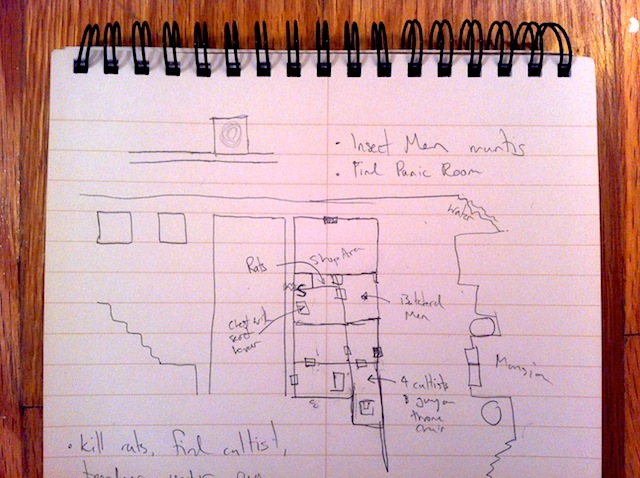
The first room we examined was full of bodies in various states of butchery. That’s just not pleasent. From here we found a room containing an empty chest, presumably already looted. I’m always a bit suspicious of empty chests, so I decided to investigate futher. Brendan asked how exactly I do so. Now, at this point I thought my character was going to die in a firey inferno. Thankfully, this wasn’t the case. We found a secret room and an apparently elven magic sword. We call that, “loot.” In hindsight I probably should have devised a safer scheme for examining the chest, but it was late at night and sometimes it’s good to not be so timid.
It’s always funny watching the push and pull between the cautious and the not so cautious. We alternated between busting heads and hiding in alleyways and dark corners. We killed some cultists, some giant rats–of course–and some good for nothing demons. In Brendan’s game you only get XP for finding and spending gold so these fights were purely for our own satisfaciton.
We explored the mansion a little bit, and it was an interesting scene. I had memorized Read Magic for the delve: it’s the only first level spell I know. Seriously. In all our previous fights I had joked about how I had prepared Read Magic and then promptly hid in a corner till the carnage was over. When we enterd the mansion we came upon a room divided in two by runes, presumably of a magic nature. That’s what i’m talking about! A Read Magic later and we learned they were probably sealing some sort of evil inside the mansion.
In the next room we discovered a giant demon frozen in place with a sword through its chest. I’m going to guess it’s evil. It was a tough and anguished decision, but it was decided that pulling the sword out should probably wait.
Till next time.
by Ramanan Sivaranjan on August 26, 2012
Tagged: baroviania dnd ravenloft nintendo
I rolled up Maria, a Rune Knight from the Dark Capital, for Reynaldo’s Baroviania game a few days ago. Yesterday she got drafted for her first game, the 7th session of the campaign. I wasn’t quite sure what to expect. It seems like most sessions of Baroviania thus far have been kind of zany.
Things began, as they often do, in a tavern. Maria started the game with 80gp and I spent most of that on a sword and plate mail. Buying the plate was probably a poor decision, since my character doesn’t even own rations or rope or any of the tools of the adventuring trade. I just can’t help myself: the AC bonus for plate mail is insane. Wearing shiny new armour from the Dark Capital I figured she’d be sitting alone. Being so thoroughly broke I figured she’d just be nursing an almost empty drink or eating the fantasy equivalent of bar peanuts. Scattered around the bar was a frogling from the HMS Apollyon, a little gnome, and a battle princess. The gnome approached and offered my hobo of a character some food. And so an adventuring party was born.
This merry scene was disrupted when a person entered the tavern through the window. On the other side of some broken glass were three maids. My character decided the prudent course of action was to munch down as much food as she could before a fight got underway. There was no fight.
A sleep spell later and we had knocked out the person who went through the window, but none of his assailants. This wasn’t what we were going for. Somehow we managed to convince the maids the prudent course of action was to negotiate what to do with our prisoner, who we decided we had captured fair and square. In the end we agreed to hand the fellow over if they agreed to pay the bar for the broken window. (I think they might have been better negotiators than us.) We learned they worked for Sasha, a mover and shaker in Baroviania. We also figured out that they were probably some sort of golem because they were kind of creepy and robotic.1
We followed them as they left with the prisoner, who it turned out looked an awful lot like Wolverine.2 It became clear they were also being followed by another person. We met him when we both ended up outside Sasha’s giant tower. He was working for Sasha’s rival, Azalin, as was the person the dolls had captured. He had decided busting into the tower was too risky, and left to let his master know what was up.3 We were strongly considering busting into the tower, but cooler heads prevailed. You may be asking yourself why we trekked all the way here only to not go in: good question. Due diligence I suppose.
We ventured North to the Eyevalis woods. It was dark when we arrived and pretty spooky. We were about light some more torches and charge in, but decided exploring during the day would probably be smarter. Adventuring in the forest during the day was uneventful. We did find a stump of a tree that opened up into a dungeon of sorts, and that’s where we ventured next.
Our first encounter was with a group of small monsters. Rather than fight we once more tried to negotiate, and once more dice rolls were in our favour. We left the room they were guarding, which contained a statue what was clearly a petrified person, with no one worse for wear.4 Our second encounter involved freeing a prisoner we stumbled upon. His name was Cody, and he looked like he could fight a street fight. He may have thanked us. He definitely ran away very quickly.5 His jailer arrived shortly after, annoyed at the escape. We somehow managed to convince him we weren’t involved. We all exited the dungeon together. Above ground he ran off after the mystery prisoner. We were left to decide what to do next.
D&D is ostensibly a game about break and enters and ultra violence. The game incentivizes two tasks: killing monsters and getting gold. Later iterations of the game got rid of the second incentive, so they are much more combat centric, and still don’t really reward acting nice. This session was funny because we some how managed to avoid every opportunity for adventure and destruction. We didn’t fight the maids, nor the strange little gremlin creatures, despite both of them clearly acting like assholes. We didn’t venture into the dangerous tower or the dangerous forest at night because we decided that would stupid. Our gnome was the group’s pacifist, the battle princess our groups pragmatist. I don’t know if there would have been more violence or looting if we had one player, but not the other. The groups make up seemed perfectly suited for the sort of session we had.
All in all it was a fun time. I need to play again so I get a chance to use my plate mail.
by Ramanan Sivaranjan on August 25, 2012
Tagged: readingthedmg gygax dmg ad&d
Gary Gygax introduced the world to the thief class in the first supplement to the original D&D books, Greyhawk. They of course lived on in Gygax’s magnum opus AD&D. Clearly he was unhappy with how they were being used under the loosey-goosey rules of OD&D.
Climbing Walls: This is probably the most abused thief function, although hiding in shadows vies for the distinction.
You sons of bitches. Gygax clearly wasn’t out to model spiderman when developing his thief class. To aid DMs when their players attempt to scale oil slick glass walls, the DMG includes a table–of course–that outlines how hard it is to climb up surfaces of various textures based on how slippery they are. I recently learned Gygax was an actuary, which actually explains so much about Dungeons and Dragons.
And I know you are dying to know what he has to say about hiding in shadows.
Hide In Shadows: As is plainly stated in PLAYERS HANDBOOK, this is NEVER possible under direct (or even indirect) observation. If the thief insists on trying, allow the attempt and throw dice, but don’t bother to read them, as the fool is as obvious as a coal pile in a ballroom. Likewise, if a hidden thief attempts movement while under observation, the proverbial jig is up for him or her.
I have to wonder how many times this came up in his games. I’m guessing more than once.
#
23
August
2012
There were lots of other bloggers besides myself in attendance at OSRCon. As one might imagine many of them wrote about their time at the convention. Grognardia has a post about OSRCon along with another post about running Dwimmermount with Ken St. Andre as a player and one about the game I participated in. Discourse and Dragons covers the convention as well, and in particular about playing in this infamous game of D&D with Ken. Speaking of Ken, he has a post with lots of photographs about his time in Toronto. Two Americans I met at the convention, Carter and Brendan, both wrote about their time in Toronto and their feelings around the convention. Carter ran the Labyrinth Lord game I played in on Friday afternoon. Steve, who ran the Boot Hill games, discusses the convention and the OSR from a non-D&D point of view in two posts: Reflections Part I and Reflections Part II. Last, but not least, we have Untimately and Akratic Wizardry’s comments on the convention.
#
22
August
2012
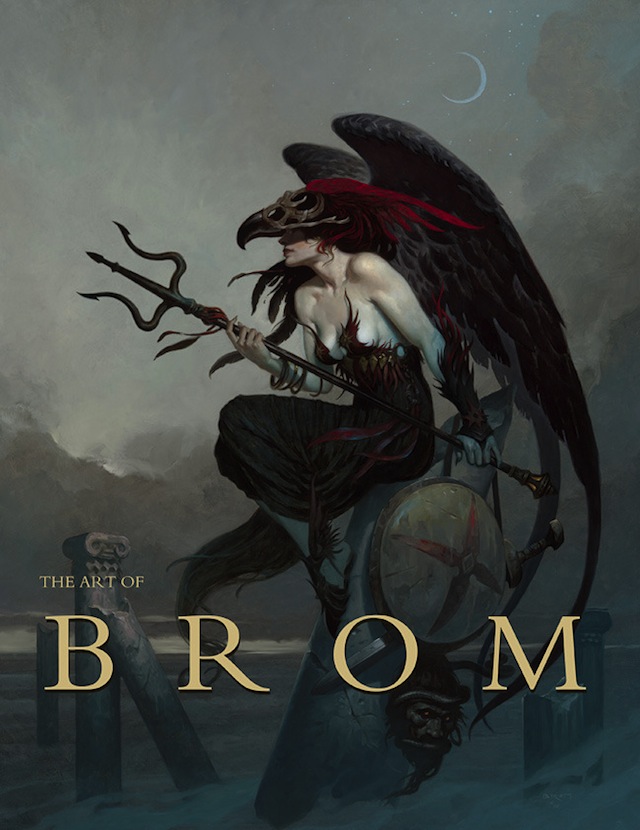
Gerald Brom’s art work shaped the way the Dark Sun game setting evolved. He would paint scenes that the game designers would then use as inspiration when building the world and the game mechanics that went with it. He has a very distinctive and I would say classic fantasy style. His work reminds me a little bit of the work of Frank Frazetta. He’s probably the greatest fantasy artist alive today–yeah I said it. He also has a Kickstarter project on right now to fund a retrospective book of his work. I’m losing my shit over here.
by Ramanan Sivaranjan on August 20, 2012
Tagged: osr odnd dwimmermount toronto osrcon osrcon2012 convention
After a short break we continued our delve of Dwimmermount. We were joined by two more players: another magic-user, and the dumbest fighter ever–the poor guy had a Wisdom score of 3–who was played to perfection by Steve Conner. It turns out those two characters were with us all along, of course.
At the foot of the steps down to level two were a set of lifeless bones wearing armour with weapons at their side. That’s certainly unusual. Our cleric tried to turn them to no effect. You can’t turn a bunch of bones, after all. We walked further down the steps and then they sprung to life. (Maybe you saw that coming.) So began an exploration of the second level of Dwimmermount.
We headed South, finding a room with 6 pillars. Each pillar was made out of a unique material, and each had a character inscribed upon it. In a normal game we would have spent much longer puzzling out what this room was about. As we were playing for a fixed amount of time we quickly moved on. This came up often when exploring the second floor. Because this was a convention game we didn’t dedicate as much time as probably would have in a normal game trying to understand what the rooms we encountered were about. There were lots of strange and interesting rooms on this floor we quickly glossed over. Our focus was more survival and gold.
From here we went East, eventually stumbling upons the ruins of a library. Some careful searching revealed a secret room filled with a cache of books we assumed were of some value. The dilemma: there were hundreds of pounds of these books. We each grabbed one, and decided to move on. We would come back for them at some later date. (Well, in our imaginations, I suppose.)
We moved North from here, passing a room with shattered statues and a stone gargoyle we proceeded to shatter ourselves. We were waiting for it to spring to life. Nope. James informed us that room was now completely full of broken statues. Destroying things was a recurring theme with our party.
Further on we found a room with writing on its walls we couldn’t read. The funny thing about this situation was that we had previously had a conversation about Read Magic / Language being a useless spell because no one ever wastes a spell slot on it. Both our magic-users had charm and sleep. We couldn’t figure out what to do about the writing so we decided to make a sketch and back track.
Heading North once more, we came across another set of pillars. There were four of them, each made of glass, and they ran floor to ceiling seemingly beyond this level in both directions. Each contained one of the four elements. We were going to move on, but someone had a pretty great idea: the air pillar was empty, so why not smash it open and jump down to a lower level of the dungeon. (OK: maybe “great” is the wrong adjective to use with respect to the idea.) We got to smashing and eventually broke enough of the pillar we could send a man through. The problem: we had assumed we had found an empty pillar; in fact air was zipping through the pillar very quickly. We spent a fair amount of time throwing things down the hole to see how fast they sped away, and if we could hear them landing somewhere safely. After some scientific research we decided jumping down was probably not a good idea. Steve’s fighter needed to be talked off the ledge, so to speak.
The very next room we encountered contained several large glass tubes, with doors. Guarding the giant empty tubes were hobgoblins. Our magic-user didn’t feel like another fight so he shouted, “sleep!” and that was that. We decided we would carry one hobgoblin with us to interrogate later. The rest? Well we fed them to the dungeon disposal system we had just found in the previous room. They zipped away to places unknown.
We explored a little bit more, and would have continued to explore indefinitely had Brendan not asked, “can we grab all of those books we found in the secret room, head back to town, try and level up, and then come back to the dungeon ’two weeks later'”
And so it came to pass we found ourselves levelling up characters in the middle of a one-shot. James didn’t bother rolling for random encounters, something i’m guessing he would do if this was a normal game. As such our exit was without incident. My character actually didn’t earn enough gold to get to the next level, but other players fared better. (We each were grabbing odds and ends as we made our way through Dwimmermount, hence the disparity.) The hobgoblin we were lugging around was now a charmed hireling known as long hair, because we had fed him a potion of hair growth while he was unconscious. (We learned it was a potion of hair growth when his hair started growing.) With that we headed back into the dungeon, right back to where we left off. Once again, I suspect James skipped a few steps to speed things along.
The very first room we encountered when back in the dungeon was once again full of hobgoblins, but also a metric ton of treasure. God damn it! If we had explored one more room before heading back to town we all would have definitely gained a level.
From here we once again encountered a series of strange rooms we didn’t have time or energy to investigate fully: a triangle painted on the ground, probably magical; a room full of statues of gods with their heads replaced, and finally a locked door. We could hear what were probably horrible monsters behind it, so it was probably for the best the doors were locked.
We were running short on time. We back tracked to the start of the level and made our way East. We replaced one charmed hobgoblin hireling with another, after the first was killed in battle with the second. We pressed on, but ultimately our search for a way to the third level wouldn’t be fruitful. No one can say we didn’t try.
The game was a lot of fun. James wasn’t to fussy about a lot of the more tedious rules one would probably pay more attention to in a typical dungeon crawl. We weren’t really tracking time, how long torches last, etc. I think these things can be an important part of the game, but if you are only playing for 3-4 hours, there are much better things to focus on. James also drew the map of Dwimmermount as we explored. (I made my own copy, as I knew I’d want to write about this game later.) This all helped the game run quickly and smoothly. I felt like we accomplished so much in such a short period of time.
This game was probably the highlight of my time at OSRCon. I felt like we had a good group, and that we all had a good time. If you have a chance to play in a game with James I recommend you take it.