Continuing my series of great D&D blogs, may I suggest the consistently good Dungeon of Signs by Gustie1. It’s hard to pick any one thing to highlight, so I’ll point out the most recent post about his demon infested ocean liner megadungeon the HMS APOLLYON. The post is a good mix of great writing, art, and creativity that is more or less the staple of each and every post on his site. Why are you still reading this? Go!
I now play D&D with him weekly, so this review isn’t completely unbiased: though I thought the blog was pretty great before we had ever met. ↩︎
The first module for Geoffrey McKinney’s new imprint Psychedelic Fantasies is Beneath the Ruins by Alex Fotinakes. The module describes the first level of the vast ruins of Kihago. One might describe the dungeon as “gonzo”: there are laser pistols and weird science, mutant men, and yeast monsters.
The dungeon is divided into three main zones. Two of the zones are controlled by warring factions: the Luminites, who worship ancient alien technology and believe nothing exists outside of the dungeon, and the Tribe of Yrtuk, mutant men who have lived in Kihago for centuries. The third zone of the dungeon is a no man’s land, both tribes considering it too dangerous to explore. There are two optional sub-levels that can be used if you want to run the module as a self-contained unit. The author also recommends using the dungeons as the first level of a large complex. The booklet concludes with a handful of new monsters and stats for lasers guns.
The module is 16 pages long, printed as a long skinny booklet. This is a really great format for an adventure. (Though, I think it would have worked well as a two-column digest sized booklet as well.) The cover contains the map and is detachable. Each page holds a fair amount of information. Room descriptions are short enough I could imagine running the adventure with almost no prep. The type is a bit small, but I don’t think its hard to read. Some thought has clearly gone into the layout of the booklet. Room descriptions rarely cross pages–I found one exception, and here the break is clear as it happens mid-sentence. When a monster appears in a room its stat blocks is separated from the room description making it easy to pick out which rooms have monsters. All in all its clear this module is meant for your gaming table.
Beneath the Ruins is probably one of the better modules I’ve purchased recently. It’s also incredibly cheap. You should check it out.
A Bone Man (AC 3, MV 60', HD 1+1, Lawful) and a Jale Women (AC 9, MV 120', HD 1+1, Neutral) explore the badlands in search of alien technology for their war tribe.
A party of 2-8 inter-dimensional travelers search for their lost companion. They are armed with turn of the century firearms: pistols & shotguns. They are cautious around and distrustful of any natives of Carcosa they encounter. They will however aid anyone who agrees to help them find their friend.
3-18 red orbs can be seen floating in the distance.
2 Unquiet Worms make their home in the shade of a disabled alien tank. Within the tank, two dead aliens lay mummified in their spacesuits. Sufficiently intelligent creatures can restore the tank to working order after 2-6 turns of experimentation.
Trails of small insects converge on the rocky husk of a massive dead insect. Within an inter-dimensional traveler to Carcosa lays shackled to the ground. Insects crawl in and out of his body. A sorcerer and his minions are in the middle of casting the ritual Canticle of the Crawling God. They will summon the Crawling God in 1-3 hours.
You may use the following table to restock the hex:
1D4
Hex Description
1
3-18 red orbs lay inert on the ground throughout the badlands. If investigated characters must make a Save vs. Poison or develop a random mutation.
2
The Crawling God crosses the badlands trailed by a sea of insects.
3
2 Unquiet Worms feast on the remains of a small party of adventurers. On the bodies can be found: pistols, shotguns and worthless foreign currency.
4
A Bone Man rides through the badlands on an alien tank. He is accompanied by an inter-dimensional traveller to Carcosa. Within the tank is a small cache of books describing sorcerous rituals and the dead body of a Jale Woman.
When you are playing a game that you suspect might be a role playing game, ask yourself these questions:
Am I pretending to be someone I am not.
Am I holding dice.
If you answered yes to both these questions, congratulations, you are probably playing a role playing game. Now go have some fun!
I have heard it remarked that Dungeons and Dragons isn’t a role playing game, it’s a war game. Now, clearly we can see this isn’t the case–unless you are a halfing wizard or some such thing–so the next question to ask is: how do I know if I am playing a war game? If you find yourself wondering if you are playing a war game, ask yourself these questions:
Do I see miniatures.
Am I holding a ruler or tape-measure.
If you answered yes to both these questions, congratulations, you are playing a war game. Now go flank some units!
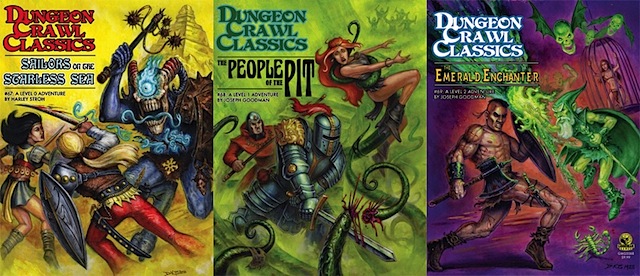
I’ve been reading through my DCC RPG adventures recently. I’ve been buying them as they come out, mostly for the covers, but there is probably some aspect of comic book collecting at play. Each adventure is titled with a giant number indicating where it fits in the sequence of DCC RPG modules. There’s probably something deep in my subconscious that makes me want to buy DCC 68 because I own DCC 67, and then buy DCC 69 because now I own DCC 67 and 68. So it has gone for the last few months.
In Sailors of the Starless Sea (DCC 67), an abandoned keep sits atop an ancient underground sea, where beast men attempt to summon their demonic god. Next we have People of the Pit (DCC 68), in which mutant cultists worship a tentacled Cthulhu monster that feeds on fair maidens. This was followed up with a raid on a wizard’s home in The Emerald Enchanter (DCC 69): a bright green wizard communes with dead sorcerers, uses imprisoned demons for power and resources, and spends his spare time building emerald golems–sometimes out of innocent villagers.
I think it’s fair to say that all of the plot hooks in these modules are pretty fantastic. The adventures are very pulp-fantasy. I could picture running these modules in the world of Carcosa or a game set in the Land of a Thousand Towers just as easily as I could in a more typical fantasy game. For the most part each modules is a well realized set pieces.
There’s a lot to like in these modules, though they all share a very linear structure and a combat heavy focus. To be fair, this is more or less how the adventures are billed by Goodman Games themselves.
Remember the good old days, when adventures were underground, NPCs were there to be killed, and the finale of every dungeon was the dragon on the 20th level? Those days are back. Dungeon Crawl Classics don’t waste your time with long-winded speeches, weird campaign settings, or NPCs who aren’t meant to be killed. Each adventure is 100% good, solid dungeon crawl, with the monsters you know, the traps you fear, and the secret doors you know are there somewhere.
All the adventures end with a ‘boss fight’. Regardless of how messy the maps might look they can often we unwound into a series of rooms the players have to walk through. After reading through modules with more interesting layouts the DCC RPG dungeons can feel a bit lacklustre.
The modules themselves are well put together. They’re 8’x11.5’ softcover books. They have thick glossy covers and paper the modules are printed on doesn’t feel flimsy. All the modules feature fantastic covers by Doug Kovacs that are worth the price of admission alone. Each module is about $10. I’m pretty sure if I wanted to buy a glossy Doug Kovacs print it’d cost me more than $10. The fact the covers come with adventures is a nice bonus. The interior art for each module is just as strong. As objects the modules don’t disappoint.
The Emerald Enchanter is my favourite of the first three modules from DCC RPG, but they are all enjoyable reads. I feel like you could turn them into something more open-ended if that’s the sort of thing you like, and they each have some interesting ideas to steal.
Delving Deeper was released as a set of PDFs yesterday. It’s a retroclone of the Original D&D rules. The only other edition i’m aware of that is similar in scope is the Sword and Wizardry White Box. Unlike the White Box, Delving Deeper stays much closer to Original D&D in its rules. I also think it’s a much better laid out and organized product. The White Box PDF feels more verbose than it need be. That said, some of the additional exposition is good for getting a better understanding of Original D&D. The White Box also feels like a neglected product, with Sword and Wizardry seemingly more interested in their other products.
Original D&D is an incredibly simple game. Delving Deeper would be a great edition to use to teach someone how to play D&D. There are only a few mechanics for resolving problems, there are only a handful of character classes, and all the rules and spells fit in a 34 page booklet. People complain Original D&D is a bit ambiguous at times, and it certainly can be, though I think that’s part of its charm. If you have one player who knows how to play D&D I think the ambiguity won’t be a problem.
Delving Deeper is available for free so you should certainly check it out. The PDFs by Simon J. Bull are really well done. I heartily recommend it. If I ever run a game I think I’ll use this ruleset.
With that in mind, here are 16 new hex descriptions for your Carcosa game.
1D16
Hex Description
1
An Orange Man 1 dressed in furs hunts a band of mutant men. He is armed with a whip and accompanied by 2-12 giant beasts and dinosaurs; these creatures are under his complete control.
2
Spawn of Shub-Niggurath (AC 18, MV 120, HD 3, Chaotic): a blue arachnoid with two red eyes and a toothed mouth. It currently entangled in a grappling hook and 100' of rope. An orange laser pistol can be found in its belly.
3
1 Deep One.
4
Village of 278 Yellow Men ruled by “the Evil Queen,” a Chaotic 9-th Level Sorcerer.
5
A humanoid robot (AC 16, MV 90', HD 4, Chaotic) guards the remains of a crashed alien spaceship. He is armed with a sword and a laser pistol. His 3 large eyes rotate about his head. He can not be surprised and will react with hostility to all who approach.
6
A Blue Man Cyborg with a metal jaw and a robotic hook arm (AC 18, MV 90', HD 4, Chaotic) commands a group of 6-36 Blue Men bandits armed with bone weapons. The bandits demand the players hand over any metal items in their possession, which their leader will proceed to eat. The Cyborg earns +1 to hit for each piece of metal he consumes; this effect lasts one day. (When encountered he has a 0-3 bonus to hit.) His hunger for metal can not be satiated.
7
A hulking Blue Man (AC 15, MV 120', HD 6, Chaotic) with unusual red hair wields a cursed two handed sword. (This character wields the sword one handed, carrying a shield in the other.) Any character possessing the sword is compelled to eradicate all white men from the world; with each white man they kill their hair turns a darker shade of red. The sword is -1 to hit, but +3 to hit vs. White Men.
8
Monastery of 56 Brown Men ruled by “the Golden Hand,” a Chaotic 5-th Level Fighter.
9
Village of 156 Green Men ruled by "the Dragon," a 4th-level Sorcerer. The Sorcerer's research has left him disfigured: he has the scales and tail of a lizard, and is cold blooded.
10
Spawn of Shub-Niggurath (AC 18, MV 90' / 120' [swimming], HD 3, Neutral [intelligent]): an orange anthropoid with scaly skin, two yellow eyes, and a toothed mouth. One of its arms is an oversized claw. In its other hand it carries a green mace.
11
A large bird of prey stalks the players. After 1-3 hours it will turn and fly off into the distance. The bird does not attempt to hide its presence.
12
A disfigured two-headed mutant man lays face down in the ground. His body is half purple & half blue. Characters who investigate the body must make a Save vs. Death Ray each turn or suffer a random mutation.
13
A Purple Man hangs limp from a tree. He is pierced head to toe by spikes. Two tridents lay near his lifeless body.
14
12 Black Men led by a putrid smelling Sorcerer (AC 18, MV 120', HD 3, Chaotic) are in the middle of casting Manifestation of the Putrescent Stench. The Sorcerer is armed with a laser pistol and wears a bright orange alien space suit.
15
4 Snake Men attempt to repair a time machine. The Snake Men and their collection of high-tech gadgetry are incomprehensible to characters with an intelligence score less than 18.
16
A massive snake shaped citadel coils around the peaks of a craggy mountain. Within 22 Bone Man are led by a Chaotic 16th-level Sorcerer. He is planning the total conquest of Carcosa.
Historical Amsterdam could probably be turned into any bustling port city. A D50 random random of encounters offers up some things to do while wandering around town. There are a couple tables for dealing with buying and selling things on the black market. I could imagine this would be useful in all sorts of settings. The later half of the book describes Joop van Ooms, what makes him such a strange and magical figure, his home, and a few of his compatriots. The character is a magical renaissance man, with all that might entail. Van Ooms could be used as a patron for a group of heroes: he’s rich, magical, and has an interesting world view.
Like most of the recent stuff to come out from LotFP, it’s a gorgeous little booklet: the layout, design, and illustrations are all top-notch. Jez Gordon has done a great job here. The PDF is fully bookmarked. (If you read it in Adobe Acrobat, everything that’s a multiple of 8 is hidden from view, as van Ooms would like it.) Like most A5 books, it looks great on the iPad.
The Magnificent Joop van Ooms is a magnificent little book. It’s a quick read and well worth checking out. If you’re looking for a fully fleshed out adventure, this isn’t going to satisfy. The Magnificent Joop van Ooms a book of ideas. I picked up a copy of The Magnificent Joop van Ooms to pad out an order from LotFP, and for the price I heartily recommend you do the same. The cover art is amazing: for $7 bucks you can frame the book and hang it on your wall.
Since starting this blog the amount of D&D I’ve been playing has increased greatly. I continue to participate in the Encounters games held at Dueling Grounds. In addition to those games I’ve been playing a fair amount of old-school D&D: a weekly game run by Brendan of Untimately and occasional games run by James M of Grognardia and Reynaldo of Baroviania fame. After playing so much D&D recently I find the differences between the modern incarnation of D&D and its older editions are quite stark.
D&D Encounters is very much the pathological case of a 4th Edition game. Each session is distilled down to the core of 4th Edition: mostly combat with a tiny bit of role playing. For many people D&D Encounters is their first introduction to D&D. After playing in these games for several months now my feeling is that they teach bad gaming habits. Killing things is more or less the only option open to players to resolve conflicts. You might be able to avoid a fight, but there is a disincentive to do so because then you would probably end up with a very short game. Because each Encounters session needs to transition into the next there is also no room for exploration or change. You can’t take a session in a wild new direction. This isn’t true of 4th Edition, obviously, but is of D&D Encounters. I think a good DM can do a lot to keep the game interesting, but the structure of the adventures hinders a lot of creativity.
The Dwimmermount sessions I’ve participated in are actually similar in scope to the Encounters sessions. Dwimmermount offers a good alternative to running a pick up game. Each session is more or less a self contained unit of adventure: you begin on some level of the dungeon and end things back outside. There isn’t some overarching story that ties the Dwimmermount games together. The story is the exploration of the dungeon; the story is what you and the other players choose to make it. Each session can end in all sorts of strange ways because there is no need to lead into the next chapter of a particular adventure.
I’d love to see a D&D Encounters game that was just a dungeon crawl, but i’m not sure that will ever happen. The current structure lets people discuss the game they played in like they might a TV show. Everyone doing their own thing doesn’t facilitate that sort of conversation.
Combat is fast in the older editions of D&D. This is because it’s very abstract. My old-school D&D sessions often feel like they are full of accomplishment. In a few hours you can do a lot: lots of exploring, lots of fighting, lots of puzzles. 4th Edition is much more tactical and meticulous in its presentation of combat. An Encounters session is usually an hour and a half, give or take, and the bulk of that time is spent on a single fight.
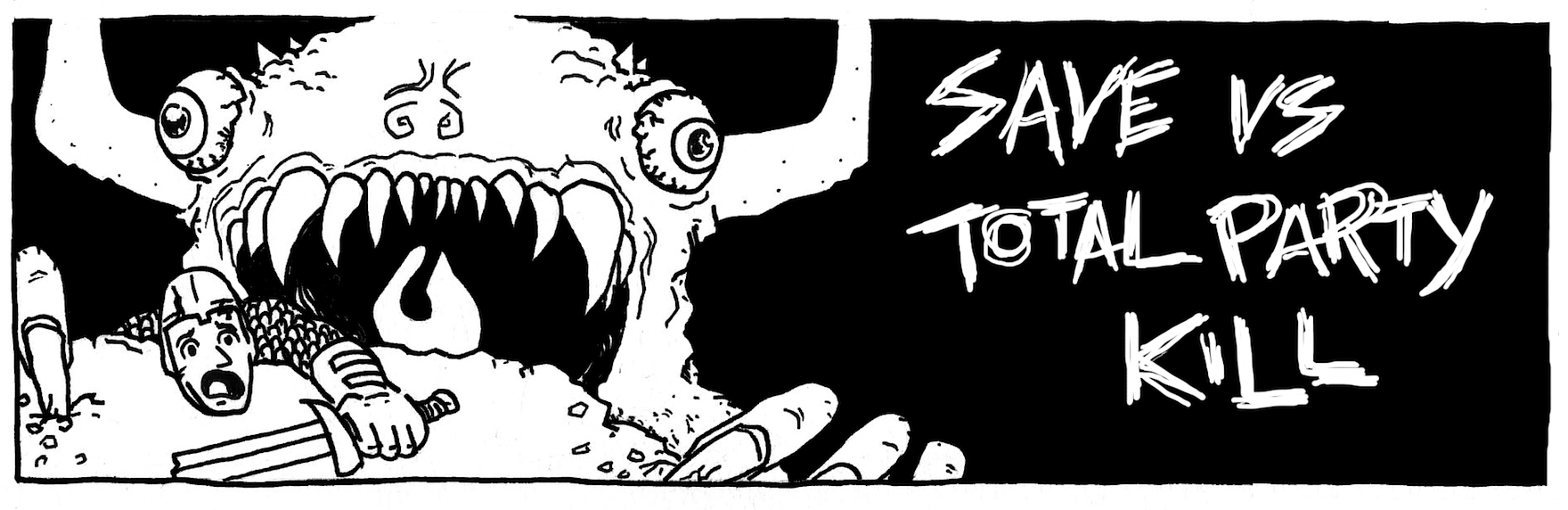
I think most people would agree that faster combat is better, but the way 4th Edition handles combat is not without its merit. Because 4th Edition combat is far less abstract you can talk about that fight in a level of detail you don’t often get with older editions of D&D. Dungeon’s Master’s recaps of his Encounter’s sessions are usually quite long, despite the fact they are primarily a description of a fight, because the pieces that make up combat are quite expressive. You really feel the ups and downs of a fight in 4th Edition. In the last game I played we had a round where almost everyone was down, we were on the verge of a total party kill, only to manage a big come back big the next round. It was amazing.
I’m curious to see if the structure of the public play events Wizards of the Coast runs will change with the release of D&D Next. Combat in D&D next is much faster so adventures wouldn’t need to be modeled as a series of fights. They would presumably still be quite linear, but I suspect you could accomplish more per session than you do in the current Encounters program. There are rumours that the next Encounters game will be more varied in what happens week to week. We will have to wait and see.
Duties It is not practical to try to determine the time and expenses necessary to accomplish everything possible for the scores of standard hirelings possible to employ, so each DM will have to decide. For example, assume that a player character hires a tailor to make plain blue cloaks for all of his or her henchmen. This will take only about 1 day per garment and cost the stated amount of money plus 5 c.p. (10% of the cost of a cloak) per cloak for materials. However, if the same cloaks were to be fashioned of a material of unusual color and have some device also sewed upon them, time and materials costs would be at least double standard, and probably more.
This is the sort of wonderful throw away paragraph that makes the Dungeon Master Guide such a fun read. Gary Gygax begins by telling you, the DM, that he can’t possibly enumerate all the things a player could hire a person to do. That’s a fair point. You don’t want to make the rule book any loner than it already is. He then goes on to provide the fiddliest of rules for making matching capes. The rules seem so specific. Was this something that came up all the time in old-school games? I picture an entourage of dungeon delvers decked out like a boy-band fighting Orcus.