Tephrotic Nightmares is about the sea of ash, a region that was ruined by The Arsonist. Dark Sun had a Sea of Silt, so perhaps I am already biased towards liking this book. The very first thing we learn about this place is water is the currency of note, letting us know what is important and valuable up front. (I was reminded of light in Veins of the Earth.)
The order elements of an adventure are presented in is something I find intriguing. After the introductory page explaining you are exploring a sea of ash, we jump straight to rules for sailing this silt sea in Mork Borg. Luke writes about the various modes of transport available to the players, Mad Max like boats, and the various weapons and defences available to trick them out. The book came with a map and chits so you can play a wargame. Hells yeah!
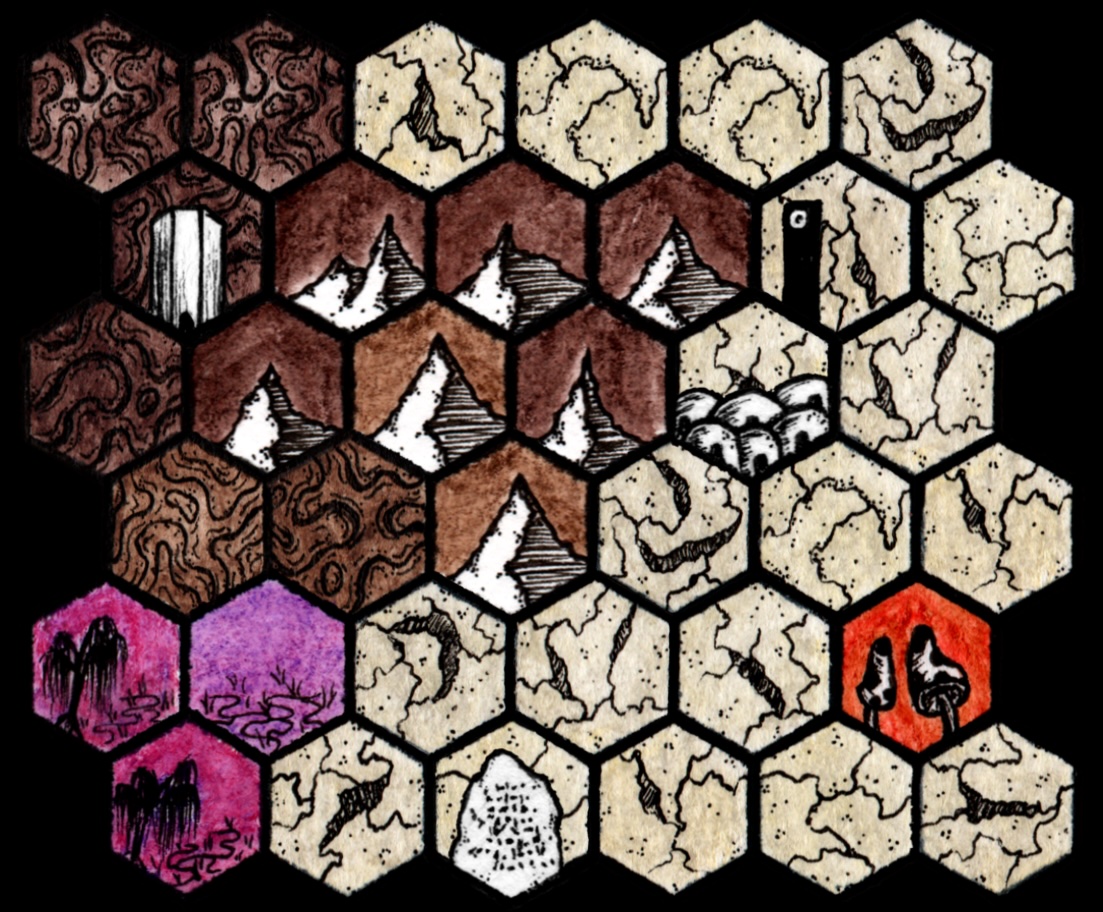
Factions come next. There are several. Their bases are placed on the hex map of the region. Each faction is described briefly, with a goal, their current challenges, offerings and rituals. These are a sentence or two, and hint at how players may end up interacting them. None are presented in a way that they are explicitly in conflict with one another. The typical units that make up the faction are described, with stats for Mork Borg, along with the vessels each faction uses for travel. Between Luke’s writing and Johan’s art, we get a vivid picture of these groups without too much faffing about.
A bestiary follows. Everything is flavourful, starting with a small and vicious dog, the ash mink. Luke lets you know people are harvesting bodies for water, like Dune. Johan draws some cool witches.
The back half of this book are locations of varying sizes found in the ash sea. There are 22 places in all, starting with the headquarters of 5 of the 6 factions. The region is fairly large, most hexes aren’t described. As this is a sea, that makes sense. Ships move 1-3 hexes per days, so there will be a fair bit of multi-day travel to get from location to location. There are random encounter tables, but I think a GM would want to think about how they want to run the parts of the game that are sailing between locations.
The Bloodhunter Fortress has NPCs who can let the PCs know where to find various monsters. Perhaps the campaign becomes a monster hunter game for a while? The Urniversity will pay PCs to go map a region of the sea. Perhaps the its a game of exploration for a while. The Pyromancers of the Cold Hearth, home of the Burnt Offering faction, will reward players if they find the holy book secreted away within the hidden fortress of the Arsonist, the person who created the ash sea. The Necromancers of the same faction want that book as well. More adventure for the PCs. Locations can feel a bit disconnected from one another, but I found them cool all the same.
The first big dungeon detailed is the faction headquarters of the Cannibal Count. His mount-manse is detailed over 12 pages, with art and maps by Johan. Maps are repeated so you don’t need to flip pages when running, a nice touch. Room descriptions are short and punchy, as I like them. Luke informs the reader that unless the players are hostile encounters should be social, but these people are cannibals: there’s gonna be tension there. These are strange bureaucratic cannibals. Lots of departments and assistants to assistants, working despite their boss seemingly being long gone.
Hex 11 describes a shipwreck, a creature within may take a character hostage and demand the captain of the boat return. But where is the captain? I thought this might be an exercise for the reader. The GM will make something up, maybe some random NPC in one of the faction bases is the captain. Reading ahead, we learn he is a prisoner in Hex 18, The Grinding. So this is still an exercise, just not the one I thought: make note of where they are!
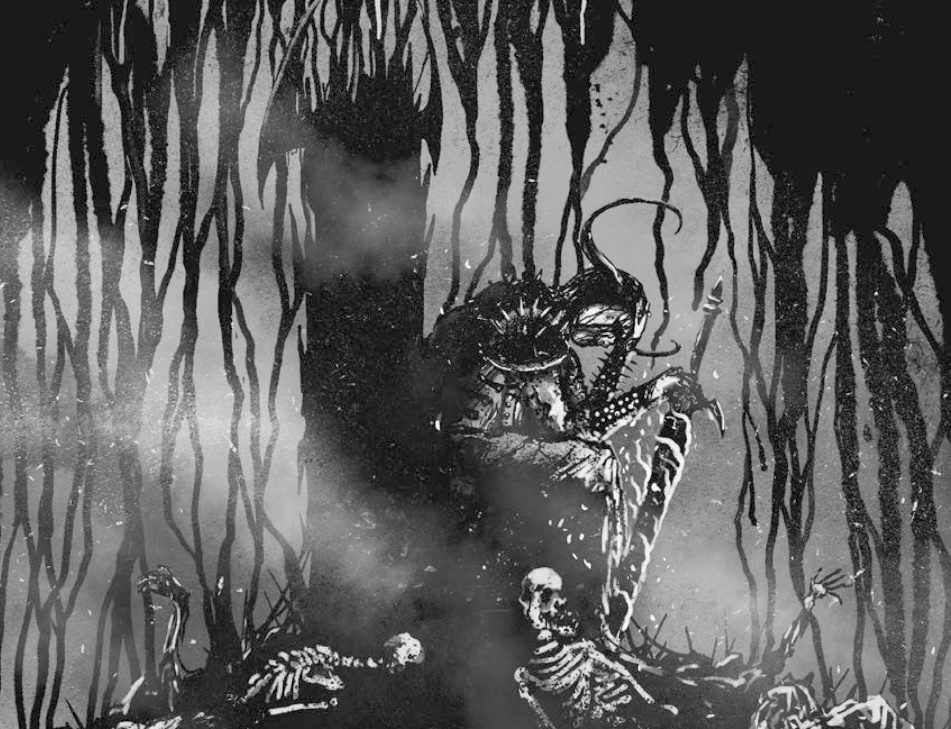
The book concludes with another big dungeon, which takes up 20 pages of the book. The “big boss”, the Arsonist, is found here. As with most everything in this book, there is nothing pushing the players here, though I imagine through the course of play they may find their own reasons.
I was reminded of a False Machine joint based solely on the amount of cannibalism in this book. It feels like every other group you meet eats people.
Tephrotic Nightmares is interesting object: the spine is exposed: you can see the stitched binding and it will lie perfectly flat. The other pages aren’t cut, you need to peel them apart as you read. Your first encounter with the book is a bit of an experience. The hardcover book is genuinely lovely, and if you can afford its price I would recommend it wholeheartedly over a boring PDF. Johan has done an incredible job with the art and graphic design—unsurprisingly.
It was interesting to read this book after reading His Majesty the Worm. In contrast to the exposition and support in HMtW, Tephrotic Nightmares really doesn’t hold your hand. Here are rules for sailing around, here are a bunch of weirdo factions, here are some monsters, here are some places. How you thread it all together is left up to you. Proper OSR nonsense! I really love books like this. A sandbox of stuff. The writing is strong. The art is great. It’s all very atmospheric. But is it too static? If there is criticism to be had, I suspect it will fall here. I think this sort of adventure is perfectly fine. The GM will figure out what’s up, along with the players, through play. From running adventures like this, stuff gets messy when the players get involved.
Masters of Carcosa is the longest campaign I have run. My friends and I played 23 sessions, starting at the end of 2014, ending near the start of 2016. The game began after Brendan took a break from running Pahvelorn, likely to focus on his PhD. I hadn’t run a game since I was a kid! Playing in Brendan’s Pahvelorn campaign was hugely inspirational, and has informed how I have run games since. With Pahvelorn we were exploring a megadungeon, with the occasional trips out to explore the larger world. I wanted to run a hex crawl, but wasn’t completely sure how to start. In 2014 it didn’t feel like there nearly as many resources available compared to talking about dungeon delving.
My plan was to run a game set in the world of [Carcosa][], a gonzo setting by Geoffrey McKinney, originally published as a small zine, in the style of old Judge’s Guild hex crawls. I was running from the fancier version put out by LotFP, which featured Rich Longmore’s incredible art. We learn about the setting via hex descriptions like the following:
Village of 240 Yellow Men ruled by “the Fullness of Benedictions,” a chaotic 10th-level Fighter.
2 B’yakhee.
On a natural stone outcrop is a 2 high statue of Hastur,
made of an indestructible dull black stone. In front of it is a human skeleton. If anyone touches the statue, he will be cursed to carry the 40 pound statue with him always. The only way to lift the curse is to give the statue to a willing recipient, but no one wants the vile thing.
The book was pretty polarizing for lots of reasons, one being how phoned-in some of the hex descriptions are. I loved it all the same. You would be surprised how far “2 B’yakhee” can take you in a session. I enjoyed improvising off the small hard facts presented in the book and my own notes.
At the time I wrote a second review of Carcosa, after having run the campaign for few sessions. It’s interesting to look at the review now, as it focuses almost exclusively on how I went about setting up the campaign we would play. But how do you even run a hex crawl?
Sandbox play is long term play. A hex crawl is about exploring the world, and that’s hard to do in an interesting or meaningful way in a handful of sessions. If there is one lesson to be learned about running a sandbox, it’s that whatever rules & mechanics nonsense you come up with to make your game go, none of it will matter if you don’t actually play. I was inconsistent when it came to scheduling the game, and it was likely the biggest reason we finally stopped playing. Players would regularly miss sessions because they thought we were playing the following week, miss a game because I had to push it out a week at the last minute and they already had plans, etc. People will tell you that this or that game isn’t suited for long term play. “Mothership is only good for one-shots.” Bull shit. Games don’t stall out because the levelling mechanics aren’t interesting enough, or because high level fighters become too dominant, or the wizard knows too many spells. Games stall out because people can’t get their schedules to match. Picking a schedule and sticking to it is really the only “mechanic” you need for long term play. This is the fundamental theorem of gaming.
Related to the above, running an open-table will make it easy to keep a game going when people lead busy lives and can’t commit to regular play. For those unfamiliar, an open-table simply means there are no fixed set of players participating in the game. Session to session you’ll have a different roster of players playing. Masters of Carcosa had 16 players over its 23 sessions. Eric made every single session save 1, and the one he missed was over scheduling confusion, my mistake. Gus, Nick, and Dion were other core players, making most games. If we had kept playing Chris likely would have become another core player. Everyone else played a few games and moved on with their lives, dropping in and out. Brendan would require us to return to a home base at the end of each session, and I had the same rule for my own game. The players always returned to a safe settlement at the end of each session, which made the juggling of players work in the fiction. (Mind you, I think it’s best not to be too fussed about how Dwarf Icefingers suddenly appeared when he wasn’t in the dungeon last session.)
You shouldn’t prepare too much to start. Chgowiz says this best in his classic blog post Just Three Hexes, but this blog post didn’t exist when I started playing. Lucky for me, not prepping enough is how I live my whole life. I drew a mini campaign map focused on a smaller section of Carcosa, where I expected the game to begin before the players ventured off into the wider world. The players never left. They didn’t even explore all the hexes in my mini-map! A small region can provide years of play.
There is lonely fun to be had in prep, and you can often find ways to repurpose work you’ve done that will clearly never find the light of day, but it takes a lot of energy to keep a game going for a long time, so best to spend your time wisely. Prepping too much before you’ve even played a game feels like writing an elaborate backstory for your player character before a campaign begins. Good advice for players remains good advice for game masters: let things evolve over time.
You shouldn’t front load too much. When you finish a session, take copious notes. I would write recaps of each session, so I would remember what took place. Anything important for the future I would add as notes for the given hex. A throw away NPC can suddenly become crucially important. This is a more dynamic and interesting way to run a game—both for yourself and your players. You just need enough hard facts for the choices the players take to be meaningful. You can always build upon these facts as the game moves along.
When I shared the invites for my games on Google+ I would include rumours, things the players were made newly aware of, and reminders of loose threads from previous sessions. I maintained a Google+ post of all the open threads and rumours, so they wouldn’t forget about a weirdo they met in the wilderness, or a dungeon they might want to go back and explore. There was no overarching “plot” for the campaign. Everything that happened was player driven. For that to work you need a world without enough juice that there are different avenues for the players to pursue. In Masters of Carcosa the players were obsessed with destroying the Jale Slavers. There is a parallel universe where the campaign instead focused on exploring the Putrescent Pits of the Amoeboid Gods.
I would seed information about the world and its machinations wherever I could. NPCs would tell the players about nearby settlements, or factions they encountered in the wilderness. The players would find letters on dead bodies, discussing what was happening in the wider world. In one Sages in town would trade information for gold, or send the players on little quests. I made an effort to try and always reinforce that there was a lot going on completely divorced from the players and their immediate actions.
I have written on this topic in the past, but it’s a mistake to be too coy about what’s going on in the world, what your factions are up to. There is a fine balance here. Some of the fun situations that occurred during the campaign came from my players being unaware of what was happening off camera. They set one of the villains of the game free in the first session. Many sessions later the same villain returned to recapture the base he was imprisoned within. Later still the players would liberate that base, unaware they had set this all in motion until after they had succeeded. A different faction was exploring the dungeon the players had no interest in exploring. They would find the occasional missive or hear a story about the cult looting in their place, but only if they travelled to areas where such news would be more likely to be found. I had another faction messing around in the region, Snake Men who had travelled forward in time to save their people. I was so secretive about their machinations the players never really knew they existed, just brushing up against the aftermath of their actions. If we had played longer, perhaps this would have made for a good reveal. Or perhaps the lack of information would continue to make it too difficult for players to make any meaningful choices about how to engage with them. Sometimes it’s fine for things to be a little gamey. I eventually moved to sharing what was happening off camera in my Carcosa-style recaps that featured hex descriptions and encounter tables.
I enjoyed being as surprised as my players when it came to what would happen during a session. I made extensive use of random tables to make the game go. This was perhaps partly an artifact of how terse Carcosa is, partly due to my own terse notes, and partly just my own preferences for how I like to run games. With wilderness exploration this feels like the most effective way to drive the game without relying on laborious prep. Groups of hexes would share a unique encounter table. The area around the players starting base began with: slavers and escaped slaves, a merchant caravan and their guards, bandits, Spawn of Shub-Nigguraths, and a unique spherical hunter robot that captures people in the wilderness to take back to its base. This table already tells a story about what’s happening in the region.
My secret sauce was expanding on these tables as we played the game. If an encounter with bandits was memorable, and they didn’t kill them all, they would return as a future entry on the encounter table. When the players desecrated a space alien tomb, stealing some armour, I added the Space Alien Strike Force who were trying to track down the culprits to the encounter table. This group ended up becoming an important mini-faction in the game, and close allies of the players. On multiple occasions the players released giant Spawn of Shub-Nigguraths, worshiped as gods, into the wilderness. Of course I added them to the encounter tables. It made the world feel alive when the players would bump into old friends or enemies, keep running up against factions they hated, or have to run away from giant god-monsters.
Players actions should impact their place within the world. If they are dirt bags to the slavers (as they should be) then the slavers will be dirt bags to them. I had a reputation system to track how the players were regarded by the various factions. I would give the players positive or negative reaction rolls modifiers based on their reputation, which was based on their actions in the game. I would stop rolling if it felt like their actions had firmly placed them on a faction’s good or bad side.
Factions should have their own goals, sometimes at odds with the players, sometimes at odds with other factions. They make progress towards their goals unless actively impeded by the PCs. The world should feel like it’s moving independently of the players. I was running things so long ago it didn’t feel like there was an obvious system to steal. Nowadays I would just use the rules from Mausritter. There doesn’t feel like much else to say here, they are so simple and good.
I decided from the start that in the barren wastes of Carcosa travelling through any hex would be as difficult as travelling through any other. I didn’t want to fuss around with different travel times for different types of hexes. In Carcosa they all felt roughly the same. Brendan had written a post called Solipsistic Hexes that may have been some of the inspiration for this choice. A decade later, Mythic Bastionland takes the same approach. There are interesting choices to be had if your setting has roads, or varied terrain that encourages particular routes through the wilderness, but I think you can get far just having hard barriers the players need to navigate around. In my Carcosa game I had huge valleys, mountains, toxic rivers, etc, to block the player’s way.
The rules for how I ran wilderness exploration were quite short:
There are 4 wilderness actions: move, camp, hunt & forage for food, and explore. Characters may take two actions during the day, and one at night.
The DM’s map of Carcosa is divided up into 10 mile hexes. There are no short simple trips through the wilderness. The world of Carcosa lacks proper roads, with much of the planet a rocky badland. Moving allows players to travel from hex to the next. (Some hexes, like those covered in mountains or filled with swamps, may require characters use more than one move action to get through.)
Characters generally rest at night by Camping. Skipping a camp action puts the characters at a -2 for all rolls during the following day.
Hunting and Foraging for Food can be done to attempt to find food (rations) in the wild.
Exploring will reveal a random unknown location within the hex. The players may instead attempt to find a specific location they know is somewhere in the hex. If the location is well hidden, doing so requires the character with the highest wisdom score roll under their wisdom.
Re-reading this now, it isn’t that far and away from what Chris would settle on in Mythic Bastionland. It’s a shame he hadn’t written his game at the time, I could have just started from his work. After each action the players would roll an overloaded encounter die to see what complications arise. I settled on encounters on the 1 & 2, a complication on a 3, lost on a 4, and safe on a 5 or 6. These rolls ended up being a big driver of action in the game, because as noted above, each region had their own wilderness encounter tables, and they tied back into the game world.
And that was the game! The players would plan out goals for the session. Wander off into the wilderness. Get lost. Fight bandits. Rescue slaves. This was all driven from this loose process and framework for play. I started with almost nothing, and figured it out as I went along. You shouldn’t let a fear of doing it wrong stop you from playing. It’s honestly pretty hard to play wrong.
I was thinking the next little web application I was going to build would be something for managing notes for a hex crawl.
One problem with the way they are published now is that you need to flip all over the place because hexes are usually listed in columns. If your players are in Hex 0101 information about Hex 0201 is going to be further away than information about Hex 0116, which seems silly. With a website you could view your hex crawl as a series of 3 x 3 grids, the hex you are on being the centre. Clicking on one of the adjacent hexes would bring up a new 3 x 3 grid with information about the new hexes the players could now move into. This would probably give you a better sense of what’s happening around a hex than the way most books present things. With a web page you could even display a big grid of all the hexes and information about each one. You could scroll around on the page to see what’s up.
The PDF version of Carcosa does a pretty good job of linking to anything and everything it can within its hex descriptions. This is something you can do quite easily with a web page. More so, you could have this cross reference information be generated automatically based on the description the user types in.
As players move around they’re going to effect the world they are wandering around in. You could track these notes and changes, updating your hex crawl as you go. You could track what the players have done, and what your NPCs are doing as well. You could see a history of what’s happened in any hex, which could be handy.
I’m curious if anyone else has thought about this stuff? Is there other stuff about running a hex crawl that could benefit from the power of modern computing?
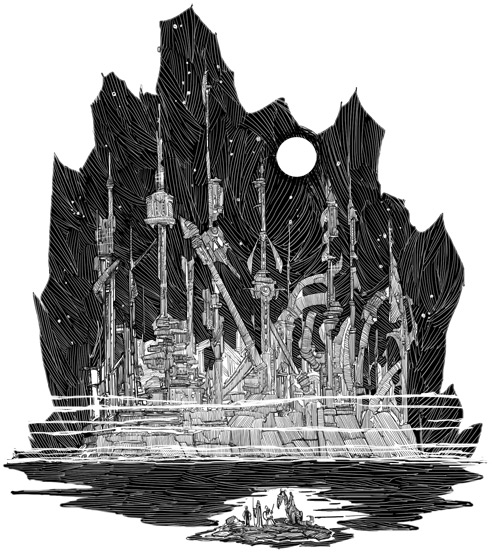
1507: On a lifeless island of black stone stands the alien city of Carcosa.
A silhouette of this city is featured on the cover of Carcosa. The city is only mentioned once in the book, in this description. It’s certainly an evocative sentence.
Carcosa concludes with a tour of its world via a hex map and descriptions of those hexes. As has been a running theme in my reviews of the book1, the details of each hex are quite terse. Geoffrey McKinney continues to say the bare minimum needed to convey anything at all about the world he has created. There is definitely something old-school in this sort of presentation.
Each hex description includes two possible things the PCs could come across. The first description is written by McKinney, and was the only description presented in the original booklet version of Carcosa. The second set of descriptions were created by fellow gamer and fan of the setting Chris Robert; he had previously published these descriptions as a free PDF, Strange Sights of the Doomed World Carcosa.
McKinney’s descriptions are very matter of fact. There is a village here; there is a disgusting monster there. Occasionally he will hint at something sinister or exciting, but it’s just a hint. Robert’s descriptions are somewhat similar in tone, but are a bit more varied in their execution. I can imagine coming up with my own set of encounters, using Robert’s take on things as a good example of how to proceed.
The hex descriptions of Carcosa can be split into three types of encounters: villages and citadels, spawns of Shub-Niggurath, and the “weird”. That last category is broad, clearly.
402: Here looms the great and extinct black volcanic Mount Voormith’adreth, honeycombed with weird and outré caverns, and beneath which bubbles and heaves Shub-Niggurath.
This is a pretty important place in Carcosa. It’s home of Shub-Niggurath, the creator of almost all the important species on the planet. Spawns of Shub-Niggurath are one of the most common creatures encountered on the planet. This little passage is all that McKinney dedicates to their creator’s home.
1610: Village of 370 Red Men ruled by “the Lover of Peace,” a lawful 5th-level Sorcerer.
This is your typical village description: here are some men and this is their leader. You can often get a sense of what the village will be like based on the leader’s alignment and title.
1609: Citadel of 83 Bone Men led by a chaotic 6th-level Fighter.
Some times descriptions are even more terse. Who knows what this village is like? The village is 6-12 miles from the citadel. Maybe there is a relationship there? Carcosa encourages thinking like this.
1513: Ulfire Mold.
The tersest hex description possible? The alternate encounter for this hex, by Robert’s, is a bit more meaty.
1513: The undying and practically invisible brain of a chaotic Bone Man Sorcerer lies shallowly buried in the reeking fens of this hex. It is eager to find new flesh, though discriminating enough to consider only a fellow Bone Man as an acceptable vessel. Any Bone Man coming with 100′ of the brain must make a saving throw vs. magic. Failure indicates that he is compelled to unearth the brain, tear his own brain from his head, and replace it with the Sorcerer’s brain. If this occurs, the Sorcerer will take the first opportunity to escape to his secret lair in hex 0715, there to resume his experiments into the forbidden.
There are lots of interesting little encounters to be had throughout Carcosa. Even if you weren’t interested in running a game in the settings there is definitely stuff one could steal here.
The book concludes with a short adventure and random tables to aid a DM in running a hex crawl on the planet. The adventure is presented as a keyed dungeon and a mini hex-crawl. Besides wandering monster tables, we also get a table for creating alien technology, one for making spawns of Shub-Niggurath, and one for making random robots.
If it’s not clear by now, I really liked Carcosa. The book is physically fantastic. It’s definitely worth buying for Rich Longmore’s art alone. His illustrations of the setting are incredible. The pictures i’ve used in my reviews are a small sampling of the stuff in the book. The fact the material itself is also quite good was a nice bonus. I didn’t expect to enjoy this book as much as I did. I had no real interest in hex-crawl adventures, Lovecraft, weird sci-fi in my fantasy, or half the things that Carcosa is all about. McKinney has done a great job in sharing the things that he likes about D&D. You should buy this book already.