by Ramanan Sivaranjan on January 01, 0001
Tagged:
A lot of the DM facing rules in Dungeon World seem interesting outside of the game itself. Fronts are one aspect of Dungeon World that seem to be loved by all. Presented below is the chapter from Dungeon World on Fronts. (This text was generated from the text on Github.) — RAM
Fronts
Fronts are secret tomes of GM knowledge. Each is a collection of linked
dangers—threats to the characters specifically and to the people,
places, and things the characters care about. It also includes one or
more impending dooms, the horrible things that will happen without the
characters’ intervention. “Fronts” comes, of course, from “fighting on
two fronts” which is just where you want the characters to be—surrounded
by threats, danger and adventure.
Fronts are built outside of active play. They’re the solo fun that you
get to have between games—rubbing your hands and cackling evilly to
yourself as you craft the foes with which to challenge your PCs. You may
tweak or adjust your fronts during play (who knows when inspiration will
strike?) but the meat of them comes from preparation between sessions.
Fronts are designed to help you organize your thoughts on what opposes
the players. They’re here to contain your notes, ideas, and plans for
these opposing forces. When you’re in a bind your fronts are where
you’re going to turn and say, “Oh, so that’s what I should do.”
Consider them an organizational tool, as inspiration for present and
future mayhem.
When you’re building fronts, think about all the creepy dungeon
denizens, the rampaging hordes and ancient cults that you’d like to see
in your game. Think in broad strokes at first and then, as you build
dangers into your fronts, you’ll be able to narrow those ideas down.
When you write your campaign front, think about session-to-session
trends. When you write your adventure fronts, think about what’s
important right here and right now. When you’re done writing a few
fronts you’ll be equipped with all the tools you’ll need to challenge
your players and ready to run Dungeon World.
When to Make Fronts
You’ll make your campaign front and first adventure fronts after your
first session. Your campaign front may not be complete when you first
make it—that’s great! Just like blanks on a map, unknown parts of your
campaign front are opportunities for future creativity.
After that first session you’ll also make some adventure fronts. One or
two is usually a good number. If you find yourself with more adventure
fronts consider leaving some possible fronts as just notes for now.
Campaign and Adventure Fronts
At their core, all fronts contain the same components. They sort and
gather your dangers into easy-to-use clusters. There are, however, two
different kinds of fronts available to you. On the session-to-session
level there are your adventure fronts. These fronts will see use for a
few sessions each. They’re tied to one problem and will be dealt with or
cast aside as the characters wander the dungeon or uncover the plot at
hand. Think of them as episodic content: “Today, on Dungeon World…”
Tying your adventure fronts together is your campaign front. While the
adventure fronts will contain immediate dangers—the orcs in Hargrosh
Pass, say—the campaign front contains the Dark God Grishkar who drives
the orcs to their pillaging. The campaign front is the unifying element
that spans all the sessions of your Dungeon World game. It will have
slower-burning portents but they’ll be bigger in scope and have a deeper
impact on the world. Most importantly they’ll be scarier if they’re
allowed to resolve.
When a danger from an adventure front goes without resolution you’ll
have to make a decision. If the danger is something you like and feel
has a place in the larger world of your game don’t hesitate to move it
to the campaign front. You’re able to make smaller dangers that went
unresolved into bigger dangers some day later on. You can move dangers
from the campaign fronts to an adventure front if they’ve come to bear,
too.
Creating Fronts
Here’s how a front comes together:
- Choose campaign front or adventure front
- Create 2-3 dangers
- Choose an impending doom for each danger
- Add grim portents (1-3 for an adventure front, 3-5 for the
campaign front)
- Write 1–3 stakes questions
- List the general cast of the front
Creating Dangers
Not every element of your game will warrant a danger—traps, some roving
monsters, and other bits of ephemera may just be there to add context
but aren’t important enough to warrant inclusion. That’s okay. Fronts
are here to keep you apprised of the bigger picture. Dangers are divided
into a handful of categories, each with its own name and impulse.
Every danger has a crucial motivation that drives it called its impulse.
The impulse exists to help you understand that danger. What pushes it to
fulfill its impending doom? Impulses can help you translate the danger
into action.
When creating dangers for your front, think about how each one interacts
as a facet of the front as a whole. Keep in mind the people, places, and
things that might be a part of the threat to the world that the front
represents. How does each danger contribute to the front?
Let’s say we have an idea for a front—an ancient portal has been
discovered in the icy north. We’ll call our front “The Opening of the
White Gate.”
The easiest place to start is with people and monsters. Cultists, ogre
chieftains, demonic overlords, and the like are all excellent dangers.
These are the creatures that have risen above mere monster status to
become serious threats on their own. Groups of monsters can be dangers
too—goblin tribes or a rampaging centaur khanate, for example.
For the front we’re creating, we can pick a few different groups or
people who might be interested in the gate. The College of Arcanists,
perhaps. There’s a golem, too, we’ve decided, that protects the
forgotten portal. The golem is just an obstacle, so we won’t make him a
danger.
Thinking more broadly, less obvious elements of the world can be
dangers. Blasted landscapes, intelligent magical items, ancient spells
woven into the fabric of time. These things fulfill the same purposes as
a mad necromancer—they’re part of the front, a danger to the world.
For our front, we’ll add the gate itself as a danger.
Lastly, if we think ahead, we can include some overarching dangers. The
sorts of things that are in play outside the realm of the obvious—godly
patrons, hidden conspiracies and cursed prophecies waiting to be
fulfilled.
Perhaps the White Gate was carved in the ancient past, hidden by a race
of angels until the Day of Judgement. We’ll add the Argent Seraphim to
our front as a new danger.
There’s always more dangers you could add to a front, but limit yourself
to 3 at most and leave room for discovery. Like a map, blank spaces can
always be filled in later. Leaving room for player contribution and
future inspiration means you’ll have freedom to alter the front and make
it fit the game. Not every bad thing that could happen deserves to be
made into a danger. If you’re uncertain, think about it this way:
dangers can always get worse.
A barbarian tribe near the gate, the frozen tundra itself, a band of
rival adventurers; all these things could be dangerous elements of the
game but they’re not important enough just yet to deserve to be dangers.
Creating dangers is a way to slice up your overall front concept into
smaller, easier to manage pieces. Dangers are tools for adding detail to
the right parts of the front and for making the front easier to manage
in the long run.
Once you’ve named and added a danger to the front you need to choose a
type for that danger from the list below. Alternately, you can use the
list of types to inspire dangers: with your front in mind, peruse the
list and pick one or two that fit.
For our three dangers (The College of Arcanists, The White Gate and the
Argent Seraphim) we’ve selected Cabal, Dark Portal and Choir of Angels,
respectively.
Types of Dangers
- Ambitious Organizations
- Planar Forces
- Arcane Enemies
- Hordes
- Cursed Places
Ambitious Organizations
- Misguided Good (impulse: to do what is “right” no matter the cost)
- Thieves Guild (impulse: to take by subterfuge)
- Cult (impulse: to infest from within)
- Religious Organization (impulse: to establish and follow doctrine)
- Corrupt Government (impulse: to maintain the status quo)
- Cabal (impulse: to absorb those in power, to grow)
GM Moves for Ambitious Organizations
- Attack someone by stealthy means (kidnapping, etc.)
- Attack someone directly (with a gang or single assailant)
- Absorb or buy out someone important (an ally, perhaps)
- Influence a powerful institution (change a law, manipulate doctrine)
- Establish a new rule (within the organization)
- Claim territory or resources
- Negotiate a deal
- Observe a potential foe in great detail
Planar Forces
- God (impulse: to gather worshippers)
- Demon Prince (impulse: to open the gates of Hell)
- Elemental Lord (impulse: to tear down creation to its component
parts)
- Force of Chaos (impulse: to destroy all semblance of order)
- Choir of Angels (impulse: to pass judgement)
- Construct of Law (impulse: to eliminate perceived disorder)
GM Moves for Planar Forces
- Turn an organization (corrupt or infiltrate with influence)
- Give dreams of prophecy
- Lay a Curse on a foe
- Extract a promise in exchange for a boon
- Attack indirectly, through intermediaries
- Rarely, when the stars are right, attack directly
- Foster rivalries with other, similar powers
- Expose someone to a Truth, wanted or otherwise
Arcane Enemies
- Lord of the Undead (impulse: to seek true immortality)
- Power-mad Wizard (impulse: to seek magical power)
- Sentient Artifact (impulse: to find a worthy wielder)
- Ancient Curse (impulse: to ensnare)
- Chosen One (impulse: to fulfill or resent their destiny)
- Dragon (impulse: to hoard gold and jewels, to protect the clutch)
GM Moves for Arcane Enemies
- Learn forbidden knowledge
- Cast a spell over time and space
- Attack a foe with magic, directly or otherwise
- Spy on someone with a scrying spell
- Recruit a follower or toady
- Tempt someone with promises
- Demand a sacrifice
Hordes
- Wandering Barbarians (impulse: to grow strong, to drive their
enemies before them)
- Humanoid Vermin (impulse: to breed, to multiply and consume)
- Underground Dwellers (impulse: to defend the complex from
outsiders)
- Plague of the Undead (impulse: to spread)
GM Moves for Hordes
- Assault a bastion of civilization
- Embrace internal chaos
- Change direction suddenly
- Overwhelm a weaker force
- Perform a show of dominance
- Abandon an old home, find a new one
- Grow in size by breeding or conquest
- Appoint a champion
- Declare war and act upon that declaration without hesitation or
deliberation
Cursed Places
- Abandoned Tower (impulse: to draw in the weak-willed)
- Unholy Ground (impulse: to spawn evil)
- Elemental Vortex (impulse: to grow, to tear apart reality)
- Dark Portal (impulse: to disgorge demons)
- Shadowland (impulse: to corrupt or consume the living)
- Place of Power (impulse: to be controlled or tamed)
GM Moves for Cursed Places
- Vomit forth a lesser monster
- Spread to an adjacent place
- Lure someone in
- Grow in intensity or depth
- Leave a lingering effect on an inhabitant or visitor
- Hide something from sight
- Offer power
- Dampen magic or increase its effects
- Confuse or obfuscate truth or direction
- Corrupt a natural law
Description and Cast
Write up something short to remind you just what this danger is about,
something to describe it in a nutshell. Don’t worry about where it’s
going or what could happen—grim portents and the impending doom will
handle that for you; you’ll get to those in a bit. If there are multiple
people involved in the danger (an orc warlord and his clansmen, a
hateful god and his servants) go ahead and give them names and a detail
or two now. Leave yourself some space as you’ll be adding to this
section as you play.
Custom Moves
Sometimes a danger will suggest a move that isn’t covered by any
existing ones. You can write custom moves to fill the gaps or to add the
right effects for the danger. They can be player moves or GM moves, as
you see fit. Of course, if you’re writing a player move, keep your hands
off the dice and mind the basic structure of a move. A 10+ is a complete
success, while a 7–9 is a partial success. On a miss, maybe the custom
move does something specific, or maybe not—maybe you just get to make a
move or work towards fulfilling a grim portent. The formatting of these
moves varies from move to move.
For the Opening of the White Gate, I just know some fool PC is going to
end up in the light that spills from the gate, so I’m writing a move to
show what might occur.
When you stand in the presence of the Light From Beyond, roll+WIS:
✴ On a 10+ you are judged worthy, the Argent Seraphim will grant you a
  vision or boon.
✴ On a 7-9 you are under suspicion and see a vision of what dark fate
   might befall you if you do not correct your ways.
✴ On a miss, thou art weighed in the balance and art found wanting.
Grim Portents
Grim portents are dark designs for what could happen if a danger goes
unchecked. Think about what would happen if the danger existed in the
world but the PCs didn’t—if all these awful things you’ve conjured up
had their run of the world. Scary, huh? The grim portents are your way
to codify the plans and machinations of your dangers. A grim portent can
be a single interesting event or a chain of steps. When you’re not sure
what to do next, push your danger towards resolving a grim portent.
More often than not grim portents have a logical order. The orcs tear
down the city only after the peace talks fail, for example. A simple
front will progress from bad to worse to much worse in a clear path
forward. Sometimes, grim portents are unconnected pathways to the
impending doom. The early manifestations of danger might not all be
related. It’s up to you to decide how complex your front will be.
Whenever a danger comes to pass, check the other dangers in the front.
In a complex front, you may need to cross off or alter the grim
portents. That’s fine, you’re allowed. Keep scale in mind, too. Grim
portents don’t all have to be world-shaking. They can simply represent a
change in direction for a danger. Some new way for it to cause trouble
in the world.
Think of your grim portents as possible moves waiting in the wings. When
the time is right, unleash them on the world.
I’ve chosen a few grim portents for my new front.
- The College sends an expedition to the Gate
- The Key is discovered
- The First Trumpet sounds
- A Champion is chosen
- The Second Trumpet sounds
- The Herald appears
- The Gate is Opened
When a grim portent comes to pass, check it off—the prophecy has come
true! A grim portent that has come to pass might have ramifications for
your other fronts, too. Have a quick look when your players aren’t
demanding your attention and feel free to make changes. One small grim
portent may resound across the whole campaign in subtle ways.
You can advance a grim portent descriptively or prescriptively.
Descriptively means that you’ve seen the change happen during play, so
you mark it off. Maybe the players sided with the goblin tribes against
their lizardman enemies—now the goblins control the tunnels. Lo and
behold, this was the next step in a grim portent. Prescriptive is when,
due to a failed player move or a golden opportunity, you advance the
grim portent as your hard move. That step comes to pass, show its
effects and keep on asking, “What do you do, now?”
Impending Doom
At the end of every danger’s path is an impending doom. This is the
final toll of the bell that signals the danger’s triumphant resolution.
When a grim portent comes to pass the impending doom grows stronger,
more apparent and present in the world. These are the very bad things
that every danger, in some way, seeks to bring into effect. Choose one
of the types of impending dooms and give it a concrete form in your
front. These often change in play, as the characters meddle in the
affairs of the world. Don’t fret, you can change them later.
- Tyranny (of the strong over the weak or the few over the many)
- Pestilence (the spread of sickness and disease, the end of wellness)
- Destruction (apocalypse, ruin and woe)
- Usurpation (the chain of order comes apart, someone rightful
is displaced)
- Impoverishment (enslavement, the abandonment of goodness and right)
- Rampant Chaos (laws of reality, of society, or any order
is dissolved)
When all of the grim portents of a danger come to pass, the impending
doom sets in. The danger is then resolved but the setting has changed in
some meaningful way. This will almost certainly change the front at
large as well. Making sure that these effects reverberate throughout the
world is a big part of making them feel real.
Stakes
Your stakes questions are 1-3 questions about people, places, or groups
that you’re interested in. People include PCs and NPCs, your choice.
Remember that your agenda includes “Play to find out what happens?”
Stakes are a way of reminding yourself what you want to find out.
Stakes are concrete and clear. Don’t write stakes about vague feelings
or incremental changes. Stakes are about important changes that affect
the PCs and the world. A good stakes question is one that, when it’s
resolved, means that things will never be the same again.
The most important thing about stakes is that you find them interesting.
Your stakes should be things that you genuinely want to know, but that
you’re also willing to leave to be resolved through play. Once you’ve
written it as a stake, it’s out of your hands, you don’t get to just
make it up anymore. Now you have to play to find out.
Playing to find out is one of the biggest rewards of playing Dungeon
World. You’ve written down something tied to events happening in the
world that you want to find out about—now you get to do just that.
Once you have your stakes your front is ready to play.
My stakes questions include, as tailored to my group:
- Who will be the champion?
- How will Lux respond to the Light From Beyond?
- Will the College be able to recruit Avon?
Resolving a Front
Often a front will be resolved in a simple and straightforward manner. A
front representing a single dungeon may have its dangers killed, turned
to good, or overcome by some act of heroism. In this case the front is
dissolved and set aside. Maybe there are elements of the front—dangers
that go unresolved or leftover members of a danger that’s been
cleared—that live on. Maybe they move to the campaign front as brand new
dangers?
The campaign front will need a bit more effort to resolve. It’ll be
working slowly and subtly as the course of the campaign rolls along. You
won’t introduce or resolve it all at once, but in pieces. The characters
work towards defeating the various minions of the big bad that lives in
your campaign front. In the end, though, you’ll know that the campaign
front is resolved when the Dark God is confronted or the undead plague
claims the world and the heroes emerge bloodied but victorious or
defeated and despairing. Campaign fronts take longer to deal with but in
the end they’re the most satisfying to resolve.
When a front is resolved take some extra time to sit down and look at
the aftermath. Did any grim portents come to pass? Even if a danger is
stopped, if any grim portents are fulfilled, the world is changed, if
only in subtle ways. Keep this in mind when you write your future
fronts. Is there anyone who could be moved from the now-defeated front
to somewhere else? Anyone get promoted or reduced in stature? The
resolution of a front is an important event!
When you resolve an adventure front usually that means the adventure
itself has been resolved. This is a great time to take a break and look
at your campaign front. Let it inspire your next adventure front. Write
up a new adventure front or polish off one you’ve been working on, draw
a few maps to go with it and get ready for the next big thing.
Multiple Adventure Fronts
As you start your campaign you’re likely to have a lightly detailed
campaign front and one or two detailed adventure fronts. Characters may
choose, part-way through an adventure, to pursue some other course. You
might end up with a handful of partly-resolved adventure fronts. Not
only is this okay, it’s a great way to explore a world that feels alive
and organic. Always remember, fronts continue along apace no matter
whether the characters are there to see them or not. Think offscreen,
especially where fronts are concerned.
When running two adventure fronts at the same time they can be
intertwined or independent. The anarchists corrupting the city from the
inside are a different front from the orcs massing outside the walls,
but they’d both be in play at once. On the other hand one dungeon could
have multiple fronts at play within its walls: the powers and effects of
the cursed place itself and the warring humanoid tribes that inhabit it.
A situation warrants multiple adventure fronts when there are multiple
impending dooms, all equally potent but not necessarily related. The
impending doom of the anarchists is chaos in the city, the impending
doom of the orcs is its utter ruination. They are two separate fronts
with their own dangers. They’ll deal with each other, as well, so
there’s some room for the players choosing sides or attempting to turn
the dangers of one front against the other.
When dealing with multiple adventure fronts the players are likely to
prioritize. The cult needs attention now, the orcs can wait, or vice
versa. These decisions lead to the slow advancement of the neglected
front, eventually causing more problems for the characters and leading
to new adventures. This can get complex once you’ve got three or four
fronts in play. Take care not to get overwhelmed.
An Example Front: The Opening of the White Gate
Dangers
The College of Arcanists (Cabal)
Impulse: to absorb those in power, to grow
Grim Portents:
- The College sends an expedition to the Gate
- The Key is discovered
- The Gate’s Power is harnessed
- The College seizes control
Impending Doom: Usurpation
The White Gate (Dark Portal)
Impulse: to disgorge demons
Grim Portents:
- The First Trumpet sounds
- The Second Trumpet sounds
- The Gate is opened
Impending Doom: Destruction
The Argent Seraphim (Choir of Angels)
Impulse: to pass judgement
Grim Portents:
- A Champion is chosen
- An organization of power is formed or co-opted
- The Herald appears
- Judgement is passed
Impending Doom: Tyranny
Description and Cast
An ancient gate, buried for aeons in the icy north. It opens into a
realm of pure light, guarded by the Argent Seraphim. It was crafted only
to be opened at Judgement Day, so that the Seraphim could come forth and
purge the realm of men. It was recently uncovered by the College of
Arcanists, who do not yet understand its terrible power.
- Oren Balserus, Arcanist Supreme
- Hali’el, voice of the Seraphim
- Drudge, a manservant
Custom Moves
When you stand in the presence of the Light From Beyond, roll+WIS.
✴ On a 10+ you are judged worthy, the Argent Seraphim will grant you a
vision or boon.
✴ On a 7-9 you are under suspicion and see a vision of what dark fate
might befall you if you do not correct your ways.
✴ On a miss, thou art weighed in the balance and art found wanting.
Stakes
- Who will be the Champion?
- How will Lux respond to the holy light?
- Will the College be able to recruit Avon?
The world
Much of the adventuring life is spent in dusty, forgotten tombs or in
places of terror and life-threatening danger. It’s commonplace to awaken
from a short and fitful rest still deep in the belly of the world and
surrounded by foes. When the time comes to emerge from these
places—whether laden with the spoils of battle or beaten and bloody—an
adventurer seeks out safety and solace.
These are the comforts of civilization: a warm bath, a meal of mead and
bread, the company of fellow men and elves and dwarves and halflings.
Often thoughts of returning to these places are all that keep an
adventurer from giving up altogether. All fight for gold and glory but
who doesn’t ache for a place to spend that gold and laugh around a fire,
listening to tales of folly and adventure?
This chapter covers the wider world—the grand and sweeping scope outside
the dungeon. The always marching movement of the GM’s fronts will shape
the world and, in turn, the world reflects the actions the players take
to stop or redirect them.
Steadings
We call all the assorted communities, holds, and so on where there’s a
place to stay and some modicum of civilization steadings, as in
“homestead.” Steadings are places with at least a handful of
inhabitants, usually humans, and some stable structures. They can be as
big as a capital city or as small as few ramshackle buildings.
Creating the world
Remember how you started the first session? With action either underway
or impending? At some point the characters are going to need to retreat
from that action, either to heal their wounds or to celebrate and
resupply.
When the players leave the site of their first adventure for the safety
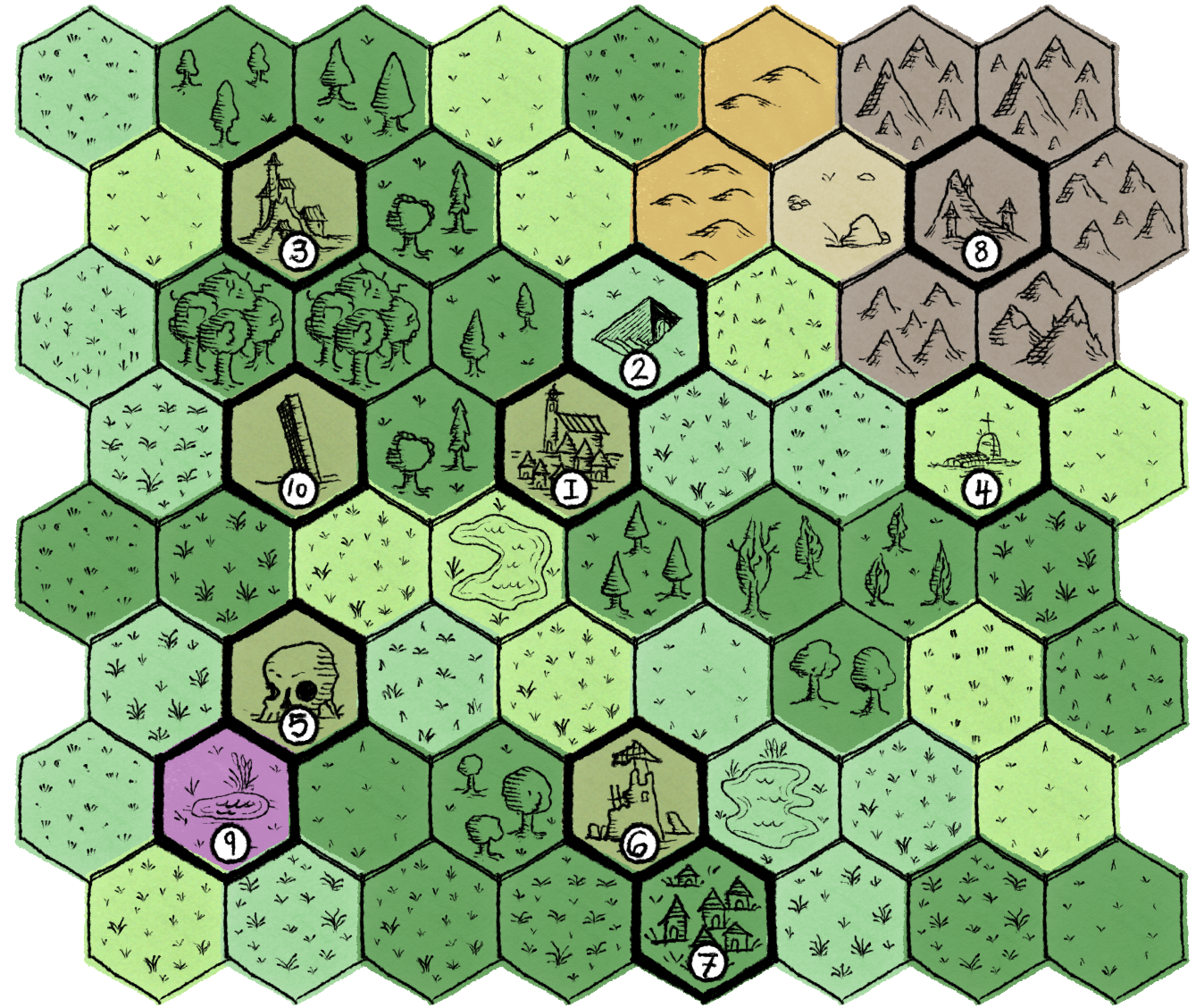
of civilization it’s time to start drawing the campaign map. Take a
large sheet of paper (plain white if you like or hex-gridded if you want
to get fancy), place it where everyone can see, and make a mark for the
site of the adventure. Use pencil: this map will change. It can be
to-scale and detailed or broad and abstract, depending on your
preference, just make it obvious. Keep the mark small and somewhere
around the center of the paper so you have space to grow.
Now add the nearest steading, a place the characters can go to rest and
gather supplies. Draw a mark for that place on the map and fill in the
space between with some terrain features. Try to keep it within a day or
two of the site of their first adventure—a short trip through a rocky
pass or some heavy woods is suitable, or a wider distance by road or
across open ground.
When you have time (after the first session or during a snack break, for
example) use the rules to create the first steading. Consider adding
marks for other places that have been mentioned so far, either details
from character creation or the steading rules themselves.
##While You’re In Town…
When the players visit a steading there are some special moves they’ll
be able to make. These still follow the fictional flow of the game. When
the players arrive, ask them “What do you do?” The players’ actions
will, more often than not, trigger a move from this list. They cover
respite, reinvigoration, and resupply—opportunities for the players to
gather their wits and spend their treasure. Remember that a steading
isn’t a break from reality. You’re still making hard moves when
necessary and thinking about how the players’ actions (or inaction)
advances your fronts. The impending doom is always there, whether the
players are fighting it in the dungeon or ignoring it while getting
drunk in the local tavern.
Don’t let a visit to a steading become a permanent respite. Remember,
Dungeon World is a scary, dangerous place. If the players choose to
ignore that, they’re giving you a golden opportunity to make a hard
move. Fill the characters’ lives with adventure whether they’re out
seeking it or not. These moves exist so you can make a visit to town an
interesting event without spending a whole session haggling over the
cost of a new baldric.
Elements of a Steading
A steading is any bit of civilization that offers some amount of safety
to its inhabitants. Villages, towns, keeps, and cities are the most
common steadings. Steadings are described by their tags. All steadings
have tags indicating prosperity, population, and defenses. Many will
have tags to illustrate their more unusual properties.
Steadings are differentiated based on size. The size indicates roughly
how many people the steading can support. The population tag tells you
if the current population is more than or less than this amount.
Villages are the smallest steadings. They’re usually out of the way, off
the main roads. If they’re lucky they can muster some defense but it’s
often just rabble with pitchforks and torches. A village stands near
some easily exploitable resource: rich soil, plentiful fish, an old
forest, or a mine. There might be a store of some sort but more likely
its people trade among themselves. Coin is scarce.
Towns have a hundred or so inhabitants. They’re the kind of place that
springs up around a mill, trading post, or inn and usually have fields,
farms, and livestock of some kind. They might have a standing militia of
farmers strong enough to wield a blade or shoot a bow. Towns have the
basics for sale but certainly no special goods. Usually they’ll focus on
a local product or two and do some trade with travelers.
A keep is a steading built specifically for defense—sometimes of a
particularly important location like a river delta or a rich gold mine.
Keeps are found at the frontier edges of civilization. Inhabitants are
inured to the day-to-day dangers of the road. They’re tough folks that
number between a hundred and a thousand, depending on the size of the
keep and the place it defends. Keeps won’t often have much beyond their
own supplies, traded to them from nearby villages, but will almost
always have arms and armor and sometimes a rare magical item found in
the local wilds.
From bustling trade center to sprawling metropolis, the city represents
the largest sort of steading in Dungeon World. These are places where
folk of many races and kinds can be found. They often exist at the
confluence of a handful of trade routes or are built in a place of
spiritual significance. They don’t often generate their own raw
materials for trade, relying on supplies from villages nearby for food
and resources, but will always have crafted goods and some stranger
things for sale to those willing to seek them.
Prosperity indicates what kinds of items are usually available.
Population indicates the number of inhabitants relative to the current
size of the steading. Defenses indicate the general scope of arms the
steading has. Tags in these categories can be adjusted. -Category means
to change the steading to the next lower tag for that category (so
Moderate would become Poor with -Prosperity). +Category means to change
the steading to the next higher tag (so Shrinking becomes Steady with
+Population). Tags in those categories can also be compared like
numbers. Treat the lowest tag in that category as 1 and each successive
tag as the next number (so Dirt is 1, Poor is 2, etc.).
Tags will change over the course of play. Creating a steading provides a
snapshot of what that place looks like right now. As the players spend
time in it and your fronts progress the world will change and your
steadings with it.
Adding Steadings
You add your first steading when you create the campaign map—it’s the
place the players go to rest and recover. When you first draw it on the
map all you need is a name and a location.
When you have the time you’ll use the rules below to create the
steading. The first steading is usually a village, but you can use a
town if the first adventure was closely tied to humans (for example, if
the players fought a human cult). Create it using the rules below.
Once you’ve created the first steading you can add other places
referenced in its tags (the oath, trade, and enmity tags in particular)
or anywhere else that’s been referred to in play. Don’t add too much in
the first session, leave blanks and places to explore.
As play progresses the characters will discover new locales and places
of interest either directly, by stumbling upon them in the wild, or
indirectly, by hearing about them in rumors or tales. Add new steadings,
dungeons, and other locations to the map as they’re discovered or heard
about. Villages are often near a useful resource. Towns are often found
at the point where several villages meet to trade. Keeps watch over
important locations. Cities rely on the trade and support of smaller
steads. Dungeons can be found anywhere and in many forms.
Whenever you add a new steading use the rules to decide its tags.
Consider adding a distinctive feature somewhere nearby. Maybe a forest,
some old standing stones, an abandoned castle, or whatever else catches
your fancy or makes sense. A map of only steadings and ruins with
nothing in between is dull; don’t neglect the other features of the
world.
Prosperity
Dirt: Nothing for sale, nobody has more than they need (and they’re
lucky if they have that). Unskilled labor is cheap.
Poor: Only the bare necessities for sale. Weapons are scarce unless
the steading is heavily defended or militant. Unskilled labor is readily
available.
Moderate: Most mundane items are available. Some types of skilled
laborers.
Wealthy: Any mundane item can be found for sale. Most kinds of skilled
laborers are available, but demand is high for their time.
Rich: Mundane items and more, if you know where to find them.
Specialist labor available, but at high prices.
Population
Exodus: The steading has lost its population and is on the verge of
collapse.
Shrinking: The population is less than it once was. Buildings stand
empty.
Steady: The population is in line with the current size of the
steading. Some slow growth.
Growing: More people than there are buildings.
Booming: Resources are stretched thin trying to keep up with the
number of people.
Defenses
None: Clubs, torches, farming tools.
Militia: There are able-bodied men and women with worn weapons ready
to be called, but no standing force.
Watch: There are a few watchers posted who look out for trouble and
settle small problems, but their main role is to summon the militia.
Guard: There are armed defenders at all times with a total pool of
less than 100 (or equivalent). There is always at least one armed patrol
about the steading.
Garrison: There are armed defenders at all times with a total pool of
100–300 (or equivalent). There are multiple armed patrols at all times.
Battalion: As many as 1,000 armed defenders (or equivalent). The
steading has manned maintained defenses as well.
Legion: The steading is defended by thousands of armed soldiers (or
equivalent). The steading’s defenses are intimidating.
Safe: Outside trouble doesn’t come here until the players bring it.
Idyllic and often hidden, if the steading would lose or degrade another
beneficial tag get rid of safe instead.
Religion: The listed deity is revered here.
Exotic: There are goods and services available here that aren’t
available anywhere else nearby. List them.
Resource: The steading has easy access to the listed resource (e.g., a
spice, a type of ore, fish, grapes). That resource is significantly
cheaper.
Need: The steading has an acute or ongoing need for the listed
resource. That resource sells for considerably more.
Oath: The steading has sworn oaths to the listed steadings. These
oaths are generally of fealty or support, but may be more specific.
Trade: The steading regularly trades with the listed steadings.
Market: Everyone comes here to trade. On any given day the available
items may be far beyond their prosperity. +1 to supply.
Enmity: The steading holds a grudge against the listed steadings.
History: Something important once happened here, choose one and detail
or make up your own: battle, miracle, myth, romance, tragedy.
Arcane: Someone in town can cast arcane spells for a price. This tends
to draw more arcane casters, +1 to recruit when you put out word you’re
looking for an adept.
Divine: There is a major religious presence, maybe a cathedral or
monastery. They can heal and maybe even raise the dead for a donation or
resolution of a quest. Take +1 to recruit priests here.
Guild: The listed type of guild has a major presence (and usually a
fair amount of influence). If the guild is closely associated with a
type of hireling, +1 to recruit that type of hireling.
Personage: There’s a notable person who makes their home here. Give
them a name and a short note on why they’re notable.
Dwarven: The steading is significantly or entirely dwarves. Dwarven
goods are more common and less expensive than they typically are.
Elven: The steading is significantly or entirely elves. Elven goods
are more common and less expensive than they typically are.
Craft: The steading is known for excellence in the listed craft. Items
of their chosen craft are more readily available here or of higher
quality than found elsewhere.
Lawless: Crime is rampant; authority is weak.
Blight: The steading has a recurring problem, usually a type of
monster.
Power: The steading holds sway of some type. Typically political,
divine, or arcane.
Steading Names
Graybark, Nook’s Crossing, Tanner’s Ford, Goldenfield, Barrowbridge, Rum
River, Brindenburg, Shambles, Covaner, Enfield, Crystal Falls, Castle
Daunting, Nulty’s Harbor, Castonshire, Cornwood, Irongate, Mayhill,
Pigton, Crosses, Battlemoore, Torsea, Curland, Snowcalm, Seawall,
Varlosh, Terminum, Avonia, Bucksburg, Settledown, Goblinjaw, Hammerford,
Pit, The Gray Fast, Ennet Bend, Harrison’s Hold, Fortress Andwynne,
Blackstone
Making a Village
By default a village is Poor, Steady, Militia, Resource (your choice)
and has an Oath to another steading of your choice. If the village is
part of a kingdom or empire choose one:
- The village is somewhere naturally defended: Safe, -Defenses
- The village has abundant resources that sustain it: +Prosperity,
Resource (your choice), Enmity (your choice)
- The village is under the protection of another steading: Oath (that
steading), +Defenses
- The village is on a major road: Trade (your choice), +Prosperity
- The village is built around a wizard’s tower: Personage (the
wizard), Blight (arcane creatures)
- The village was built on the site of religious significance: Divine,
History (your choice)
Choose one problem:
- The village is in arid or uncultivable land: Need (Food)
- The village is dedicated to a deity: Religious (that deity), Enmity
(a settlement of another deity)
- The village has recently fought a battle: -Population, -Prosperity
if they fought to the end, -Defenses if they lost.
- The village has a monster problem: Blight (that monster),
Need (adventurers)
- The village has absorbed another village: +Population, Lawless
- The village is remote or unwelcoming: -Prosperity, Dwarven or Elven
Making a Town
By default a town is Moderate, Steady, Watch, and Trade (two of your
choice). If the town is listed as Trade by another steading choose one:
- The town is booming: Booming, Lawless
- The town stands on a crossroads: Market, +Prosperity
- The town is defended by another steading: Oath (that steading),
+Defenses
- The town is built around a church: Power (Divine)
- The town is built around a craft: Craft (your choice), Resource
(something required for that craft)
- The town is built around a military post: +Defenses
Choose one problem:
- The town has grown too big for an important supply (like grain,
wood, or stone): Need (that resource), Trade (a village or town with
that resource)
- The town offers defense to others: Oath (your choice), -Defenses
- The town is notorious for an outlaw who is rumored to live there:
Personage (the outlaw), Enmity (where the crimes were committed)
- The town has cornered the market on a good or service: Exotic (that
good or service), Enmity (a settlement with ambition)
- The town has a disease: -Population
- The town is a popular meeting place: +Population, Lawless
Making a Keep
By default a keep is Poor, Shrinking, Guard, Need (Supplies), Trade
(someplace with supplies), Oath (your choice). If the keep is owed
fealty by at least one settlement choose one:
- The keep belongs to a noble family: +Prosperity, Power (Political)
- The keep is run by a skilled commander: Personage (the commander),
+Defenses
- The keep stands watch over a trade road: +Prosperity, Guild (trade)
- The keep is used to train special troops: Arcane, -Population
- The keep is surrounded by fertile land: remove Need (Supplies)
- The keep stands on a border: +Defenses, Enmity (steading on the
other side of the border)
Choose one problem
- The keep is built on a naturally defensible position: Safe,
-Population
- The keep was a conquest from another power: Enmity (steadings of
that power)
- The keep is a safe haven for brigands: Lawless
- The keep was built to defend from a specific threat: Blight
(that threat)
- The keep has seen horrible bloody war: History (Battle), Blight
(Restless Spirits)
- The keep is given the worst of the worst: Need (Skilled Recruits)
Making a City
By default a city is Moderate, Steady, Guard, Market, and Guild (one of
your choice). It also has Oaths with at least two other steadings,
usually a town and a keep. If the city has trade with at least one
steading and fealty from at least one steading choose one:
- The city has permanent defenses, like walls: +Defenses, Oath
(your choice)
- The city is ruled by a single individual: Personage (the ruler),
Power (Political)
- The city is diverse: Dwarven or Elven or both
- The city is a trade hub: Trade (every steading nearby), +Prosperity
- The city is ancient, built on top of its own ruins: History (your
choice), Divine
- The city is a center of learning: Arcane, Craft (your choice),
Power (Arcane)
Choose one problem:
- The city has outgrown its resources: +Population, Need (food)
- The city has designs on nearby territory: Enmity (nearby steadings),
+Defenses
- The city is ruled by a theocracy: -Defenses, Power (Divine)
- The city is ruled by the people: -Defenses, +Population
- The city has supernatural defenses: +Defenses, Blight (related
supernatural creatures)
- The city lies on a place of power: Arcane, Personage (whoever
watches the place of power), Blight (arcane creatures)
Fronts on the Campaign Map
Your steadings are not the only thing on the campaign map. In addition
to steadings and the areas around them your fronts will appear on the
map, albeit indirectly.
Fronts are organizational tools, not something the characters think of,
so don’t put them on the map directly. The orcs of Olg’gothal may be a
front but don’t just draw them on the map. Instead for each front add
some feature to the map that indicates the front’s presence. You can
label it if you like, but use the name that the characters would use,
not the name you gave the front.
For example, the orcs of Olg’gothal could be marked on the map with a
burning village they left behind, fires in the distance at night, or a
stream of refugees. Lord Xothal, a lich, might be marked by the tower
where dead plants take root and grow.
As your fronts change, change the map. If the players cleanse Xothal’s
tower redraw it. If the orcs are driven off erase the crowds of
refugees.
Updating the Campaign Map
The campaign map is updated between sessions or whenever the players
spend significant downtime in a safe place. Updates are both
prescriptive and descriptive: if an event transpires that, say, gathers
a larger fighting force to a village, update the tags to reflect that.
Likewise if a change in tags mean that a village has a bigger fighting
force you’ll likely see more armored men in the street.
Between each session check each of the conditions below. Go down the
list and check each condition for all steadings before moving to the
next. If a condition applies, apply its effects.
Growth
When a village or town is booming and its prosperity is above
moderate you may reduce prosperity and defenses to move to the next
largest type. New towns immediately gain market and new cities
immediately gain guild (your choice).
Collapse
When a steading’s population is in exodus and its prosperity is poor
or less it shrinks. A city becomes a town with a steady population and
+prosperity. A keep becomes a town with +defenses and a steady
population. A town becomes a village with steady population and
+prosperity. A village becomes a ghost town.
Want
When a steading has a need that is not fulfilled (through trade,
capture, or otherwise) that steading is in want. It gets either
-prosperity, -population, or loses a tag based on that resource like
craft or trade, your choice.
Trade
When trade is blocked because the source of that trade is gone, the
route is endangered, or political reasons, the steading has a choice:
gain need (a traded good) or take -prosperity.
Capture
When control of a resource changes remove that resource from the
tags of the previous owner and add it to the tags of the new owner (if
applicable). If the previous owner has a craft or trade based on that
resource they now have need (that resource). If the new owner had a need
for that resource, remove it.
Profit
When a steading has more trade than its current prosperity it gets
+prosperity.
Surplus
When a steading has a resource that another steading needs unless
enmity or other diplomatic reasons prevent it they set up trade. The
steading with the resource gets +prosperity and their choice of oaths,
+population, or +defenses; the steading with the need erases that need
and adds trade.
Aid
When a steading has oaths to a steading under attack that steading
may take -defenses to give the steading under attack +defenses.
Embattled
When a steading is surrounded by enemy forces it suffers losses. If
it fights back with force it gets -defenses. If its new defenses are
watch or less it also gets -prosperity. If it instead tries to wait out
the attack it gets -population. If its new population is shrinking or
less it loses a tag of your choice. If the steading’s defenses outclass
the attacker’s (your call if it’s not clear, or make it part of an
adventure front) the steading is no longer surrounded.
Opportunity
When a steading has enmity against a weaker steading they may
attack. Subtract the distance (in rations) between the steadings from
the steading with enmity’s defenses. If the result is greater than the
other steading’s defenses +defense for each step of size difference
(village to town, town to keep, keep to city) they definitely attack.
Otherwise it’s your call: has anything happened recently to stoke their
anger? The forces of the attacker embattle the defender, while they
maintain the attack they’re -defenses.
Clash
When two steadings both attack each other their forces meet
somewhere between them and fight. If they’re evenly matched they both
get -defenses and their troops return home. If one has the advantage
they take -defenses while the other takes -2 defenses.
Other Updates
The conditions above detail the most basic of interactions between
steadings, of course the presence of your fronts and the players mean
things can get far more complex. Since tags are descriptive, add them as
needed to reflect the players’ actions and your fronts’ effects on the
world.
*Like Dungeon World, this page is is licensed under the Creative Commons Attribution 3.0 Unported License. To view a copy of this license, visit http://creativecommons.org/licenses/by/3.0/ or send a letter to Creative Commons, 444 Castro Street, Suite 900, Mountain View, California, 94041, USA. *